

1. Scorecard
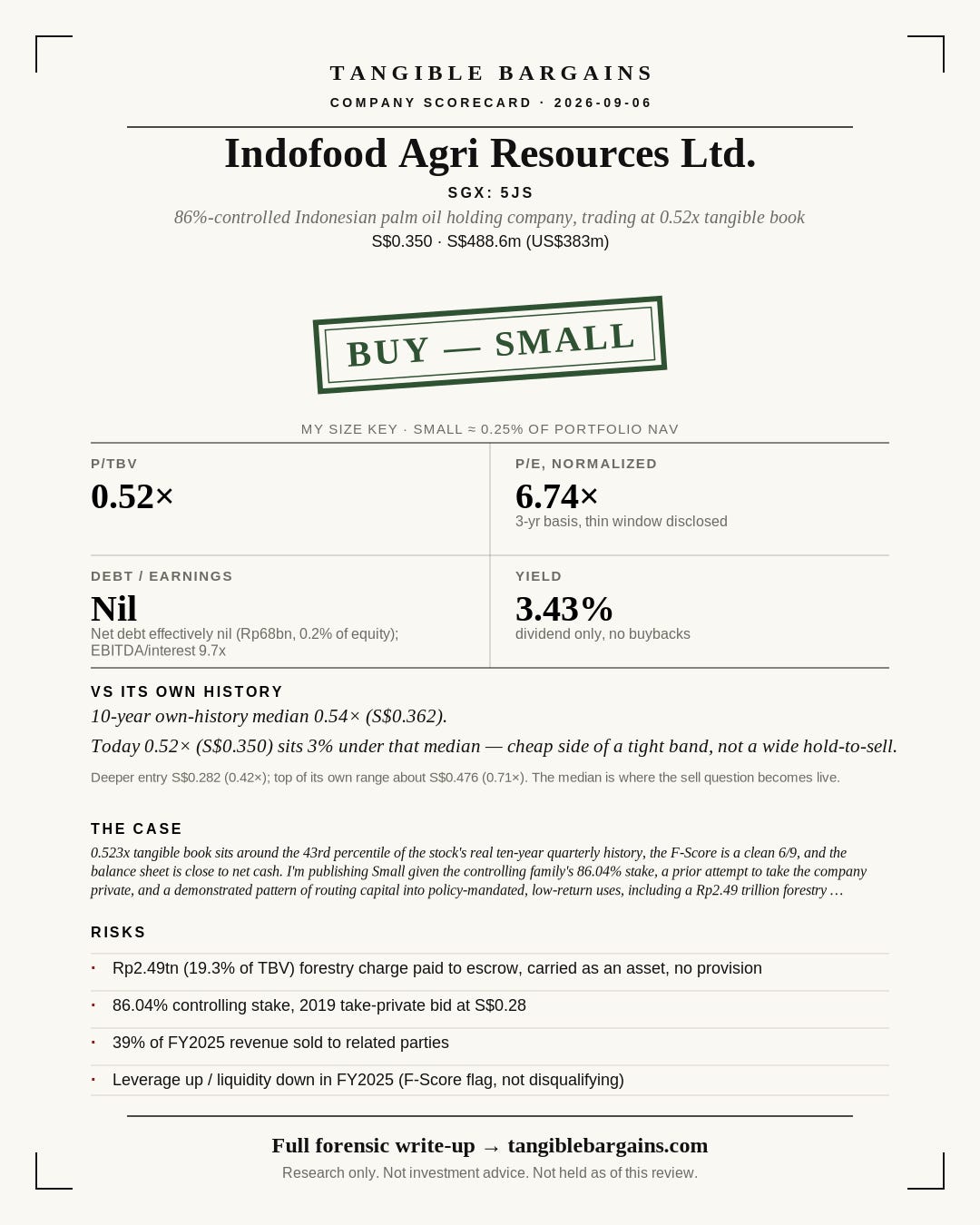
2. Argument
The short version
Indofood Agri Resources is a Singapore-listed holding company wrapped around a large Indonesian palm oil and edible oils group. The operating recovery is real: FY2025 revenue reached Rp21.06 trillion, operating cash flow was Rp3.38 trillion, and 1H2026 attributable profit rose 32% year on year. Cash of Rp9.05 trillion almost covers borrowings and the FY2025 dividend rose for a third consecutive year.
At S$0.350 on 4 September 2026, the shares trade at 0.523x derived tangible book and about 4.9x trailing earnings. That is below the stock's own ten-year quarterly median, but it is not an extreme bargain. The verdict is BUY, SMALL. The small size is a governance decision, not a valuation decision: the controlling family is deemed interested in 86.04%, the public float is 13.92%, the group tried to take the company private in 2019, and capital has been routed into policy-driven uses such as plasma provisions and a Rp2.49 trillion forestry charge paid into escrow.
Why it qualifies
The shares trade at 0.523x tangible book, around the 43rd percentile of the stock's real ten-year quarterly P/TBV history, below its 0.54x median.
The balance sheet is close to net cash: Rp9.05 trillion of cash against Rp9.08 trillion of borrowings at 30 June 2026, with cash covering current borrowings 1.09x.
Owner profit improved in 1H2026, while FY2025 operating cash flow of Rp3.38 trillion exceeded capital additions of Rp1.44 trillion.
The Piotroski score is 6/9, the dividend reached S$0.012 for FY2025, and the current shareholder yield is 3.43% with no buybacks.
Why it is not a clean bargain
An 86.04% deemed interest leaves minority holders with little practical ability to block ordinary resolutions, even though the board now has three independent directors.
The Rp2.49 trillion forestry charge is paid into escrow and carried as an asset while under appeal, equal to 19.3% of tangible book with no provision.
The government-mandated plasma programme has produced a Rp1.08 trillion write-off, continuing charges, and up to Rp523.1 billion of guarantees.
Related parties bought Rp8.26 trillion of FY2025 revenue, while 94% of 1H2026 CPO volume moved internally, limiting the arm's-length quality of the reported segment economics.
The operating margin is already rolling over: gross margin fell from 29.8% in FY2024 to 25.6% in FY2025 and 22.4% in 1H2026.
What would change the view
A full or materially larger forestry loss, or a provision that shows the escrowed asset is not recoverable.
A second consecutive period of leverage rising and liquidity deteriorating, or a failed renewal of the short-dated bank facilities.
A call on the unreserved plasma guarantees or another large credit-loss charge.
A CPO price reversal combined with further own-estate yield decline, or evidence that minority leakage and related-party terms are worsening.
Sources and gaps
This snapshot uses the 2025 annual report, the condensed interim statements for the six months ended 30 June 2026, the 1H2026 results materials, the 2026 AGM materials, the 31 July 2026 board-change announcements, SGX filings, and public price history. FY2021 and FY2022 audited statements were not retrievable for the supplementary annual cross-check; bank covenant headroom and inter-segment transfer prices are not disclosed; and the exchange announcement index after 21 January 2026 could not be checked in full for later director or substantial-shareholder dealings. The latest board changes were checked separately.
3. Backup and sources
This last layer is the full working file: every source, calculation, and gap, kept so the argument above can be checked. The scorecard and the argument are the synthesis. Open this only if you want to check the work.
1. Executive Summary
Indofood Agri Resources ("IndoAgri") is a Singapore-incorporated holding company for a vertically integrated Indonesian agribusiness: 278,099 hectares of planted nucleus estates and 27 palm oil mills feeding five refineries that turn crude palm oil into branded cooking oil, margarine and shortening (Bimoli, Happy, Palmia, Amanda, Simas), with smaller rubber, sugar, cocoa, tea and timber operations and a Brazilian sugar-and-ethanol joint venture. Roughly 97% of revenue is earned inside Indonesia, and the money is made twice, once on the plantation spread between fruit cost and CPO price, again on the refining and branding margin downstream. The verdict is BUY — SMALL. At S$0.350 (4 September 2026) the shares trade at 0.523× the tangible book value derived in the valuation discussion and about 4.8× trailing earnings. Measured against the stock's own ten-year quarterly P/TBV history, 0.523× sits at the 43rd percentile, cheaper than average, comfortably inside the range between the own-history Buy-Below (0.42×) and the Sell Range floor (0.54×), not at an extreme in either direction. The Piotroski screen scores a clean 6/9: two of the three failed signals are real and worth naming, leverage rose and liquidity deteriorated in the same fiscal year (debt to average assets 22.3% against 20.4%; current ratio 1.27 against 1.50), but that combination is a flag to weigh, not an automatic disqualifier, and it is stated plainly here rather than folded into a bigger score. What actually caps the position size is not valuation or the F-Score: it is governance. The controlling family holds 86.04% of the shares, tried once already to take the company private, and has a demonstrated pattern of routing capital into policy-mandated, low-return uses. That risk is real and structural, and it is why this is sized small rather than passed on entirely. The business and the balance sheet do not need a small size. The ownership structure does.
The business itself is doing better than it has in years. FY2025 revenue rose 32% to Rp21.06 trillion, profit from operations 14% to Rp3.70 trillion, and operating cash flow 52% to Rp3.38 trillion; 1H2026 net profit rose 32% to Rp1.01 trillion. The balance sheet is close to debt-free on a net basis, Rp9.08 trillion of borrowings against Rp9.05 trillion of cash at 30 June 2026, and the FY2025 dividend was raised for a third consecutive year, to S$0.012, a 3.5% yield. Tangible book is genuinely tangible: bearer plants, mills and refineries, with right-of-use land rights at only 18.1% of tangible book, so this name can fairly be described as cheap against tangible book value rather than against a capitalised lease.
What undermines it is the quality of ownership and of disclosure. Anthoni Salim is deemed interested in 86.04% of the shares; the public float is 13.92%, barely above the exchange's minimum; and the controlling group already attempted to take the company private at S$0.28 in 2019, failing only on the 90% acceptance threshold. Roughly 39% of FY2025 revenue was sold to related parties. In December 2025 the Ministry of Forestry imposed Rp2.34 trillion of forestry administrative charges, paid into a government escrow within 30 days and then carried as a non-current asset pending appeal, with a further Rp0.15 trillion in May 2026, Rp2.49 trillion, 19.3% of tangible book, capitalised rather than provided against and not identified as a key audit matter. Plasma receivables under a government-mandated smallholder programme carry a 61% allowance after Rp1.08 trillion was written off outright in FY2024. The operating recovery is real; the terms on which a minority holder participates in it are not.
2. Business and Market Overview
The Group reports two segments. Plantations (FY2025 total sales before elimination Rp14.46 trillion) develops and harvests 237,437 hectares of nucleus oil palm plus 16,203 hectares of rubber, 13,719 hectares of sugar cane and 13,616 hectares of other crops in Indonesia, processing fresh fruit bunches at 27 mills, rubber at five facilities, and cane at two mills and refineries (8,000 and 4,000 tonnes of cane per day). Edible Oils and Fats ("EOF", FY2025 sales Rp15.00 trillion) runs five refineries with 1.9 million tonnes of annual CPO processing capacity, selling consumer cooking oil under Bimoli, Bimoli Spesial and Happy and margarine under Amanda, Palmia and Royal Palmia, with industrial oils, margarine and shortening under Delima, Malinda, Palmia and Simas. Around 93% of EOF output is sold domestically; distribution runs through the parent group's own distribution network.
The economics are those of a price-taker with a branded tail; management says so directly: "As a price taker, we will remain focused on improving operational performance, strengthening cost discipline" (1H2026 announcement, the other-information note). Domestic CPO reference prices rose 8% in FY2025 to Rp14,234/kg and 5% again in 1H2026 to Rp14,931/kg, and Rotterdam CIF rose 15% to USD1,283/tonne then 13% to USD1,446/tonne, both supported by Indonesia's escalating B50 biodiesel mandate. Sugar moved the other way, raw sugar fell from roughly 24 US cents per pound in 2024 to about 14 cents by 1H2026, which is why the Brazilian sugar joint ventures cost the Group Rp178 billion in FY2025 and Rp223 billion in 1H2026 alone.
Customer concentration is extreme, and it is a related-party fact rather than an arm's-length one: FY2025 sales of goods to companies under common control were Rp6.17 trillion and to other Salim Group members Rp2.09 trillion, Rp8.26 trillion, 39% of consolidated revenue (Note 33). Internally, 94% of 1H2026 CPO volume moved from Plantations to EOF rather than to third parties, up from 84%, so the reported Plantations external revenue line is a residual rather than a market test. Capital intensity is high (FY2025 additions of Rp1.44 trillion against Rp3.38 trillion of operating cash flow) and regulatory exposure is heavy: export levies, domestic market obligations, a retail price ceiling on cooking oil, the plasma mandate and, new in this cycle, forest-area enforcement. The business is understandable and the products are staples; it is not predictable, it is decidedly cyclical, and it is not structurally advantaged.
3. Moat, Competitive Position, and Industry Cycle
Against the five classic moat sources the picture is thin. Intangibles and brand: Bimoli is a genuinely well-known Indonesian cooking-oil brand, but branded cooking oil sits under a government retail price ceiling and the EOF segment earned a 6% EBITDA margin in both FY2025 and 1H2026, a brand that cannot price is not a moat. Switching costs: none in a commodity oil sold by the litre. Network effects: none. Cost advantage: partial and eroding, the oil extraction rate improved to 21.5% in 1H2026 from 20.4%, but nucleus FFB production fell 4% and the Group is buying a rising share of its feedstock externally (493,000 tonnes in 1H2026, 30% of throughput), which converts an integrated cost advantage into a merchant margin. Efficient scale: the Indonesian palm sector has many large integrated players and no scale barrier at 237,000 hectares. The moat is Weak. The proof is in the returns: FY2025 return on equity of 8.1% (profit attributable to owners over shareholders' equity), up from 7.8% and 4.5%, is below any reasonable Indonesian cost of equity. This company does not compound capital at attractive rates; it converts commodity prices into cash and passes a large share of the profit to minority holders of its own listed subsidiaries.
On the cycle the evidence points to Above mid-cycle on price, with margins already rolling over. CPO prices are near multi-year highs and policy-supported; palm kernel prices rose 52% in FY2025 and 11% again in 1H2026 on a coconut-oil squeeze. But gross margin has peaked and turned: 29.8% in FY2024, 25.6% in FY2025, 22.4% in 1H2026, as heavier fertiliser application and external FFB purchases pushed cost of sales up 4% against 2% revenue growth. The Group is capturing a high-price environment with a deteriorating unit cost structure and a falling own-estate yield, the classic late-cycle plantation profile. Rubber is worse: management fully impaired Lonsum's rubber bearer plants and related fixed assets by Rp296.2 billion in FY2024 on yield and outlook grounds, which is a structural rather than cyclical judgement about that crop.
4. Management, Governance, and Capital Allocation
The board still has nine directors, but its composition changed on 31 July 2026. Philip Yeo Liat Kok remains Lead Independent Chairman; Mark Julian Wakeford remains CEO and Executive Director; Moleonoto Tjang and Suaimi Suriady remain Executive Directors; Tjhie Tje Fie and Axton Salim remain Non-Executive Directors; David Sungkoro and Andreas Tan remain Independent Directors; and Amelia Setiawan joined as a third Independent Director. Goh Kian Chee ceased to be a Non-Executive Director and Audit and Risk Management Committee member on the same date. Three of nine are independent, exactly the one-third minimum the listing rules require. The three non-independent non-executives are paid not by IndoAgri but by the parent, PT Indofood Sukses Makmur ("PT ISM"), or other PT ISM companies; Axton Salim is a member of the controlling family. The board refresh improves the audit committee's formal independence: it is now chaired by David Sungkoro with Andreas Tan and Amelia Setiawan, all three independent. It does not change the controlling family's ability to dominate ordinary resolutions.
Insider ownership and transactions. The register of directors' shareholdings kept under the Singapore Companies Act register, reproduced in the FY2025 Directors' Statement, shows exactly one director with any interest: Mark Julian Wakeford, 300,000 shares direct and 200,000 deemed, unchanged through the financial year and again between year-end and 21 January 2026. Every other director, including the Chairman and all three independents, holds no shares. There were no purchases and no sales by any director in the twelve months to 21 January 2026, and no options or share awards exist: "No option to take up unissued shares of the Company or its subsidiaries were granted during the year… There were no unissued shares… under option as at the end of the year." The regimes searched were that Companies Act register and the exchange's substantial-shareholder and director-dealing notification stream; the announcement index after 21 January 2026 could not be fully opened, so any insider dealing between then and 4 September 2026 remains a diligence gap. The 31 July board-change announcements were checked separately. Insiders do not eat their own cooking here: the controlling shareholder owns the company outright and the professional board owns essentially nothing.
Compensation. Wakeford received S$1,475,599 in FY2025 (84% fixed, 16% variable, no other benefits); directors' fees put to shareholders were S$375,000 against S$346,666 for FY2024; the top five key management personnel below the CEO were paid S$2,484,776 in aggregate, three of them by the subsidiary PT Salim Ivomas Pratama ("PT SIMP") rather than by IndoAgri. Group-wide key-management compensation under FY2025 Note 33 was Rp204.99 billion (FY2024: Rp191.09 billion), up 7.3% and equal to 16.1% of profit attributable to owners, a much wider definition covering the whole Indonesian group, but a number worth tracking against a Rp1.27 trillion attributable profit. There is no share-based compensation at all, so the share-based-compensation-to-net-income test computes 0.0% in both years: neither the ratio threshold nor the doubling condition is met, and warning 5 does not fire on that test.
Related-party transactions. FY2025 Note 33 and interim Note 18 were both read in full, and the related-party note covers more than the obvious trade flows. Beyond the Rp8.26 trillion of FY2025 sales already noted, purchases spanned packaging materials Rp151.0 billion, services, transport equipment and spare parts Rp171.6 billion, rental Rp48.0 billion, insurance Rp22.7 billion and royalty fees to a shareholder of Rp10.8 billion. Financial relationships are disclosed and material: Rp56.4 billion of financial income and Rp15.1 billion of financial expenses with other related parties, and Rp298.3 billion of loans to related parties repaid during the year. The Rule 920 disclosure for 1H2026 puts Salim Group shareholder loans at Rp621 billion at their peak (Rp299 billion at period end) and Salim Group corporate guarantees at Rp1,182 billion. No nominee, back-to-back or related-party bank-deposit arrangement is disclosed anywhere in the record.
Capital allocation. Dividends have been raised three years running, S$0.008 for FY2023, S$0.010 for FY2024 and S$0.012 for FY2025, the last paid on 28 May 2026, on a payout of roughly 17%. Cash to IndoAgri's own shareholders was Rp132.8 billion, Rp177.3 billion and Rp230.4 billion across FY2024, FY2025 and 1H2026, against Rp148.5 billion, Rp267.4 billion and Rp335.5 billion paid by subsidiaries to their non-controlling holders: in every one of those years more cash left the group to minorities of the subsidiaries than reached IndoAgri's own shareholders. There have been no buybacks and no issuance; the share count has been static throughout. The capital that has been destroyed went elsewhere: Rp1,084.1 billion of plasma receivables written off in FY2024 as unrecoverable, Rp296.2 billion of rubber impairment the same year, Rp160.9 billion and Rp401.4 billion of property, plant and equipment written off in FY2025 and FY2024, and a Brazilian sugar venture carried down from Rp955.8 billion to Rp884.3 billion in six months with Rp83.7 billion of Bússola losses and Rp442.6 billion of FP Natural Resources losses no longer recognised at all.
Governance warnings. The control concern is clear: the 2026 AGM included the required director re-elections, but with 86.04% deemed interest and a 13.92% float, no minority vote can carry or block an ordinary resolution. The controlling group has moved from 74.34% at the 2019 exit offer to 85.90% today and has already tried once to take the company private. That is control with a ballot but without a practical remedy.
Capital has also been routed into policy-driven or low-return uses. The plasma scheme produced a Rp1,084.1bn write-off in FY2024, further charges in FY2025 and 1H2026, and up to Rp523.1bn of guarantees. The Rp2.49tn of forestry charges paid into escrow and capitalised while under appeal belongs in the same risk bucket.
The dividend warning is not active: distributions resumed after the FY2019-FY2020 losses and have risen three years running, although a 17% payout from Rp9.05tn of cash is thin. The pre-AGM question-and-answer document was not located, so that point remains a gap. Pay was not outsized on the available evidence, and the Attorney General's Office later said it found no evidence linking PT SIMP in the export inquiry. Overall governance risk is High.
5. Corporate Ownership, Subsidiaries, and Joint Ventures
Substantial shareholders at 13 March 2026, from the Company's own Statistics of Shareholdings (percentages on 1,395,904,530 shares excluding treasury):
Ownership at 13 March 2026.
Indofood Singapore Holdings Pte. Ltd. held 71.51% directly.
PT Indofood Sukses Makmur Tbk held 85.90% in total, including deemed interest.
First Pacific Company Limited and its affiliates were deemed interested in 85.90%; First Pacific Investments Limited was at 85.98%; Anthoni Salim was deemed interested in 86.04%.
The company's stated public float was 13.92%. Treasury shares were 51,878,300, or 3.58% of issued shares, and carry no votes or dividends.
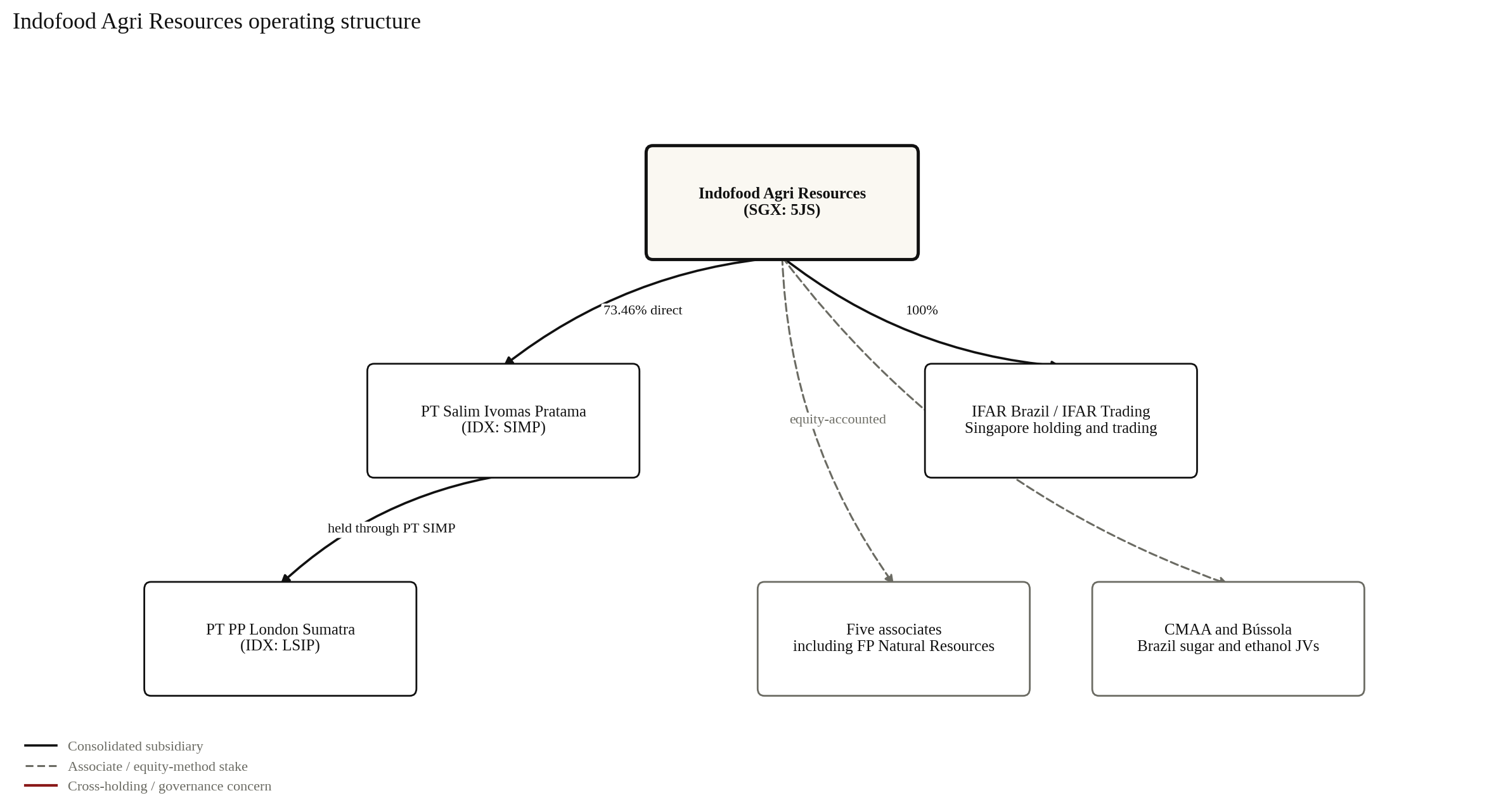
The structure matters to valuation: the Singapore listing sits above PT SIMP, Lonsum, the Brazilian interests and a further layer of equity-accounted associates.
One vote per share, one class. The top twenty registered holders account for 94.13%, and the second-largest name on the register is a broker nominee account at 11.81%, so the genuinely dispersed float is thinner than 13.92% makes it look.
The operating structure is a three-tier listed cascade:
Indofood Agri Resources Ltd.: SGX-ST (5JS), the security analysed here and the Singapore holding company.
PT Salim Ivomas Pratama Tbk (PT SIMP): 73.46% held directly, with essentially the entire operating group below it.
PT PP London Sumatra Indonesia Tbk (Lonsum): held through PT SIMP, the integrated plantation business behind the Rp2,909.8 billion Lonsum goodwill balance.
IFAR Brazil Pte. Ltd. / IFAR Trading Pte. Ltd.: wholly owned Singapore holding and trading companies for the Brazilian sugar interests.
CMAA and Bússola: unlisted, equity-accounted Brazilian sugar and ethanol joint ventures.
Five associates, including FP Natural Resources and PT Indoagri Daitocacao: unlisted, equity-accounted investments.
PT SIMP's FY2025 revenue of Rp21,056,904 million is identical to the Group's, which tells you what IndoAgri is: a Singapore listing wrapper over its Indonesian subsidiary, plus two Singapore holding companies and Rp165.0 billion of shareholder credit to a subsidiary maturing in 2028 and 2029. Non-controlling interests are correspondingly enormous, Rp13,081,696 million at 30 June 2026, 45.0% of total equity, against Rp15,965,955 million attributable to IndoAgri's own owners. PT SIMP alone carries 26.54% non-controlling interest, Rp6,153,009 million accumulated, taking Rp699.8 billion of FY2025 profit and Rp185.6 billion of dividends, and in certain subsidiaries the Group holds under 50% of the equity while controlling the votes, so consolidated assets overstate economic ownership further still. Cumulative losses the Group has stopped equity-accounting because its interest is exhausted stand at Rp442.6 billion for FP Natural Resources and Rp83.7 billion for Bússola, with no obligations incurred on behalf of either. The structural risks are the familiar ones for this shape: minority leakage at two levels, upstream PT SIMP guarantees securing subsidiary bank debt, and a holding company whose claim on the operating assets sits behind two layers of operating-company creditors and a 26.54% minority.
6. Historical Financial Quality and Normalized Owner Earnings
The comparison uses FY2025 and FY2024 from the audited statements, with FY2023 from the same report's three-year performance table and opening equity balances.
Fundamentals (Rp millions; per-share figures in Rp).
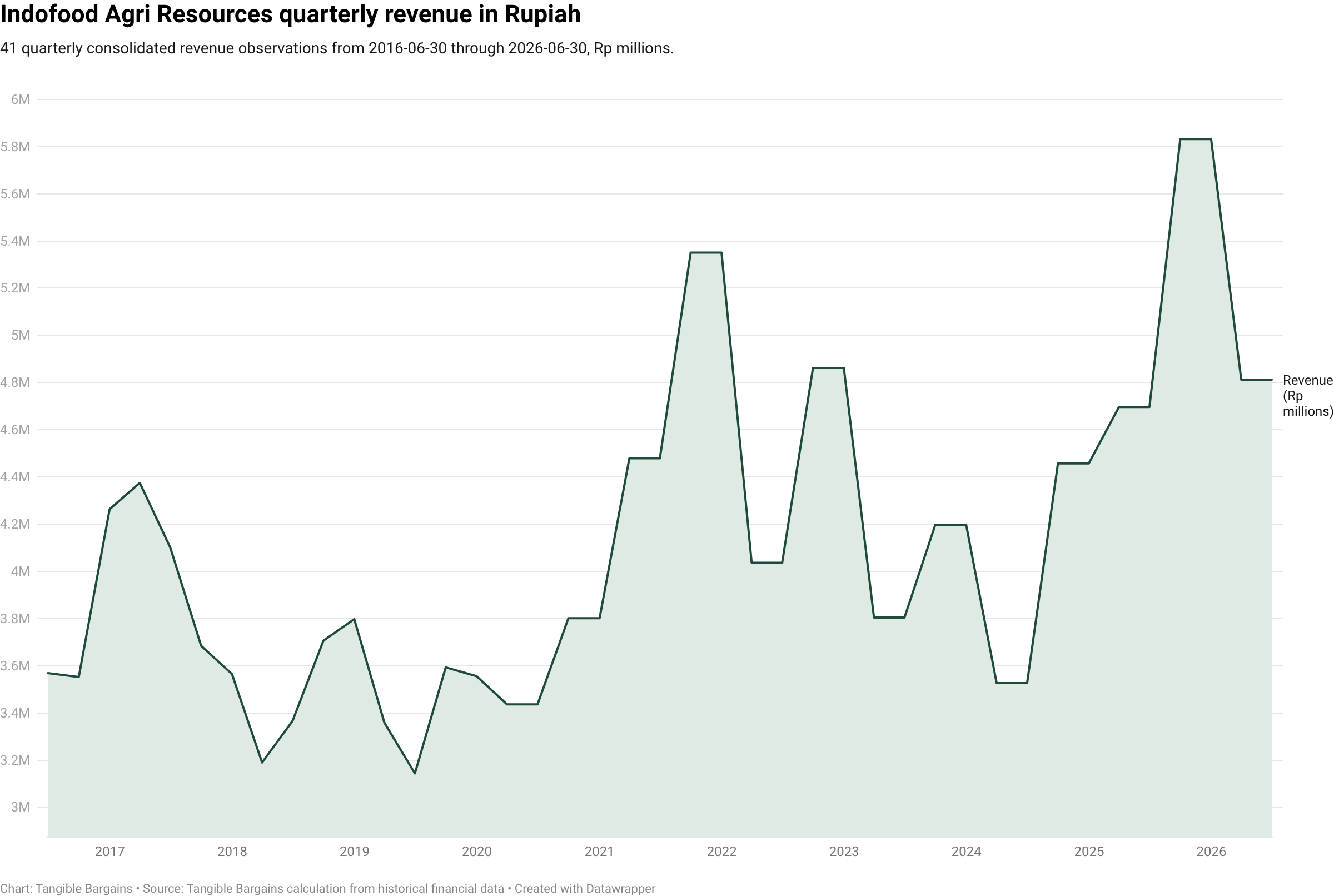
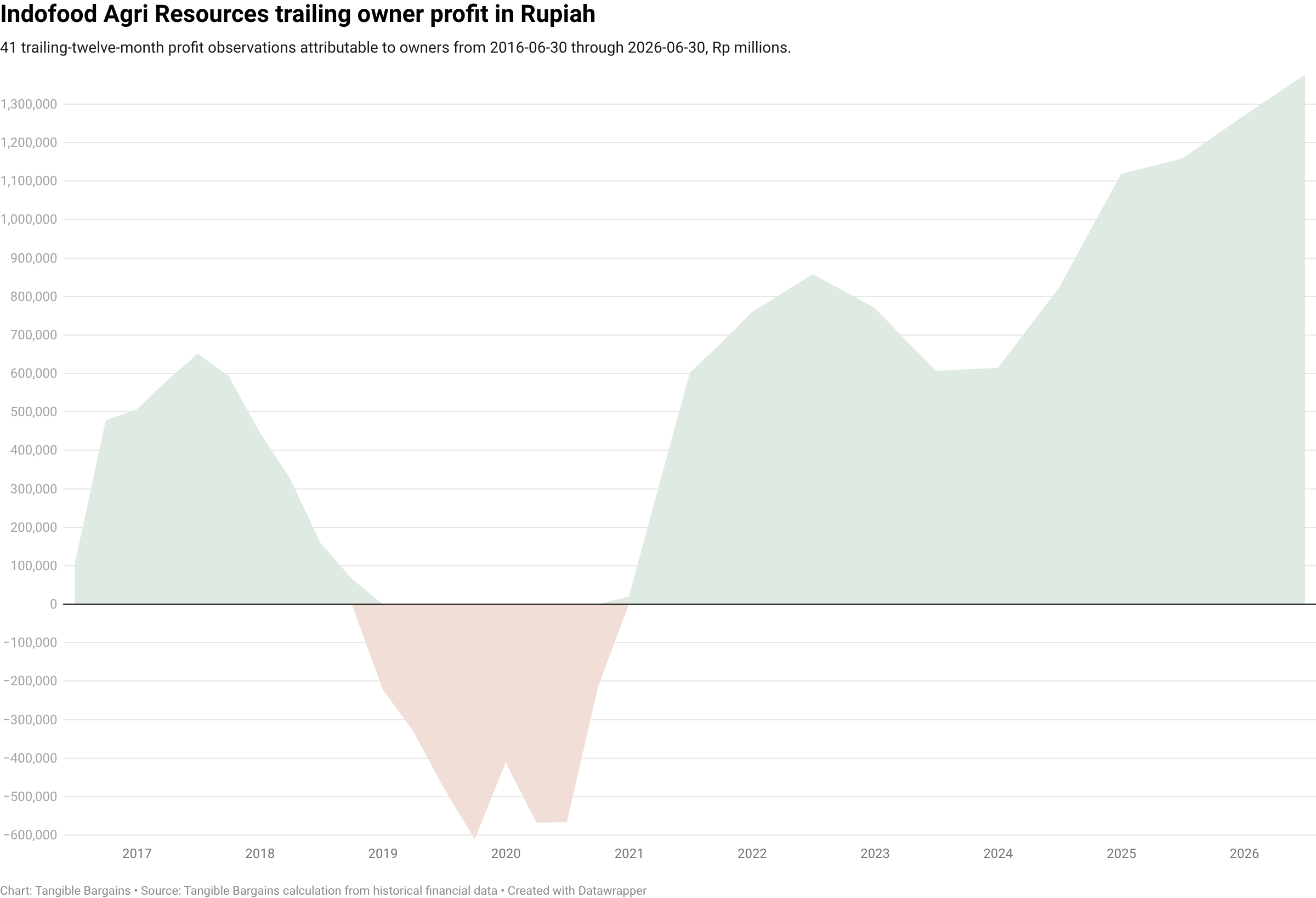
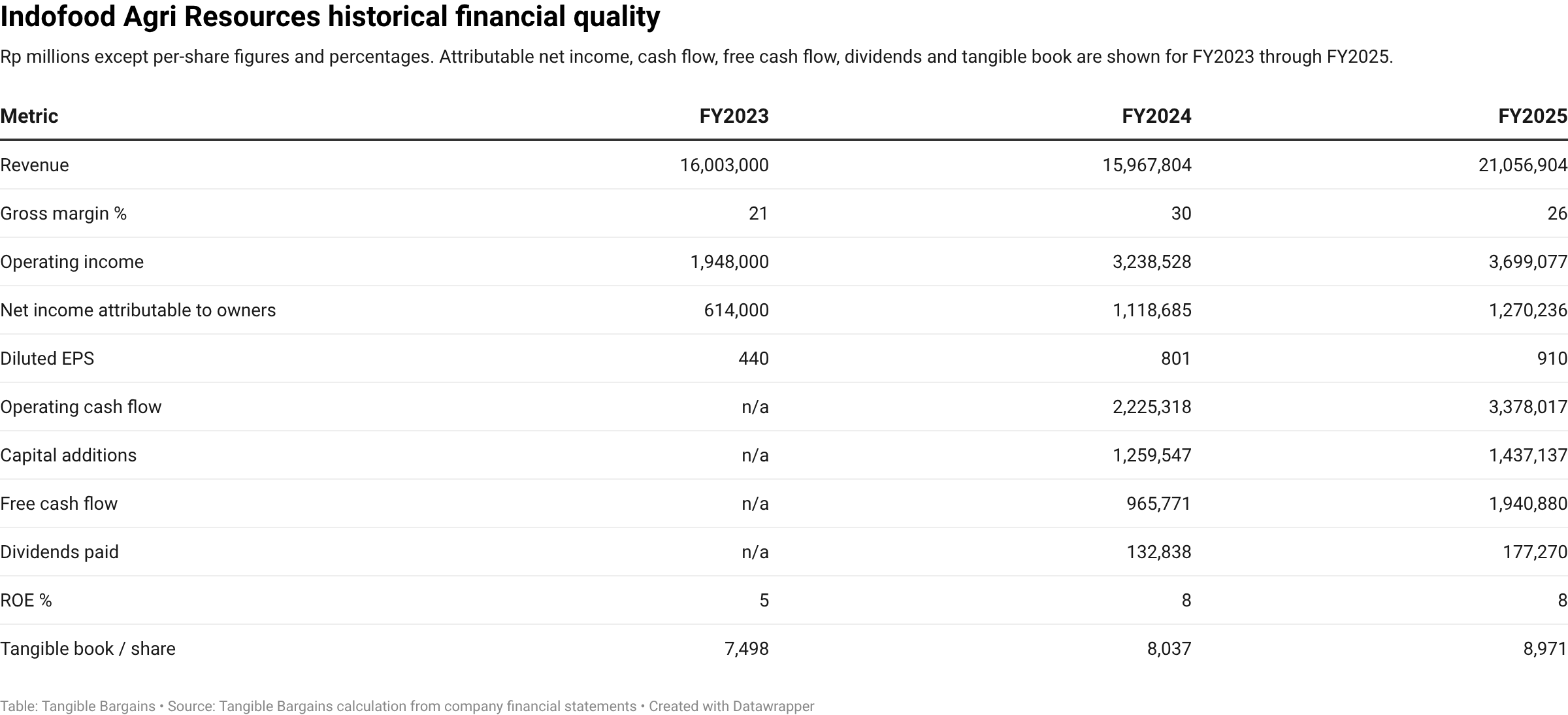
Net income and diluted EPS above are the amounts attributable to owners, consistent with the equity used in tangible book value; consolidated profit after tax was Rp936,000m, Rp2,110,017m and Rp2,513,854m across the same three years, so roughly half of every rupiah of group profit belongs to somebody else. The half-year confirms the direction: 1H2026 revenue Rp9,624,696m (+2.5%), gross profit Rp2,152,393m (−3.7%), net profit Rp1,012,124m (+32.4%), attributable profit Rp444,527m (+31.6%), operating cash flow Rp1,470,015m against Rp1,893,925m.
Normalized owner earnings. Real cash-flow figures exist, so no proxy is needed. FY2025 operating cash flow of Rp3,378,017m less capital additions of Rp1,437,137m (property, plant and equipment Rp1,130,791m plus biological assets Rp306,346m) gives free cash flow of Rp1,940,880m, against Rp965,771m in FY2024. Depreciation and amortisation of Rp1,544,452m exceeded total capital additions, so the Group is reinvesting below its own depreciation charge, an owner-earnings tailwind today and a yield question later, given immature oil palm area down from 23,806 hectares in 2023 to 15,978 in 2025. On the classic construction, owner earnings are Rp2,513,854m of consolidated net income plus Rp1,544,452m of D&A less Rp1,437,137m of maintenance-equivalent additions, or Rp2,621,169m, about Rp949 per share on IndoAgri's 50.5% share. The attributable split of free cash flow is not disclosed, so this comparison allocates consolidated cash flow using the profit split and is a sense-check only. That is within 5% of reported diluted EPS of Rp910, so reported earnings are a fair proxy for owner earnings here and there is no large accrual gap to unwind.
Symmetric normalization. The Group publishes a "core profit" measure stripping foreign exchange, biological-asset fair-value movements and the plasma credit-loss charge, and it cuts both ways. In FY2025 core profit of Rp2,595bn exceeded reported profit after tax of Rp2,514bn, because a Rp135bn biological-asset fair-value loss sat inside the reported figure; in 1H2026 core profit of Rp928bn was below reported profit of Rp1,012bn, because a Rp135bn foreign-exchange gain and a Rp78bn fair-value gain flattered it. Adding back the FY2025 charge without removing the 1H2026 gain would not be a normalization. On the company's own core basis 1H2026 was a 1.9% decline, not a 32% improvement, the cleanest single statement of what the first half actually did.
Normalized EPS. The trajectory is growing (Rp440 → Rp801 → Rp910, trailing twelve months Rp986 after adding 1H2026's Rp318 and removing 1H2025's Rp242), so the normalized basis is a three-year average of reported diluted EPS, Rp717. Only three years of primary income statements were opened, and the shortened window is disclosed rather than padded. On trailing earnings the multiple would be lower still; both land in the same valuation column, so the conclusion is insensitive to the choice.
The plasma reserve roll-forward. The Group carries a large allowance against government-mandated smallholder ("plasma") receivables and separately guarantees plasma bank loans. Both are reconstructed from the notes rather than inferred from balance-sheet movement:
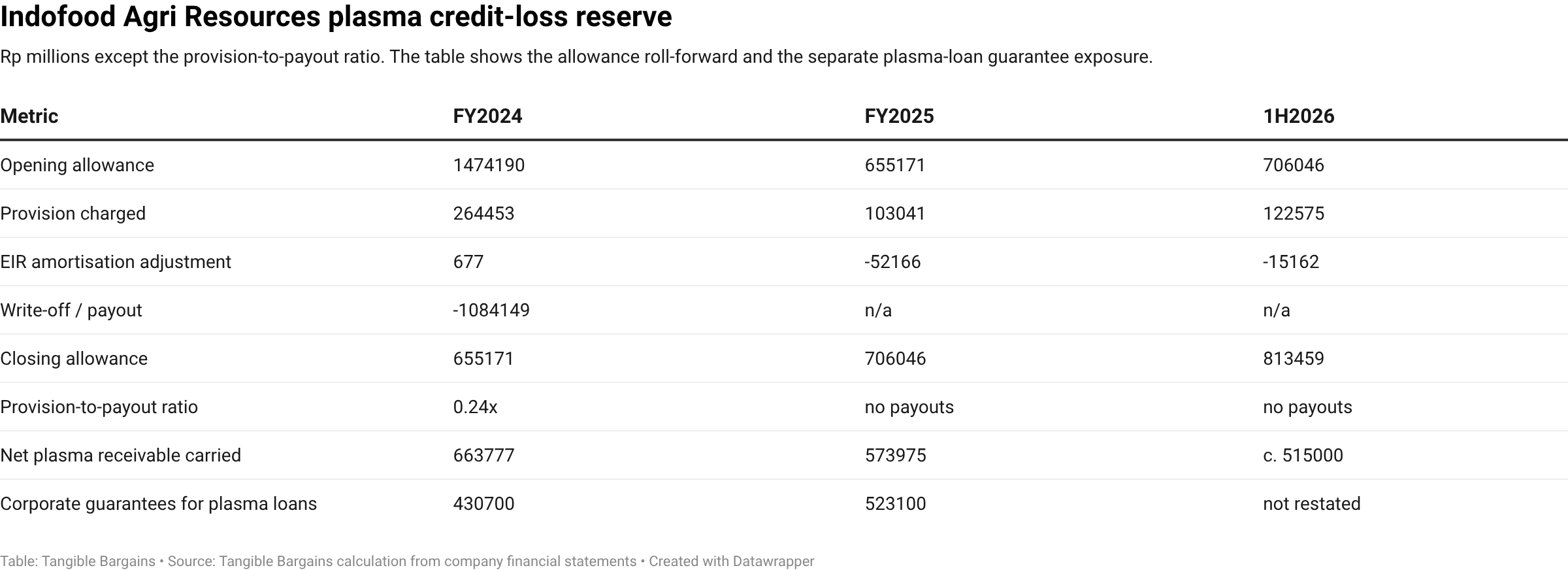
FY2024 is the year that matters: the reserve was drawn down by Rp1,084,149m against Rp264,453m of replenishment, a provision-to-payout ratio of 0.24×, with "no reasonable expectation of recovering the cash flows". Since then no write-offs have occurred and the reserve has been rebuilt, the 1H2026 charge of Rp122,575m already exceeding the whole of FY2025's Rp103,041m, up 86.9% year on year. Gross plasma receivables were Rp1,328.4 billion at 30 June 2026 against Rp813.5 billion of allowance: a 61% provision rate on an asset the Group is legally obliged to keep creating. The asymmetry check is the uncomfortable part. The on-balance-sheet allowance rose from Rp655.2 billion to Rp813.5 billion over eighteen months, while off-balance-sheet guarantee exposure to the same borrower population rose 21% from Rp430.7 billion to Rp523.1 billion and carries no recognised reserve at all, because Note 32(d) states "there are no probable claims against the Group that may cause material impact". The guarantee is contingent and the accounting defensible, but if plasma credit is deteriorating enough to justify an 86.9% increase in the on-book charge, the Rp523.1 billion guarantee line is the next thing to move, and nothing is set aside for it.
Earnings quality and conversion. Cash conversion is good, FY2025 free cash flow of Rp1,940,880m against Rp2,513,854m of consolidated profit, with operating cash flow above net income in both years, and capex intensity is moderate at 6.8% of revenue. The trap is elsewhere: the FY2025 cash flow statement shows a Rp2,177,775m increase in other non-current receivables, essentially the forestry escrow payment, which alone consumed 64% of operating cash flow before working capital.
6.5 Piotroski F-Score, 6/9
Periods compared: FY2025 vs FY2024.
Piotroski results (FY2025 versus FY2024). Six of nine signals passed. The passes were positive net income, positive operating cash flow, improved ROA, operating cash flow above net income, no dilutive issuance, and improved asset turnover. The failures were leverage, liquidity, and gross margin. All nine signals were computable.
The combined deterioration in leverage and liquidity is the serious part: debt to average assets rose from 20.4% to 22.3%, while the current ratio fell from 1.50 to 1.27. Gross margin fell from 29.8% to 25.6% as fertiliser and bought-in fruit costs rose against a rising selling price. The half-year partly repaired the balance-sheet signal, with the current ratio back to 1.38 and borrowings down to Rp9,075,310m at 30 June 2026, but a second annual reading in the same direction would matter more than this first one.
All nine signals were computable, so this is a clean 6/9, and none of the three failures is cosmetic. Gross margin fell 420 basis points on rising fertiliser and bought-in fruit costs against a rising selling price, the wrong direction at this point in a commodity cycle. Total debt rose Rp1,429,508m to Rp9,200,754m while assets rose less, taking debt to average assets from 20.4% to 22.3%, and the current ratio fell from 1.50 to 1.27 as Rp2,334,820m of long-term loans reclassified into current liabilities and Rp2,337,480m of cash left current assets for the non-current forestry escrow. Leverage rising and liquidity falling in the same year is the floor-rule flag, named here because it is real and worth watching, not because it disqualifies the name on its own: the half-year already repaired part of it, with the current ratio back to 1.38 at 30 June 2026 and borrowings down to Rp9,075,310m, and neither failure traces to a depressed prior-year comparison that would call for a cyclical override in the other direction. The next annual reading is due with the FY2026 accounts, and a second consecutive year of the same combination would be a materially stronger signal than one year taken alone.
7. Balance Sheet, Debt, Covenants, and Refinancing Risk
Every borrowing is a Rupiah-denominated Indonesian bank facility drawn at subsidiary level: no bonds, no notes, no sukuk, no offshore debt. Instrument-level detail is disclosed annually, so the FY2025 position and the 30 June 2026 totals are shown below.
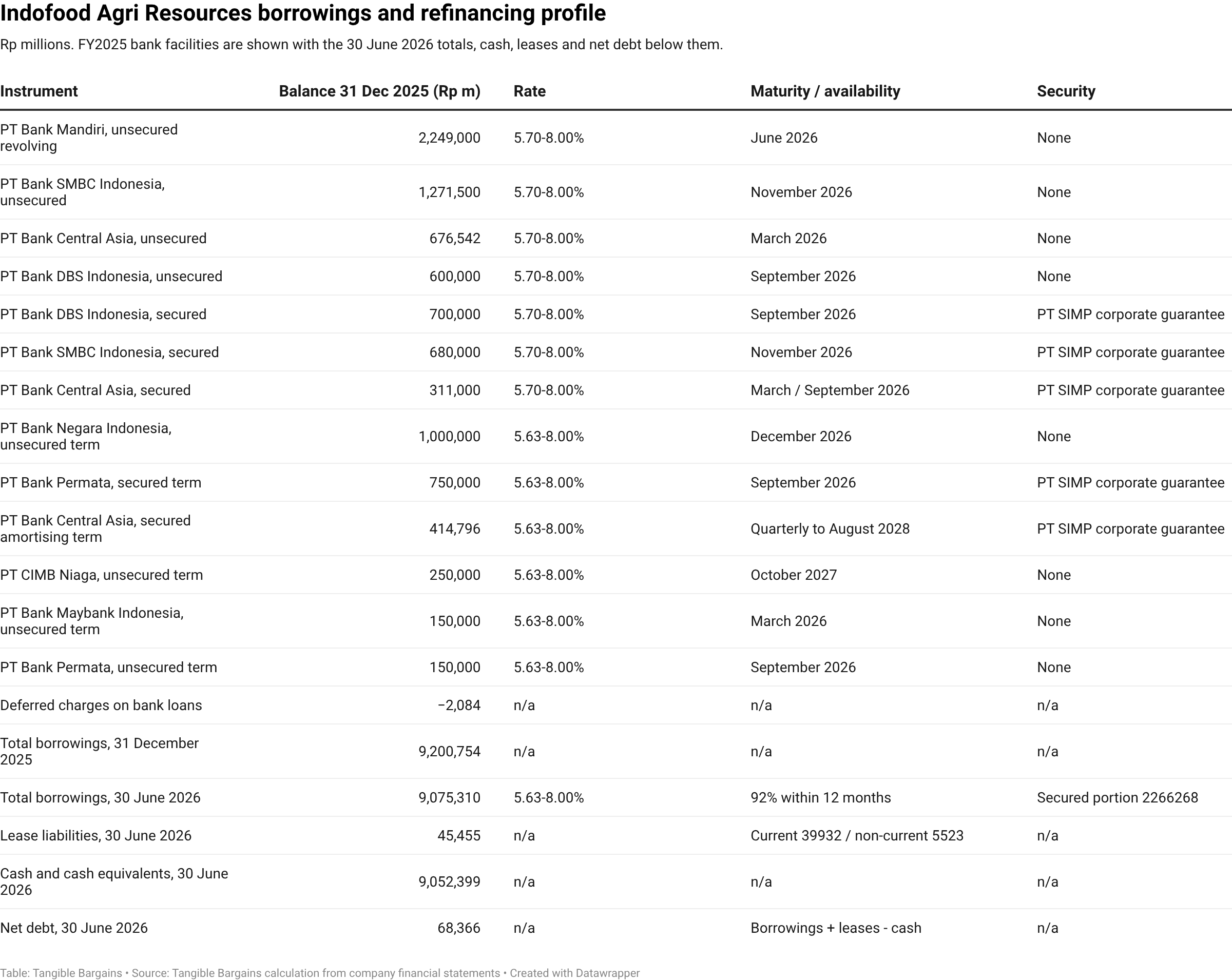
Lease liabilities are disaggregated from financial borrowings throughout, and the debt test is run on the latter: Rp9,075,310m of bank debt against Rp45,455m of leases. Financial borrowings are 31.2% of total equity and 56.8% of equity attributable to owners; total liabilities of Rp14,891,341m are 51.3% of total equity, the Schloss debt filter passes comfortably on either denominator. Debt to total assets is 20.7%, and net debt of Rp68,366m is 0.2% of total equity, which is why management describes the ratio as "less than 0.01 times".
Coverage: FY2025 adjusted EBITDA of Rp5,299bn against finance expenses of Rp548,410m gives 9.7×, and operating profit alone covers interest 6.7×; the interest line includes Rp5,241m of lease interest, so the ratio is blended and slightly conservative. Balance-sheet risk is Conservative: debt to assets of 20.7% is well inside the under-30% band, net debt is effectively nil, and no covenant concern is disclosed, the EBITDA coverage of 9.7× sits marginally below the 10× the Conservative band nominally wants, noted rather than hidden. Covenants are negative covenants at subsidiary level (restrictions on new borrowing, guarantees and asset pledges, mergers, disposals and new investment above thresholds) plus unspecified financial ratios at "certain subsidiaries"; the specific ratios and headroom are not disclosed, which is a real gap. The Group states compliance with all covenants at 31 December 2025, 31 December 2024 and 30 June 2026, and that there was "no loan default or breach of a loan agreement that has not been remedied".
The refinancing profile is the one genuinely uncomfortable feature. Rp8,343,576m, 92% of all borrowings, falls due within twelve months against a rolling stack of working-capital lines from Mandiri, BCA, DBS, SMBC, BNI and Permata, and the Group asserts "unconditional rights to rollover and/or refinance the short-term loans as and when they fall due". Cash of Rp9,052,399m covers the entire current balance 1.09 times, so even a complete failure to roll would be survivable, and 1H2026 net repayments of Rp126,054m show the lines behaving normally. Refinancing risk is low in substance but high in form: a bank-by-bank annual renegotiation at floating Indonesian rates with no disclosed covenant headroom.
8. Real Estate, Leases, and Hidden Assets
Right-of-use assets were Rp2,328,292m at 30 June 2026, 18.1% of tangible book value, 5.3% of total assets, against lease liabilities of just Rp45,455m, and that gap is the point. Almost the entire balance is Indonesian land use rights (HGB, HGU, HP and HPL, four to forty years, renewable, carrying the Group's bearer plants), paid for substantially up front rather than financed. Of the Rp2,366,815m at 31 December 2025, Rp2,351,817m was land use rights, Rp5,539m buildings and Rp9,459m office equipment; FY2025 additions of Rp425,019m were almost entirely a refinery land-lease renewal. Right-of-use is a capitalised right to occupy, not a liquidation floor, and it is disclosed here rather than stripped out of the tangible book value used everywhere in this report, removing the asset without its matching liability would be the wrong operation, and in this case the matching liability is almost nil, so the ROU line behaves far more like prepaid land than like a capitalised lease. Even so, since it is under the 25% threshold, describing this company as cheap against tangible book value is legitimate without further qualification.
The genuine downside support is elsewhere and is stronger. Cash of Rp9,052,399m is 70.2% of tangible book value on its own. Owned property, plant and equipment of Rp15,761,690m, 122.3% of tangible book, is 61% bearer plants (Rp9,695,230m net at 31 December 2025), with buildings and improvements Rp3,650,582m, plant and machinery Rp1,994,286m and heavy equipment, transport and vessels Rp721,769m. Inventory adds Rp3,797,764m.
Hidden asset value is plausible but unquantified. The 280,975 hectares of planted nucleus estates sit behind land use rights carried at Rp2,351,817m, roughly Rp8.4 million per planted hectare, a historical cost from acquisitions and renewals stretching back decades, not a mark to market. No sourced comparable transaction was obtained, so no market value is asserted; what can be said is that the carrying value is a floor rather than an estimate and that bearer plants are held at depreciated cost while the estates behind them produce at a 21.5% extraction rate. The offsetting risk runs the other way: the forestry enforcement programme in the regulatory discussion is a direct challenge to the legal status of some of that land, which is why the carrying value has become a live question rather than a dormant one.
9. Capital Markets Access, Dilution, and Financing Flexibility
The share count has not moved. Issued shares have been 1,447,782,830 at every balance-sheet date examined, with 51,878,300 in treasury (3.58%) since before FY2024, leaving 1,395,904,530 outstanding at each of 31 December 2024, 31 December 2025 and 30 June 2026. Basic and diluted counts are identical because there are no dilutive potential ordinary shares: no convertibles, no options granted, none exercised, none outstanding. There has been no issuance and no buyback, and the treasury block has been neither added to, sold, transferred nor cancelled. The count is flat, and that is the finding.
The Group does not need the market. FY2025 free cash flow of Rp1,940,880m covered the Rp177,270m paid to shareholders more than ten times over, cash rose from Rp5,945,500m to Rp8,573,289m to Rp9,052,399m across the period, and the liquidity backstop is a stack of committed working-capital bank lines rather than an equity programme. What does exist is authority rather than intent: shareholders renewed the general share-issue mandate at the April 2026 AGM permitting up to 50% of issued capital, with a 20% sub-limit for issues not made pro rata, alongside a share purchase mandate capped at 4%. A controlling shareholder at 86.04% can pass both without a single minority vote, and a 20% non-pro-rata placement is the mechanism by which a minority stake in a company like this gets diluted. Nothing suggests that is planned; the authority is standard for the market. Dilution risk is judged low on the evidence and structurally unconstrained in principle.
10. Litigation, Regulatory, and Contingent Liability Risk
The relevant disclosures are FY2025 Note 32, "Commitments and contingencies" (plasma receivables, sales commitments, capital-expenditure commitments, contingent liabilities), FY2025 Note 17, "Claims for tax refund", 1H2026 interim Note 13, "Forestry administrative charges under appeal", interim Note 15 on borrowings and defaults, and interim Note 21, "Subsequent events". Note 32(d) is the boilerplate-versus-specific test and is unambiguous: "As at 31 December 2025, there are no probable claims against the Group that may cause material impact to the Group." Note 21 is equally short: "There are no known subsequent events which have led to adjustments to this set of interim financial statements." There is no litigation note, no legal-proceedings item, no accrued loss reserve and no going-concern language anywhere in either document.
The material exposure is regulatory, not judicial, and it is large. On 1 December 2025 the Ministry of Forestry imposed forestry administrative charges of Rp2,337,480m under regulations governing forest-area governance and compliance. The Group paid the entire sum in cash on 30 December 2025, within the required timeframe, into an escrow account administered by the Forest Area Enforcement Task Force (Satgas PKH), then filed objection papers; a further Rp0.15 trillion was imposed and paid in May 2026, taking the total under appeal to Rp2.49 trillion, 19.3% of tangible book value, with the decision still pending at the date of the interim. The whole amount is recognised as an asset, "Forestry administrative charges under appeal", inside other non-current assets, with no provision. This is not an isolated action: the same task force reported recovering IDR10.2 trillion and reclaiming 5.8 million hectares from the palm-oil and mining sectors between February 2025 and May 2026, IDR3.4 trillion of it administrative fines, the programme is systematic, the counterparty is the state, and the appeal is against a policy rather than a claim.
Tax is the second exposure: claims for tax refund, advance payments plus "tax assessments being appealed to the taxation authorities", rose from Rp26,755m to Rp38,644m over the half, and the Group states that "uncertainties exist with respect to the interpretation of tax regulations". Third, the Group guarantees up to Rp523.1 billion of plasma bank loans (FY2024: Rp430.7 billion) with no recognised reserve, and PT SIMP gives upstream guarantees securing Rp2,266,268m of subsidiary borrowings.
Prior-disclosure carry-forward. The open items disclosed in the FY2025 accounts remain visible in the interim. Forestry charges: open, and escalated by Rp0.15 trillion. Plasma recoverability, a key audit matter: open, with the charge at almost double the prior-year rate. Tax assessments under appeal: open, and larger. The FY2024 rubber impairment of Rp296.2 billion: no reversal and no further charge. No covenant waiver, subpoena, class action, material weakness or going-concern qualification appears in either period. As of 29 June 2026: Indonesia's Attorney General's Office, which had questioned bank witnesses about PT SIMP's export transactions on 10 June 2026 after the Finance Minister publicly named the company in an under-invoicing and transfer-pricing investigation, stated it had found no evidence linking PT SIMP, on the ground that the company sells primarily into the domestic market. The 31 July 2026 interim makes no reference to the matter; given the timing that is consistent with there being nothing to disclose, but it is recorded because a reader relying on the filings alone would not know the episode happened. Each of these remains relevant to the risk assessment.
11. Accounting Quality and Disclosure Review
Ernst & Young LLP audited the FY2025 statements and issued an unqualified opinion dated 30 March 2026, engagement partner Lim Tze Yuen; no going-concern paragraph, no material weakness, no restatement. Two key audit matters were identified, goodwill impairment and the recoverability of plasma receivables, and the described procedures on both are substantive: an independent valuer's report reviewed for the Lonsum cash-generating unit, an internal valuation specialist engaged on discount rates and terminal growth, sensitivity analysis performed, operational assumptions benchmarked against history. The 1H2026 interim is explicitly unaudited and unreviewed, normal for the market but meaning the most recent balance sheet here carries no assurance at all.
Revenue recognition is simple and low-risk: goods transferred at a point in time, none over time, disaggregated by segment, channel, geography and product line. Non-GAAP measures are defined and reconcilable, "adjusted EBITDA" excludes foreign exchange and biological-asset fair-value movements and "core profit" additionally excludes the plasma credit-loss charge, and both are stated alongside the statutory figures rather than in place of them.
Three areas carry real estimation risk. Goodwill of Rp3,078,520m is 23.9% of tangible book and has not moved since the Lonsum acquisition, Rp2,909,757m of it in the single Lonsum integrated-estates cash-generating unit. In the October 2025 test the pre-tax discount rate on that unit was lowered from 12.46% to 11.52% and terminal growth raised from 4.95% to 4.97%, two changes that both increase headroom, in a year when Indonesian policy rates were not obviously 94 basis points lower. Management states no reasonably possible change would cause an impairment, but publishes no sensitivity figures. Biological assets of Rp1,452,511m are fair-valued, Rp957,642m of it on Level 3 unobservable inputs, and swung from a Rp135,498m loss in FY2025 to a Rp78,493m gain in 1H2026. Employee benefits are an unfunded Rp1,436,862m liability. Deferred tax is conservatively stated, a net Rp397,995m liability with only Rp6,254m of recognised tax-loss carry-forwards.
The accounting weakness is elsewhere. It is the Rp2.49 trillion of forestry administrative charges paid in cash and carried as a non-current asset while under appeal, Rp2,337,480m recognised in December 2025, 15.0% of shareholders' equity at that date, plus Rp0.15 trillion in May 2026. A contested payment to a state authority is recognised as an asset only where recovery is virtually certain; the Group's disclosure says only that objection papers have been filed and a decision is pending. No provision, no probability assessment, and, the point that matters here, the auditor did not identify it as a key audit matter in the very year it was created, while devoting two key audit matters to a goodwill balance that has not moved and a plasma allowance one-third its size. Segment transparency is a second weakness: an inter-segment transfer price that determined 94% of Plantations' CPO volume in 1H2026 is disclosed only as "based on terms agreed between the parties". Related-party disclosure, by contrast, is good.
Disclosure is classified Weak. The opinion is clean and primary-source verification of FY2023–FY2025 was full, which keeps it above Opaque; but material estimation risk met thin auditor pushback on the largest new judgement of the year, and the transfer-pricing mechanism behind most of one segment's revenue is undisclosed. The risk is elevated not because anything is provably wrong, but because the three largest soft numbers on the balance sheet, goodwill, the forestry receivable and fair-valued biological assets, total Rp7,021,031m, 54.5% of tangible book value, and all three move on management judgement.
12. Valuation and Margin of Safety
Currency convention. The Group reports in Rupiah and the shares trade in Singapore dollars. Figures are stated in Rupiah, translated at Rp13,806 per S$1, the rate the Group applies to its own 30 June 2026 balance sheet, with Singapore-dollar equivalents on the decision figures only, and US$1 = S$1.275 (4 September 2026). Earlier historical figures are not converted at today's rate.
Tangible Book Value, Derivation (anchor 2026-06-30, Condensed Interim Financial Statements for the six months ended 30 June 2026; Rp millions)
Tangible-book bridge at 30 June 2026 (Rp millions). Equity attributable to owners was Rp15,965,955m. Less goodwill of Rp3,078,520m and no other intangible balance gives tangible book value of Rp12,887,435m. Dividing by 1,395.905m current diluted shares gives Rp9,232.3183 per share. The Rp13,081,696m of non-controlling interest is excluded because the valuation uses equity attributable to IndoAgri's own shareholders.
P/TBV (derived) = Rp4,832.10 ÷ Rp9,232.3183 = 0.523× at the 4 September 2026 close.
P/TBV (derived) = 4,832.10 ÷ 9,232.3183 = 0.523× (price as of 2026-09-04)
Asset composition at 30 June 2026. Cash and short-term investments were Rp9,052,399m, or 70.2% of tangible book. Accounts receivable were Rp1,405,509m, inventory Rp3,797,764m, owned property, plant and equipment Rp15,761,690m, right-of-use lease assets Rp2,328,292m, long-term investments Rp2,257,074m, goodwill Rp3,078,520m, and other current and non-current assets Rp6,257,744m. Total assets were Rp43,938,992m.
Right-of-use assets were 18.1% of tangible book value. ROU is a capitalised right to occupy, not a liquidation floor, and it remains in the tangible-book figure used here. The balance is low enough that calling this cheap against tangible book does not require a larger lease adjustment.
Tangible book value per share is Rp9,232.32 (S$0.669) against reported net asset value of Rp11,438 (S$0.828), the Rp2,206 difference being goodwill. The one P/TBV this report uses is price divided by that derived figure: 0.523×. No adjusted tangible book is asserted, the downside cases test specific items that may prove worth less rather than pre-adjusting the bridge.
Historical Relative Multiple Valuation
The book leg uses the stock's own real trading history rather than a hand-built proxy: 40 quarterly price-to-tangible-book observations spanning 2016-06-30 to 2026-03-31 (10.0 years), each period's exchange closing price divided by the company's own reported book value at that date. The distribution: minimum 0.32×, p25 0.49×, median 0.54×, p75 0.61×, p90 0.73×, top-quartile mean 0.71×, maximum 0.82×. Today's reading of 0.523× sits at the 43rd percentile of that ten-year history, below the median, on the cheaper side of where this stock has actually traded, though not at either extreme.
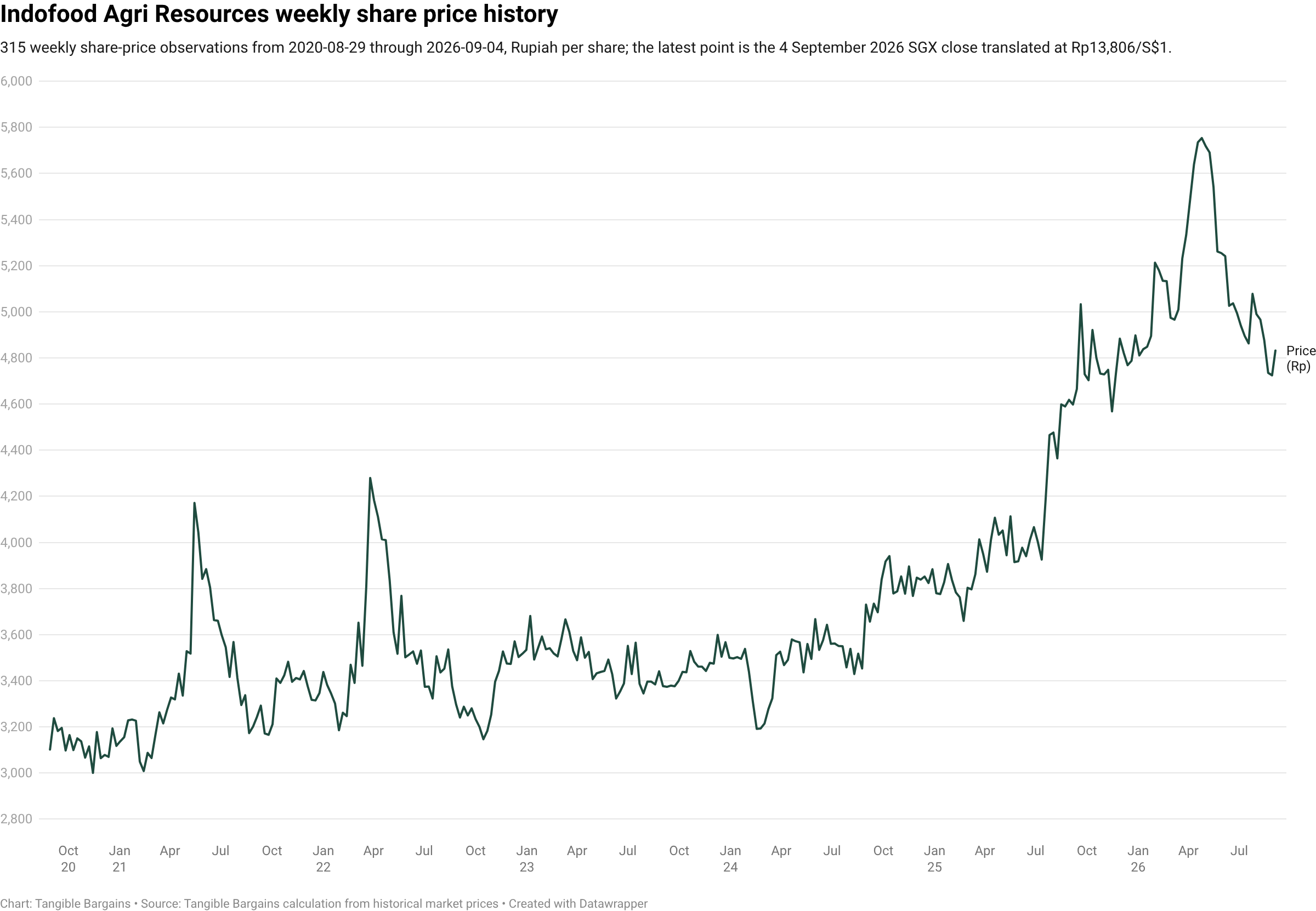
A shorter, supplementary annual series (fiscal year-end closing price ÷ that year-end's tangible book value per share, FY2021–FY2025) tells the same directional story on a thinner sample:
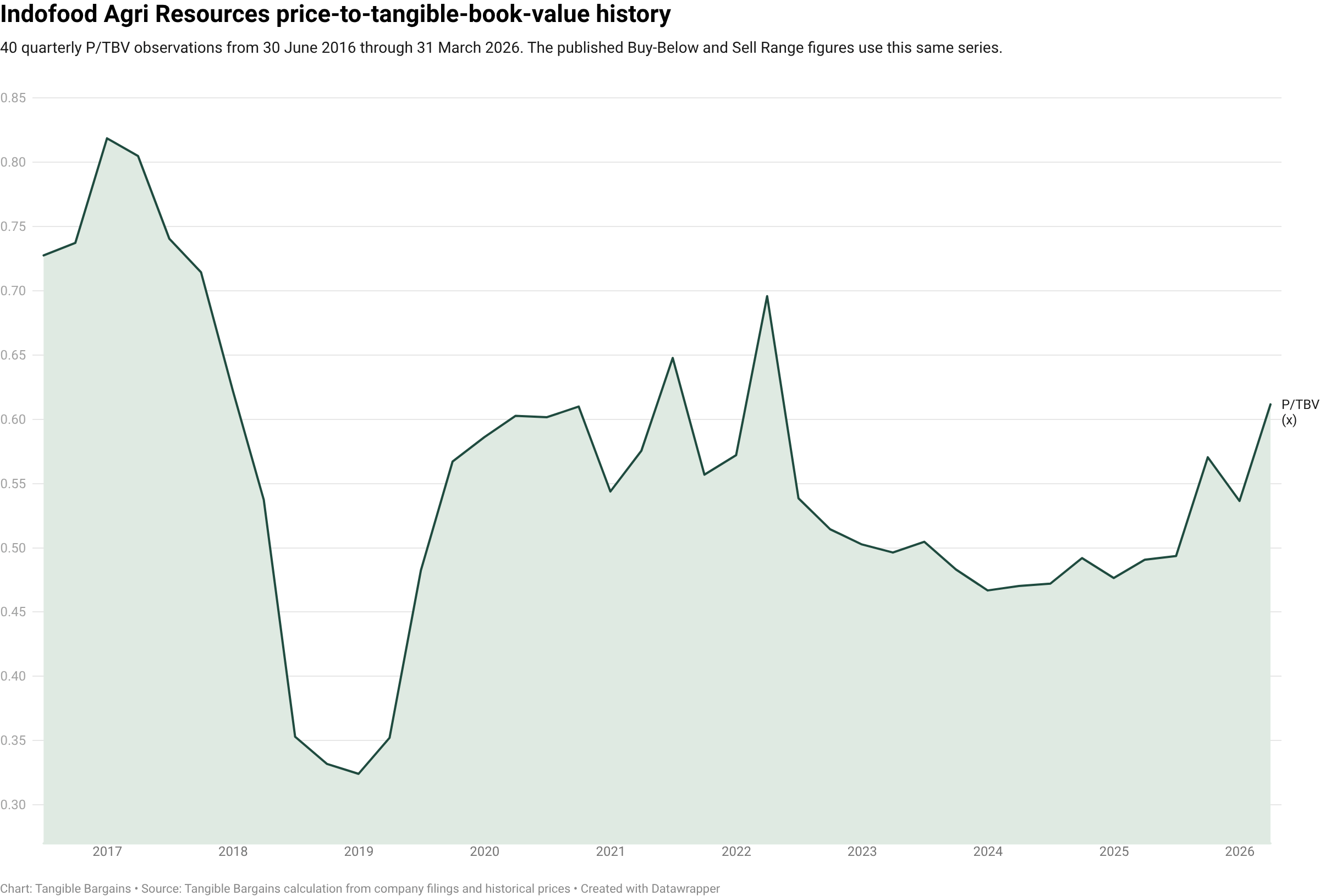
The supplementary year-end observations were: FY2021, 0.496×; FY2022, 0.414×; FY2023, 0.409×; FY2024, 0.458×; FY2025, 0.506×; and 4 September 2026, 0.523×. FY2021 and FY2022 rely on the company's reported net asset value per share and a secondary goodwill figure rather than a fresh check of those audited statements. This short series is only a cross-check. The 40-quarter history above is the valuation anchor.
The earnings leg is unaffected by any of this and stands as its own read. Fiscal-year-end price-earnings ratios of 6.32×, 6.40×, 7.96×, 4.78× and 5.28× for FY2021 to FY2025 give a typical band of about 4.8×–8.0× with a median near 6.3×; the trailing multiple today is 4.91×.*
The comparison points are:
P/TBV: 0.523× today. The 40-quarter history runs from 0.32× to 0.82×, with a p25 to p75 band of 0.49× to 0.61×, implying Rp4,524 to Rp5,632 per share.
P/E on normalized EPS of Rp717: 6.74×, against a 4.8× to 8.0× historical band, implying Rp3,442 to Rp5,736 per share.
P/E on trailing EPS of Rp986: 4.90×, against the same historical band, implying Rp4,733 to Rp7,888 per share.
The book and normalized-earnings legs overlap. The trailing-earnings leg is the outlier because Rp986 reflects a cyclical high, CPO near multi-year peaks, and half-year foreign-exchange and biological-asset gains. The book and normalized legs are the ones to lean on, producing a demonstrated range of roughly Rp4,500 to Rp5,100 (S$0.326 to S$0.369).
Two cross-checks support it. Peers: Singapore-listed palm names trade around 6–11× forward earnings, the sector's best-regarded mid-cap at roughly 8× with an 8% dividend yield. IndoAgri at 4.8× trailing and 6.5× normalized is at or below the bottom of that band, but with a 3.5% yield, an 86% controlling shareholder and two layers of minority leakage, so the discount is explained rather than dissolved. Look-through: IndoAgri's market capitalisation of about Rp6,745 billion compares with roughly Rp7,000 billion for its 73.46% of PT SIMP at the 4 September 2026 Jakarta close plus Rp2,257 billion of equity-accounted investments at book, the market prices the Singapore holding company about 29% below the sum, and about 6% below the listed stake alone. A normal holding-company discount, largely explained by the governance structure discussed above.*
Sell Range
The Sell Range applies the median and top-quartile mean of the stock's own P/TBV distribution to current tangible book value per share, using the real 40-observation quarterly series above (10.0 years, a genuinely deep history to draw one from): median 0.541×, top-quartile mean 0.712×.
Sell range: Rp4,996 – Rp6,574 per share (S$0.362 – S$0.476), i.e. 0.54× – 0.71× tangible book value. The flat 0.80× reference of Rp7,386 (S$0.535) is not used here because the full ten-year quarterly history is available. Today's price of Rp4,832 sits below the entire Sell Range, the shares are below the range where trimming would start.
Buy-Below: Rp3,889 per share (S$0.282), 0.42× tangible book, the mean of every observation at or below the twenty-fifth percentile of the same ten-year distribution. Today's price sits between Buy-Below and the Sell Range floor, meaning this name is buyable now on the numbers, without being at the deepest discount its own history has shown. On where an exit would eventually sit: return on equity has averaged 6.8% across the years behind this band (4.5%, 7.8% and 8.1%), and today's trailing figure of 8.6% is above that average, so the band is fully credible at today's earnings power rather than resting on a hoped-for recovery.
Scenario outcomes
Anchored to the stock's own P/TBV distribution and to specific balance-sheet items, not a generic percentage ladder. The lens is price to tangible book, what this sector and structure actually trade on; the earnings lens sits in the table above.
The four cases are:
Severe downside: the forestry appeal fails in full and the net plasma receivable of about Rp515,000m is written off. Residual tangible book is about Rp7,079 per share; at the series floor of 0.32×, value is Rp2,265 (S$0.164), down 51.7%.
Bear: the forestry appeal fails in full but the plasma balance holds. Residual tangible book is about Rp7,449 per share; at the series median of 0.541×, value is Rp4,031 (S$0.292), down 14.1%.
Base: the forestry escrow is recovered in full and tangible book stays at Rp9,232 per share. At the series median, value is Rp4,997 (S$0.362), up 3.4% from the 4 September 2026 close.
Bull: the forestry escrow is recovered, twelve months of retained earnings at the trailing rate lift tangible book to roughly Rp10,053 per share, and the multiple reaches the top-quartile mean of 0.712×. Value is Rp7,158 (S$0.519), up 52.5%.
Each impairment case strikes residual tangible book rather than unimpaired tangible book. The base case needs no heroic recovery assumption beyond this stock's own median multiple. A renewed take-private offer is an event rather than a valuation case: applying the 2019 offer's 21.5% premium to today's S$0.34 would be about S$0.41, or Rp5,700.
The Decision Figures, Stated
Current price: S$0.350 (Rp4,832) on 4 September 2026; market capitalisation S$488.6 million (US$383 million).
Intrinsic value range: Rp4,031 – Rp7,158 (S$0.292 – S$0.519), bear to bull, base case Rp4,997 (S$0.362), an analytical range, not a target.
Margin of safety: a 47.7% discount to tangible book value, and a positive 3.4% margin against the base-case intrinsic value. Both point the same direction here: this is not a name priced at the top of its own history, and the base case does not require anything better than what this stock has already, repeatedly, been paid.
Buy-Below: Rp3,889 (S$0.282), 0.42× tangible book, the mean of every observation at or below the twenty-fifth percentile of the stock's own ten-year quarterly distribution, 19.5% below today's price.
Sell range: Rp4,996 – Rp6,574 (S$0.362 – S$0.476), 0.54× – 0.71× tangible book, 40 quarterly observations over 10.0 years; the flat 0.80× fallback of Rp7,386 is reference only. Today's price sits below the entire range, in the hold zone above Buy-Below.
Cheapness type: asset-value cheap. Cash alone is 70.2% of tangible book, the balance is real mills and real trees, and today's 0.523× sits below the median of this stock's own ten-year trading history, a genuine, demonstrated discount, not a value trap dressed as one. The discount is not unexplained, though: an 86%-controlled Singapore holding company two levels above the operating assets, 45% of equity belonging to minorities of listed subsidiaries, and 39% of revenue sold to related parties are real, structural reasons the market has never fully closed this gap and may not soon. That argues for sizing the position to the governance risk, not for staying out of it.
13. Risk Matrix
Risk matrix.
Forestry charges not recovered, high severity and medium probability. Rp2,337,480m was imposed on 1 December 2025 and paid on 30 December, followed by another Rp0.15tn in May 2026. The full Rp2.49tn is carried as an asset while under appeal, with no provision. The objection and escrow are the mitigants; watch the Satgas PKH decision and any provision in the FY2026 accounts.
Structural minority discount, high severity and high probability. Anthoni Salim is deemed interested in 86.04%, while the stated float is 13.92%. This caps re-rating more than it threatens earnings. Watch substantial-shareholder notifications and any move toward 90%.
Commodity price reversal, high severity and medium probability. Gross margin has fallen from 29.8% to 25.6% to 22.4% while CPO prices remain near multi-year highs. A 10% CPO fall is roughly Rp700bn of gross profit. Net cash and the downstream segment provide some offset; watch domestic and Rotterdam CPO prices and B50 policy.
Goodwill impairment, medium severity and medium probability. Goodwill is Rp3,078,520m, or 23.9% of tangible book. The last test lowered the discount rate and raised terminal growth without publishing sensitivity figures. Watch the next annual impairment test.
Plasma credit deterioration, medium severity and high probability. The 1H2026 charge was Rp122,575m, up 86.9%, the allowance covers 61% of gross receivables, and Rp523.1bn of guarantees has no recognised reserve. Watch the next credit-loss charge and any guarantee call.
Estate yield decline, medium severity and high probability. Nucleus FFB production fell 2% in FY2025 and 4% in 1H2026; bought-in fruit is now 30% of throughput. Watch own-estate production, replanting and maintenance capital expenditure.
Related-party pricing, medium severity and medium probability. Rp8.26tn, or 39% of FY2025 revenue, was sold to related parties, and 94% of 1H2026 CPO volume moved internally at transfer prices disclosed only as terms agreed between the parties. Watch the interested-person-transaction disclosure and segment margins.
Short-dated refinancing, low severity and medium probability. Rp8,343,576m, or 92% of borrowings, matures within twelve months, but Rp9.05tn of cash covers it 1.09×. Watch bank-line renewals and the still-undisclosed covenant ratios.
Regulatory action against the Salim group, medium severity and low probability. The Finance Minister named PT SIMP in a CPO export transfer-pricing probe; the Attorney General later said no evidence linked PT SIMP. Watch for any reopening of the investigation.
14. Red Flags, Yellow Flags, and Green Flags
🟢 Green Flags
Net debt of Rp68,366m against Rp29,047,651m of total equity, effectively debt-free, with Rp9,052,399m of cash covering the entire current borrowing balance 1.09 times.
Free cash flow of Rp1,940,880m in FY2025 against Rp965,771m in FY2024, with no accrual gap between reported and owner earnings.
Dividend raised for a third consecutive year (S$0.008, S$0.010, S$0.012) on a 17% payout, with zero issuance or option dilution.
Right-of-use assets are only 18.1% of tangible book against Rp45,455m of lease liabilities, so the tangible book is genuinely tangible rather than a capitalised lease.
Today's 0.523× P/TBV sits at the 43rd percentile of the stock's own ten-year quarterly trading history, below the median, and between Buy-Below and the Sell Range floor, not at a historical extreme.
🟡 Yellow Flags
The Piotroski floor rule fired: leverage rose (debt to average assets 20.4% to 22.3%) and liquidity fell (current ratio 1.50 to 1.27) in the same fiscal year, a real deterioration worth watching, not an automatic disqualifier, and already partly reversed at the half-year (current ratio back to 1.38).
Gross margin has fallen for two consecutive periods, 29.8%, 25.6%, 22.4%, while selling prices rose: unit costs are outrunning a favourable price environment.
Nucleus fruit production fell 2% in FY2025 and 4% in 1H2026; immature planted oil palm dropped from 23,806 hectares to 15,978, and bought-in fruit is 30% of throughput.
Ninety-two percent of borrowings (Rp8,343,576m) mature within twelve months across six Indonesian banks, with covenant ratios and headroom not disclosed.
The goodwill test cut the Lonsum discount rate from 12.46% to 11.52% and raised terminal growth to 4.97%, with no published sensitivity, both changes increase headroom.
Brazilian sugar joint ventures cost Rp178,475m in FY2025 and Rp222,777m in 1H2026 alone, with carrying value down to Rp884,305m in six months.
🔴 Red Flags
Rp2.49 trillion, 19.3% of tangible book value, of forestry administrative charges paid in cash to a government escrow in December 2025 and May 2026 and carried as a non-current asset while under appeal, with no provision, no probability disclosure and no key audit matter.
Anthoni Salim is deemed interested in 86.04% with a 13.92% public float, up from 74.34% at the failed 2019 exit offer at S$0.28; every shareholder mandate passes without a minority vote.
Rp1,084,149m of plasma receivables written off in FY2024 with "no reasonable expectation of recovering the cash flows"; the charge now runs 86.9% above last year, the allowance covers 61% of gross, and Rp523.1 billion of plasma guarantees carries no reserve at all.
Roughly 39% of FY2025 revenue was sold to related parties and 94% of 1H2026 CPO volume moved internally at transfer prices disclosed only as "terms agreed between the parties".
⚡ Must-Watch Catalysts
The Satgas PKH decision on the Rp2.49 trillion objection, the largest binary item in the analysis, timing unknown.
FY2026 full-year results, expected late February or March 2027: the next F-Score reading, and whether the 1H2026 recovery in the current ratio to 1.38 holds.
The final FY2026 dividend, a fourth consecutive increase, or the first break in the sequence.
Any substantial-shareholder notification moving the controlling group toward the 90% compulsory-acquisition threshold, or a renewed exit offer.
The October 2026 goodwill impairment test on the Rp2,909,757m Lonsum cash-generating unit; Indonesian CPO prices and B50 mandate policy.
Recommendation
Verdict: BUY — SMALL
The numbers support a buy. The shares trade below the median of their own ten-year quarterly P/TBV history, the F-Score is 6/9 with all signals computable, and the balance sheet is close to net-cash neutral. The position stays Small for a different reason: an 86.04%-controlled family, a prior take-private attempt, and a demonstrated pattern of routing capital into policy-driven uses. That is structural minority risk. It argues for sizing down, not for pretending the risk is absent.
Current price: S$0.350 (Rp4,832) at the 4 September 2026 close; market capitalisation S$488.6m (US$383m).
Eligibility: P/TBV is 0.523×, below the 1.00× value-investing cutoff. Financial borrowings are 31.2% of total equity and 56.8% of equity attributable to owners; total liabilities are 51.3% of total equity.
Piotroski: 6/9. The failed leverage, liquidity and gross-margin signals are real; the first two partly reversed by 30 June 2026.
Valuation: 0.523× P/TBV, 6.74× normalized P/E on a three-year average EPS of Rp717, and 4.90× trailing P/E on EPS of Rp986.
Cash return: 3.43%, all dividend. The FY2025 S$0.012 dividend was paid on 28 May 2026; there were no buybacks.
Intrinsic value range: Rp4,031 to Rp7,158 per share, bear to bull, with a base case of Rp4,997 (S$0.362). The base case is 3.4% above today's price.
Buy-Below: Rp3,889 (S$0.282, 0.42× tangible book), 19.5% below today's price.
Sell range: Rp4,996 to Rp6,574 (S$0.362 to S$0.476), 0.54× to 0.71× tangible book. Today's price is below the range where trimming would start.
Position size: Small, reduced for governance risk rather than for the valuation or balance sheet.
Holding period: Three to five years, spanning a likely forestry decision and a full palm-oil cycle.
Main downside: Rp4,031 in the bear case and Rp2,265 in the severe case. The practical balance-sheet support is Rp9.05tn of cash, equal to 70.2% of tangible book.
Key thesis breakers: a full forestry loss, a second consecutive year of leverage up and liquidity down, a CPO reversal into a rising unit-cost base, a call on the unreserved plasma guarantees, or further erosion of minority standing.
What to watch
The Satgas PKH decision on the Rp2.49 trillion of forestry charges under objection. Timing unknown, outcome binary: full recovery leaves tangible book at Rp9,232 per share, a full loss takes it to Rp7,449.
Any provision raised against the forestry asset in the FY2026 accounts, or a change in how it is classified, a move from "asset" to "expense" is the fastest way this thesis resolves.
FY2026 full-year results, expected late February to March 2027: the next Piotroski reading, and specifically whether the leverage/liquidity combination repeats for a second consecutive year, that would be a materially stronger signal than the one year seen so far.
The FY2026 final dividend. Three consecutive rises (S$0.008, S$0.010, S$0.012) on a 17% payout; a fourth would be evidence the controlling shareholder is willing to distribute, a break would be evidence it is not.
The half-yearly plasma credit-loss charge, running Rp122,575m in 1H2026 against Rp103,041m for all of FY2025. Any resumption of write-offs, or any call on the Rp523.1 billion of unreserved plasma guarantees.
Renewal of the Rp8,343,576m of short-dated bank lines across Mandiri, BCA, DBS, SMBC, BNI and Permata in the second half of 2026, and any first disclosure of the financial covenant ratios attached to them.
Substantial-shareholder notifications. The controlling group has moved from 74.34% in 2019 to 85.90% today; 90% triggers compulsory acquisition, and a float below 10% triggers a listing problem, either would be reason to trim rather than add.
A renewed exit or delisting offer. The 2019 attempt was S$0.28 at a 21.5% premium to the one-month volume-weighted average; the same premium today would be roughly S$0.41 (Rp5,700), inside this report's own base-to-bull range, priced by the buyer rather than the market.
The Sell Range floor at Rp4,996 (S$0.362), the price at which trimming a position would start to make sense, well above today's level.
The Buy-Below price of Rp3,889 (S$0.282), 19.5% below today's level, the price at which the stock reaches a materially deeper own-history discount.
The October 2026 goodwill impairment test on the Rp2,909,757m Lonsum cash-generating unit, and specifically whether the pre-tax discount rate moves back up from 11.52%.
Domestic KPB and Rotterdam CPO prices, and any change to Indonesia's B50 biodiesel mandate or export levy regime, the biggest single driver of the earnings line.
Quarterly nucleus fruit production and replanting capital expenditure. Own-estate output is falling and immature area has shrunk from 23,806 to 15,978 hectares; the fix is capex the company has not yet committed.
Any reopening of the Indonesian Attorney General's palm-oil export investigation in a way that names PT Salim Ivomas Pratama again, after the 29 June 2026 statement that no evidence had been found.
Sources and diligence gaps
This analysis draws on Indofood Agri Resources' 2025 annual report, the condensed interim statements for the six months ended 30 June 2026, the 2026 AGM notice, the 1H2026 results presentation, the statutory directors' interests register, SGX announcements, and public records on the forestry enforcement programme and the 2019 exit offer. The annual report is available from the company's investor-relations archive; exchange announcements are available through the SGX company-announcement archive.
The following gaps remain material: FY2021 and FY2022 audited statements were not retrievable, so two supplementary annual valuation observations rely on reported historical net asset values and a secondary goodwill figure; the exchange announcement index after 21 January 2026 could not be checked for later insider or substantial-shareholder dealings; the specific bank covenant ratios and headroom are not disclosed; and the inter-segment transfer price for the internally moved CPO volume is not disclosed. None of those gaps changes the tangible-book bridge or the BUY, SMALL conclusion, but each matters to how confidently a minority holder should size the position.
Research only, not investment advice. Position disclosure: not held as of this review.