

1. Scorecard
2. Argument
The short version
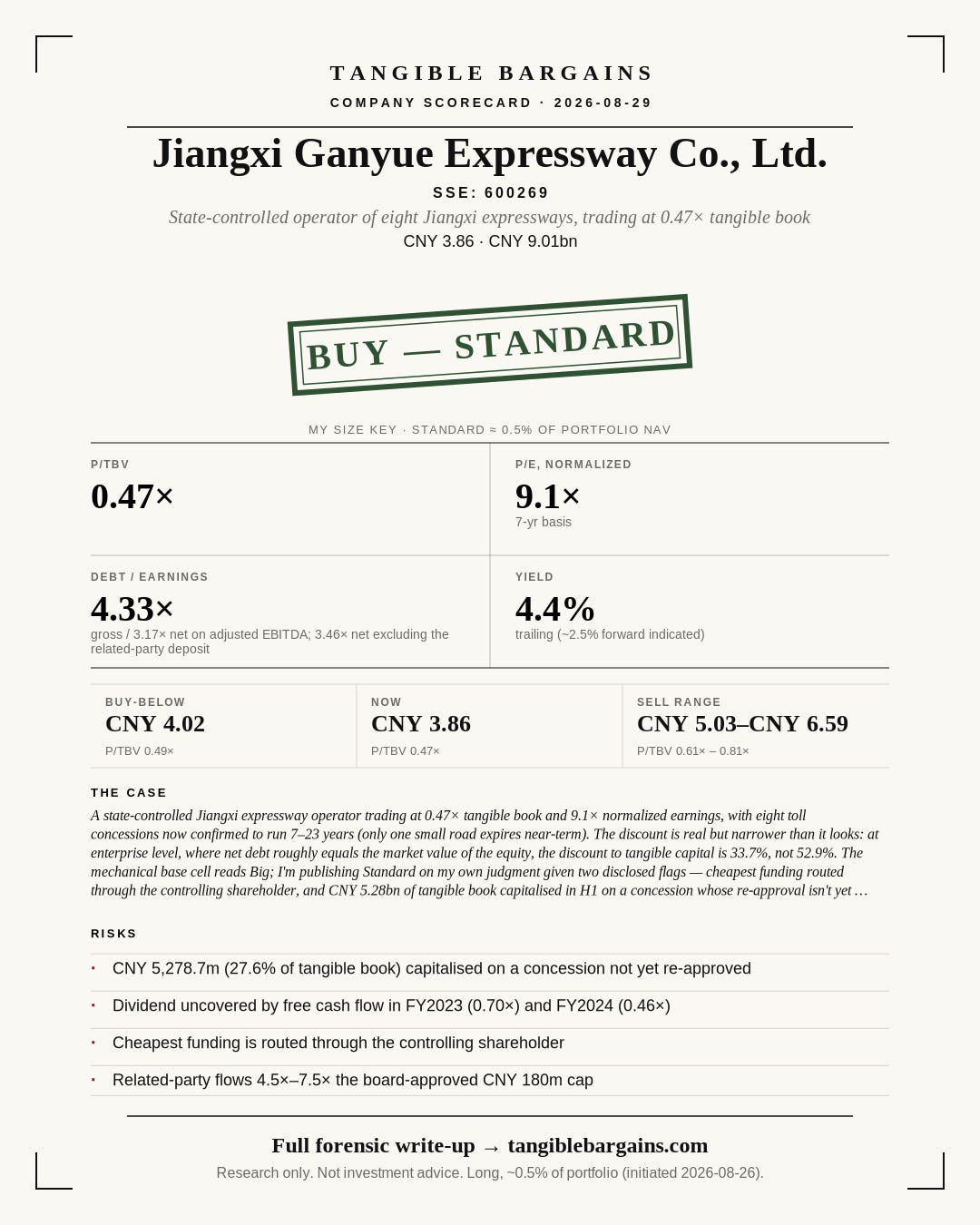
Jiangxi Ganyue Expressway operates eight state-controlled toll roads in Jiangxi province, trading at 0.47x tangible book value and 9.1x normalized earnings. Tangible book per share has compounded upward every year for seven straight years without interruption, and the concession schedule behind the roads now runs 7 to 23 years, with only one small road expiring near-term.
The discount looks larger than it is. At the enterprise level, where net debt roughly equals the market value of the equity, the real discount to tangible capital is 33.7%, not the 52.9% headline. Two disclosed flags keep this a Standard-size position rather than the largest one the numbers alone would justify: the company's cheapest financing runs through its controlling shareholder rather than standing on its own credit, and 27.6% of tangible book was capitalized in the first half of the year on a concession expansion whose re-approval is not yet confirmed.
Why it qualifies
Trades at 0.47x tangible book value, a 52.9% discount at the equity level and 33.7% at the enterprise level.
Normalized earnings multiple of 9.1x on a seven-year basis.
Tangible book per share has compounded upward every single year for seven straight years, with no interruption.
Eight toll concessions now confirmed to run 7 to 23 years; only one small road, 2.75% of toll revenue, expires near-term.
A 4.4% trailing dividend yield and an F-Score of 6 out of 9.
Why it is not a clean bargain
CNY 5,278.7 million, 27.6% of tangible book, was capitalized in the first half of the year on a concession expansion whose re-approval is not yet confirmed.
The cheapest financing runs through the controlling shareholder: cash on deposit at its finance company, a major loan intermediated through it, and fees paid to it to operate the roads. The same fact functions as both a balance-sheet strength and a governance flag.
Related-party transaction flows run 4.5x to 7.5x the board-approved CNY 180m cap, with no confirmed explanation for the gap.
The dividend was not covered by free cash flow in two of the last three years.
96.7% of short-term investments is a single related-party brokerage stock, and its mark-to-market swing drove most of this year's reported profit decline.
The controlling shareholder holds 47.84% of the company, a fired governance concentration warning on its own.
What would change the view
Confirmation, either way, of whether the concession behind the recently completed expansion is re-approved.
A primary filing on the January 2026 change of control to the provincial state asset regulator.
Resolution of the 4.5x to 7.5x gap between the board-approved related-party cap and actual related-party flows.
The related-party shareholder loan maturing 2026-09-07.
Price at or below CNY 4.02, or at or above CNY 5.03, the top and bottom of the stock's own valuation range.
Confirmation of whether the second-largest shareholder, at 4.99%, is state-linked.
Sources and gaps
This draws on the company's own H1 2026 and annual filings and a national credit rating agency's report, with the tangible-book construction independently confirmed against a mirror of the exchange filing. The concession re-approval, the January 2026 control change, and the related-party cap gap remain unconfirmed by a primary source; where a fact could not be verified, the report says so rather than estimating it. See the full detail for the source ledger, calculations, and complete diligence-gap log.
3. Backup and sources
This last layer is the full working file: every source, calculation, and gap, kept so the argument above can be checked. The scorecard and the argument are the synthesis. Open this only if you want to check the work.
Company: Jiangxi Ganyue Expressway Co., Ltd. (江西赣粤高速公路股份有限公司) Ticker: 600269, Shanghai Stock Exchange As of: 2026-08-28, price CNY 3.86, market capitalisation CNY 9,014.7m (USD 1,341m at USD/CNY 6.7217). Buy-Below, Sell Range, Add-More Trigger and the tier's stated reasoning below were corrected 2026-08-29; see the note at the start of the valuation discussion. P/TBV: 0.471× (filing TBV/share CNY 8.1876 at 2026-06-30). Verdict: BUY — STANDARD. Buy-Below: CNY 4.02 (0.49× TBV, 10.2-yr own-history). Sell Range: CNY 5.03 – 6.59 (0.61× – 0.81× TBV). Add-More Trigger (held position): CNY 2.64 (0.32× TBV), a review price for adding, not a mechanical trigger. Moat: Narrow. Governance risk: High, 2 fired warnings, 3 borderline. Position: Long, ~0.5% of portfolio, initiated 2026-08-26.
Primary sources reviewed: the 2025 Annual Report (179pp, audited), for the fiscal year ended 2025-12-31, filed 2026-03-31, read in full from the exchange's designated disclosure venue; the 2026 Interim Report (144pp, unaudited), for H1 ended 2026-06-30, filed 2026-08-10; the 2026 First Quarter Report (19pp), filed 2026-04-28; the 2025 annual general meeting resolutions of 2026-06-18 (dividend, removal of a director, D&O insurance) as reported in the interim report, though the AGM circular itself was not opened; the 2025 preliminary results bulletin was identified but not opened, superseded by the audited annual report; insider activity from the 2026 Interim Report's board, senior-management, and officer shareholding sections (China has no Form 4 analogue); every figure below comes from a primary filing or a stated secondary source, not a pre-built dataset. Other sources: the 2025 Annual Report Summary, the 2023 and 2021 Annual Report Summaries, the announcement on change in accounting estimate (2026-08-11), exchange monthly closing-price history from 2016-03 to 2026-08 and the 2026-08-28 closing quote, press coverage of the H1 2026 result and the 2026-07-14 profit warning, and a USD/CNY reference rate. Data quality: EXCELLENT.
Jiangxi Ganyue Expressway Co., Ltd. — Value Investing Analysis
1. Executive Summary
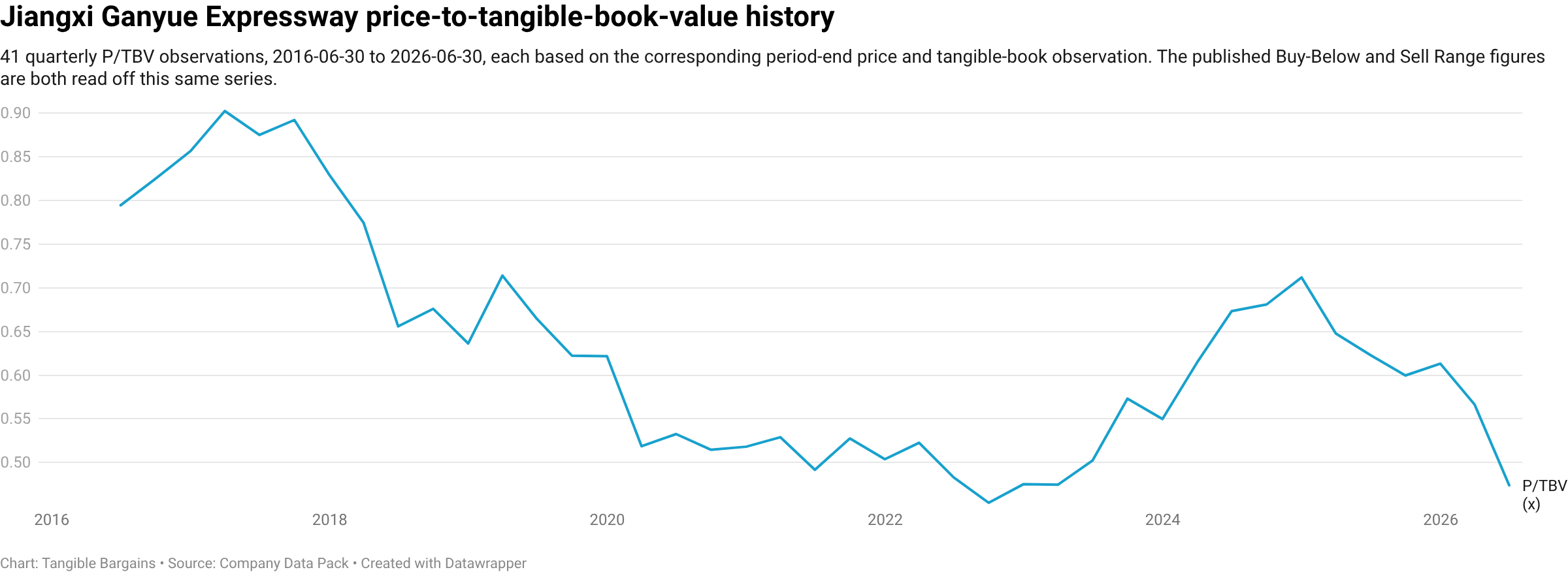
Jiangxi Ganyue Expressway operates eight tolled expressways with close to 800 km of mainline in Jiangxi province and collects a toll on every vehicle that uses them, and it runs four smaller non-toll businesses — smart-transport engineering, service-area fuel retailing, property development and construction, and a financial-investment book — alongside that core. The verdict is BUY — STANDARD. At CNY 3.86 (2026-08-28) the shares carry a market capitalisation of CNY 9,014.7m against a filing-derived tangible book value of CNY 19,121.3m, or CNY 8.1876 per share — a P/TBV of 0.471×, near the bottom of the roughly ten-year, 41-quarter series this position's price targets are built from — fractionally above the series' own floor of 0.454×, not the single cheapest print, but close to it. The tangible book is genuine road, not accounting air: owned property, plant and equipment is CNY 26,400.4m, right-of-use lease assets are CNY 44.4m (0.2% of tangible book), and goodwill is CNY 3.6m on a CNY 38.0bn balance sheet. The name is cheap against tangible book value in the strict sense the phrase is meant to carry.
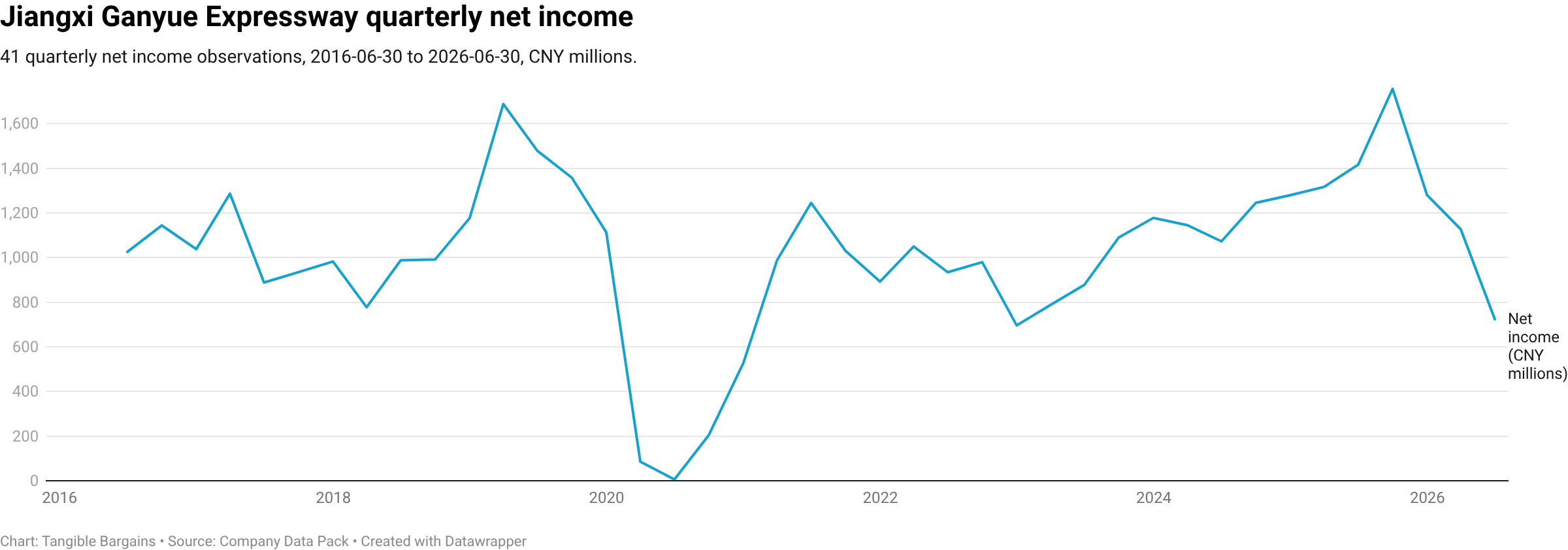
The reason the market is offering it at this price is a reported-earnings collapse that has almost nothing to do with the roads. Attributable profit for the first half of 2026 fell 72.81% to CNY 207.7m, but profit before non-recurring items fell only 14.27%, to CNY 536.4m, and toll service revenue actually rose 0.62% to CNY 1,807m. The gap is a CNY 466.2m negative fair-value swing on a listed-equity book — principally 78,500,053 shares of Guosheng Securities marked at CNY 11.00 on 30 June 2026 — plus a CNY 97.7m fall in the Xinda Real Estate holding taken through other comprehensive income. This is a toll-road company whose reported profit is being driven by a securities portfolio it did not need to own, and that is a governance finding before it is a valuation one.
The balance sheet supports the discount, with one qualification. Financial borrowings of CNY 12,321.7m sit against total equity of CNY 21,129.4m and total assets of CNY 37,973.5m — 58.3% of equity and 32.4% of assets — with lease liabilities a separate and trivial CNY 45.4m; net debt to adjusted EBITDA is 3.17× as reported, 3.46× excluding the CNY 811.7m held at the parent's finance company. Funding is cheap and lengthening: the most recent medium-term notes priced at 1.51% and 1.55% in late July 2026, the issuer rating is AAA, and a CNY 12.0bn unified debt-financing programme was registered in the first half. The Piotroski F-Score is 6 of 9, failing the ROA, leverage and gross-margin comparisons. Cash return is real: CNY 0.17 per share for FY2025, paid 8 July 2026, a 4.40% yield at today's price, with cumulative dividends since the 2000 listing above CNY 6.7bn at an average payout near 31%.
What holds this position to Standard rather than the Big tier the mechanical matrix reads is my own judgment, not a formula — the current method deliberately no longer folds governance flags into the tier automatically. Jiangxi Provincial Communications Investment Group holds 47.52% directly and a further 0.32% through a wholly-owned subsidiary acting in concert, under the ultimate control of the Jiangxi provincial state-asset regulator; the company pays that same controlling shareholder CNY 49.97m a year to operate its own toll, maintenance, safety and rescue centres; CNY 811.7m of the group's CNY 3,307.9m of cash sits on deposit with the parent's captive finance company; and the capital that produced the first-half loss went into a related-party securities house rather than into the road network. Two of five capital-allocation warnings fire and I weigh them as real enough to hold this one notch below what the numbers alone say, setting Governance Risk at High. The asset discount is wide enough to pay for that; it is not wide enough to ignore it.
2. Business and Market Overview
The toll business is eight separate expressways, all commercially operated concessions: Changjiu (127.187 km), Changzhang (104.978 km), Changtai (147.72 km), Jiujing (134.712 km), Wenhou (35.5 km), Penghu (63.93 km), Changfeng (39.05 km) and Fengtong (131.183 km). They sit on the north-south and east-west trunk of the Jiangxi provincial network and connect the provincial capital Nanchang to the province's main cities. Revenue is a toll per vehicle at prices, terms and charging methods set by government — the company says exactly that in its own risk disclosure — so volume is the only variable management controls, and even that is shaped by what else the province builds.
The five reported segments for the first half of 2026 give the shape of the group precisely: toll service revenue CNY 1,822.6m against CNY 888.9m of segment cost; engineering construction CNY 179.6m; refined-oil sales CNY 742.3m; property development CNY 31.2m; other CNY 30.8m; intersegment eliminations CNY -146.0m; total CNY 2,660.5m. Pre-tax profit by segment shows the same concentration — toll CNY 284.1m, refined oil CNY 110.7m, engineering CNY 8.4m, property CNY -42.9m. The toll segment carries CNY 43,166.6m of gross segment assets before eliminations against total group assets of CNY 37,973.5m; everything else is small.
Group revenue fell 13.66% year on year in the first half and none of that came from tolls. The smart-transport subsidiary Fangxing Technology saw revenue fall from CNY 468.3m to CNY 158.1m and earned CNY 1.7m of net profit; the property subsidiary lost money; refined-oil volumes were squeezed by international price moves and by electric substitution, which the company is answering by opening battery-swap stations for heavy trucks in its service areas — the first twelve went into operation in February 2026 under a strategic agreement signed in October 2025 with a CATL-controlled counterparty. Customer concentration inside the toll business is total but not credit-risky in the ordinary sense: at parent level 99.34% of receivables and contract assets are owed by the Jiangxi Provincial Traffic Monitoring and Command Centre, the state body that clears networked toll collection.
As of January 2026: the Zhangji expressway reconstruction and expansion project reached dual eight-lane running condition, and CNY 5,278.7m of construction in progress was transferred into fixed assets during the half — construction in progress fell from CNY 5,513.7m to CNY 235.0m while fixed assets rose from CNY 20,472.4m to CNY 26,400.4m. The company says it will apply to have the Zhangji toll period re-determined once the whole line is open, as it successfully did after the Changjiu and Changzhang widenings, and its own accounting-estimate announcement assumes a re-determined term of 30 years. That application is the most valuable pending item in the business and none of its value is in book equity today; see the concession schedule below, and the red flags list later in this report, for why this is treated as a live, unresolved risk rather than a formality.
Concession schedule (added after this draft's original writing — the single largest open item going into publication, retrieved from a national credit-rating agency's 2025 report after six earlier failed attempts):
Concession periods by road: Changjiu 1998.04 to 2049.09; Changzhang 1999.07 to 2044.03; Wenhou 1999.01 to 2028.12; Jiujing 2000.11 to 2030.11; Changtai 2003.06 to 2033.06; Penghu 2010.09 to 2040.09; Changfeng 2011.12 to 2041.12; Fengtong 2012.10 to 2042.10.
Only Wenhou expires near-term (2028.12), and it is 2.75% of 2024 toll revenue on the rating agency's own footnote. The agency's conclusion, in its own words: "the remaining operating periods of the other controlled toll roads are all 5+ years, with no near-term toll-collection-rights expiry pressure." Changjiu was re-approved out to 2049.09 after its own expansion completed, which is the precedent that matters for Zhangji. Hedge, stated plainly: this schedule is a secondary source, a rating agency's table dated to the end of 2024, not the concession grants themselves — it narrows the Zhangji/Changtai risk (Changtai itself runs to 2033.06, well beyond any near-term concern) but does not confirm that Zhangji's specific re-determination has actually been granted. That remains open; see the red flags list later in this report.
This is an understandable, highly predictable, mildly cyclical, capital-intensive regulated business bolted to four much less predictable ones. It is not a melting ice cube — the roads are being widened and their tolling lives re-cut — but essentially all of the group revenue growth of the last five years came from the non-toll segments, and those are exactly where the losses are.
3. Moat, Competitive Position, and Industry Cycle
Of the five moat sources only two apply here, and both apply strongly within their limits. Efficient scale is the real one: a built expressway on a trunk corridor cannot be economically duplicated, and the company's own listing-era undertakings record that the provincial government agreed in 1998 not to build, rebuild or expand any parallel road within 50 km of the Changjiu, Yinsanjiao and Changzhang alignments while average daily traffic stayed below defined thresholds. Cost advantage is the second: incremental traffic costs almost nothing to serve, which is why toll segment revenue of CNY 1,822.6m carried only CNY 888.9m of cost in the half. Brand, switching costs and network effects are irrelevant to a road.
The moat is real but it is Narrow, for three reasons the filings themselves supply. First, it is finite-lived — these are concessions depreciated by traffic volume over an estimated remaining tolling period, not perpetual assets, and every extension has to be applied for and granted. Second, the 1998 non-parallel-road undertaking has effectively lapsed: the interim report states that the promise cannot be performed because of the national policy of vigorously developing expressways, and that the actual controller and controlling shareholder have publicly explained the situation rather than compensated for it. The protection that made the corridor a monopoly is gone, and the party that removed it also controls the company. Third, the same controlling group owns the competing provincial network, so route competition is an internal allocation decision rather than a market one.
Compounding is therefore limited. Return on equity has run between 3.3% and 7.1% over the seven years to FY2025 and was 6.6% in FY2025 — a regulated, cash-generative, low-return business, not a compounder. Capital reinvested into road widening does buy extended concession life, which is the one mechanism by which this company grows intrinsic value organically, but the return on that capital is set by the same government that grants the extension.
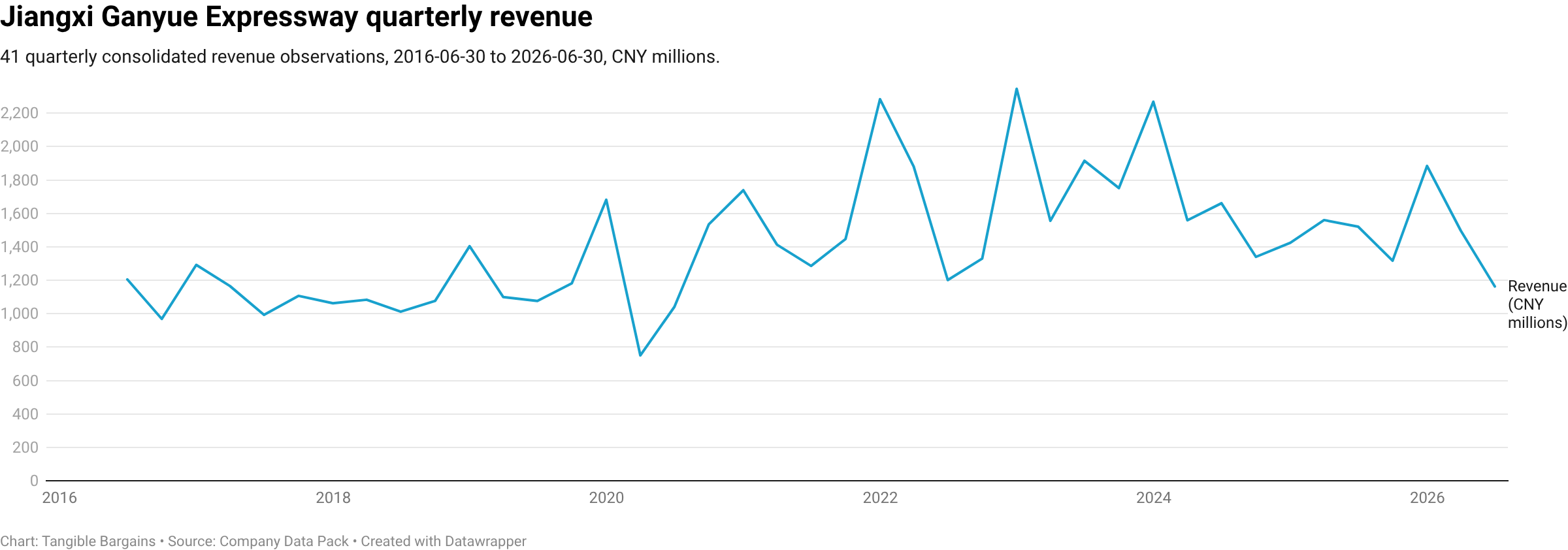
On the cycle, the toll business is Mid-cycle and there is no depressed-earnings snapback embedded in the price. National road freight volumes rose 3.2% and road passenger movements 0.9% in the first half of 2026, while the company's toll service revenue rose 0.62% — running behind the national numbers, which is consistent with diversion onto newly built parallel capacity rather than with weak underlying demand. FY2025 toll service revenue was CNY 3,608m, up 0.77%. Toll margins are stable, volumes flat to marginally positive. What is cyclical in this share price is not the road; it is the mark-to-market on a securities book.
4. Management, Governance, and Capital Allocation
The chairman and legal representative is Han Feng, who signs the accounts as the person responsible for the company. The finance director is Li Shikun, appointed by the board on 11 February 2026; the board secretary is Fu Yan. Beyond that, the management table has turned over hard in eight months. Hu Wei resigned as independent director on 25 November 2025 for personal reasons and was replaced by Yan Qingqing, elected at the extraordinary general meeting of 23 January 2026. Xu Zhihua resigned as director, general manager and member of the strategy and investment decision committee on 27 May 2026, again for personal reasons, and left the company entirely. Nie Jianchun was removed as a director by resolution of the 18 June 2026 annual general meeting, recorded as a work transfer. Xu Yibiao resigned as deputy general manager on 21 July 2026. That is five board and senior-management changes in eight months, including the general manager, and the interim report names no successor general manager. None of the departures is explained beyond "personal reasons" or "work transfer" — an absence of explanation that is itself a fact to report rather than a reassurance.
Insider ownership is nil. The interim report's section on shareholdings of serving and departed directors and senior managers is marked not applicable, meaning no director or officer holds shares and none traded in the period. China has no Form 4 analogue; the periodic report and the exchange's shareholding-change announcement regime are the disclosure venues, and both are silent, so "none found" here is a statement about the regime searched rather than an inference from absence. There is no equity incentive plan, no employee share ownership plan and no other incentive scheme. The board adopted new remuneration measures for directors and senior managers in the first half of 2026, and the annual general meeting approved directors' and officers' liability insurance capped at CNY 150,000 a year — modest, and not evidence of outsized pay, though individual compensation is not disclosed in an interim report and was not verified here.
Ownership is concentrated. Jiangxi Provincial Communications Investment Group holds 1,109,774,225 shares, or 47.52%, and Jiangxi Highway Development Co., its wholly-owned subsidiary and a declared party acting in concert, holds a further 7,379,960 shares, or 0.32%, for 47.84% combined. The ultimate controller is the Jiangxi provincial State-owned Assets Supervision and Administration Commission, which gave an undertaking in 2025, on completion of a free transfer of the controlling stake, not to transfer the 47.85% it indirectly controls for eighteen months. The largest non-state holder is Great Wall Life Insurance with 159,985,682 shares (6.85%) of own funds plus 13,258,410 (0.57%) in a universal-life account. The register held 49,523 ordinary shareholders at 30 June 2026, down from 60,547 at the end of 2023.
Related-party dealing is heavy, and disclosed in full. Under agreements signed on 31 December 2024, the controlling shareholder operates the toll collection, maintenance, safety and rescue centres of the company's own roads for CNY 49.97m a year through to 31 December 2027 — CNY 34.50m from the parent company, CNY 10.29m from Changtai and CNY 5.18m from Changtong. Ordinary-course related-party transactions for 2026 are capped at CNY 110m. At 30 June 2026 the group owed related parties CNY 3,300.4m and was owed CNY 1,414.7m; CNY 811.7m of cash sat with the parent's finance company against a contractual daily cap of CNY 850m; and CNY 140m was lent to Guosheng Securities as subordinated debt running to 27 November 2030. Guosheng Securities is also the company's largest listed-equity holding at CNY 863.5m and appears in the related-party dealings table, which places the largest financial-asset position — and the CNY 466.2m first-half fair-value loss it drove — inside the controlling group's own orbit.
Capital allocation has two faces. The dividend record is good and improving: CNY 0.12 per share for FY2021, cut to CNY 0.10 for FY2022, then CNY 0.16 for FY2023, CNY 0.17 for FY2024 and CNY 0.17 for FY2025, the last paid on 8 July 2026 for CNY 397.0m in total and 31.03% of attributable profit. Cumulative distributions since the 2000 listing exceed CNY 6.7bn at an average payout near 31%. There has never been a buyback, and none is proposed in the "quality, efficiency and returns" action plan the company has run since April 2024. On the other side, capital went into a securities portfolio that lost CNY 466.2m of fair value in six months, into a Fangxing spin-off worked on from March 2021 and abandoned in March 2025 on changed policy and market conditions, and into the Changtong subsidiary, whose equity now stands at CNY 363.1m against registered capital of CNY 4,500m and which lost CNY 97.8m in the half after losing CNY 44.2m in the comparable period.
The capital-allocation warnings are mixed. (1) Control without offsetting minority protection — FIRED: 47.84% concert-party control by a provincial state group under the state-asset regulator, and a listing-era protective undertaking whose sister promise has already been allowed to lapse. Correction: the evidentiary basis originally cited alongside this — "no disclosed independent-director veto over related-party capital allocation" — is not sound as stated: a Board Strategy & Investment Decision Committee demonstrably exists (the departing general manager sat on it before his May 2026 resignation). The warning still fires on concentration alone; that limb of the original reasoning is withdrawn, not the conclusion. (2) Capital routed to parent-mandated, policy-driven or low-return projects — FIRED: road widening executed to the provincial "transport-strong province" plan; operation of the company's own roads outsourced to the controlling shareholder at CNY 49.97m a year; CNY 811.7m of cash placed with the parent's finance company; CNY 863.5m of equity and CNY 140m of subordinated debt in a related-party securities house; and a loss-making Changtong funded pro rata by a CNY 1,989.9m shareholder loan. (3) Dividend cut or an inadequate payout — BORDERLINE, not fired: there was a cut, from CNY 0.12 to CNY 0.10 for FY2022, but it is three years past and the payout has since been raised twice to CNY 0.17; no public shareholder complaint about the payout was located. My own judgment: a 31.03% payout is adequate as-is for a capital-intensive infrastructure operator running ongoing expansion capex (the Zhangji project alone was a CNY 12.1bn total investment) — this stays borderline, not fired. (4) Non-answers on capital allocation, related parties or loss-making subsidiaries — BORDERLINE, upgraded from "not fired": the original clean reading rested on the company having answered 21 investor questions on the exchange's e-interaction platform in the half at a 100% response rate, plus results briefings and institutional meetings. Correction: a response-rate count is a measure of activity, not of substance — nobody actually read the content of those 21 answers to confirm they addressed capital allocation, related parties or loss-making subsidiaries rather than deflecting. Downgraded to borderline until the answers themselves are read. (5) Outsized pay or off-market related-party deals — BORDERLINE, not fired: the volume of related-party dealing is very large, but every item is disclosed with a stated pricing basis at or better than market, the finance-company deposit rate is contractually floored at the central-bank benchmark and at what other group members receive, and no evidence of off-market pricing was found. Individual director and officer compensation was not independently verified, which is part of why this item stays borderline rather than clear.
Two warnings fire, three sit borderline, none is clear. Governance Risk: High (2 fired).
5. Corporate Ownership, Subsidiaries, and Joint Ventures
Ownership at 30 June 2026 — one class of A-shares, one vote per share, 2,335,407,014 shares in issue and unchanged in the period:
Top holders: Jiangxi Provincial Communications Investment Group, the state-controlled parent, 1,109,774,225 shares (47.52%); Great Wall Life Insurance own funds, 159,985,682 shares (6.85%); Jiangxi Provincial Port and Shipping Construction Investment Group, a state legal person, 116,536,810 shares (4.99%); Wang Weizhen, a domestic natural person, 27,946,225 shares (1.20%); Huang Guozhen, a domestic natural person, 27,740,000 shares (1.19%); Hong Kong Securities Clearing Company (the Stock Connect nominee), 23,253,574 shares (1.00%); Great Wall Life Insurance universal-life account, 13,258,410 shares (0.57%); Huang Guoming, 8,444,659 shares (0.36%); Chen Guixing, 8,222,052 shares (0.35%); and Jiangxi Highway Development, wholly owned by the controlling shareholder and acting in concert with it, 7,379,960 shares (0.32%). Directors and senior management hold nil as a group.
Principal subsidiaries at 30 June 2026, all acquired by incorporation: Jiangxi Changtai Expressway (Changtai and Zhangji roads), 76.67% owned, assets CNY 9,730.7m, liabilities CNY 3,540.3m, H1 net profit CNY 185.8m, minority interest CNY 1,461.4m. Jiangxi Changtong Expressway (Changfeng and Fengtong roads), 57.69% owned, assets CNY 5,242.3m, liabilities CNY 4,879.3m, H1 net loss CNY 97.8m, minority interest CNY 153.6m. Jiangxi Fangxing Technology (smart transport, systems integration), 78.59% owned, assets CNY 1,754.9m, H1 revenue CNY 158.1m against CNY 468.3m a year earlier, net profit CNY 1.7m. Jiangxi Ganyue Industrial Development (service-area fuel retailing), 100% owned, 13 service-area filling-station pairs and one urban station. Shanghai Jiarong Investment Management (financial investment), 97.22% direct and 2.78% indirect, holds the fund and private-equity positions. Jiangxi Jiayuan Construction Development (property and building construction), 100% owned, became wholly owned and was renamed in September 2025. Jiangxi Jiaheng Industrial (road maintenance, asphalt supply), 95% direct and 5% indirect.
Minority interests are material and are excluded from tangible book by line choice: CNY 1,893.9m of the CNY 21,129.4m of total equity belongs to outside holders of Changtai, Changtong and Fangxing, and the CNY 19,235.5m used in the bridge is the parent share only. The structure carries two specific leakage points. Changtai, the strongest subsidiary, is 23.33% owned by outsiders, so nearly a quarter of the newly widened Zhangji economics never reaches the listed shareholder. Changtong is the mirror image — 42.31% minority, equity of CNY 363.1m against registered capital of CNY 4,500m, and a CNY 1,989.9m shareholder loan advanced pro rata by the controlling shareholder. Security is specific rather than structural: 15% of Changjiu toll income is pledged against a CNY 1.2bn Agricultural Bank facility and Changtai has pledged the Zhangji toll right and all its proceeds against a CNY 9.7bn syndicated facility, so the listed parent's residual claim on those two roads sits behind pledged revenue streams. The interim report records no significant restriction on using group assets or settling group debts, and no joint ventures material enough to require separate financial disclosure — associates are disclosed only in aggregate at a carrying value of CNY 1,070.7m.
6. Historical Financial Quality and Normalized Owner Earnings
Seven fiscal years are sourced from the company's own annual reports and summaries. The record is that of a stable regulated utility with a volatile tail: toll revenue barely moves, operating cash flow is large and reliable, and reported net income swings on property-cycle write-downs and securities marks.
The chart covers revenue, net income, operating cash flow, free cash flow, diluted EPS, dividend per share, tangible book per share and ROE across FY2019-FY2025. Two further lines the filings disclose only from FY2022 onward: gross margin 32.1%, 32.0%, 39.3%, 37.7% (FY2022-FY2025), and operating income (CNY millions) 1,095.9, 1,814.3, 2,050.6, 1,944.6 over the same four years; capex over the same window was 1,050.8, 2,306.5, 2,426.4, 1,690.0 (CNY millions), and total dividends paid, from FY2021, were 280.2, 280.2, 233.5, 373.7, 397.0 (CNY millions).
Three things stand out. Operating cash flow has been between CNY 1.9bn and CNY 3.4bn every year for seven years and has never come close to threatening the dividend. The revenue line is not a toll line — the FY2023 peak of CNY 7,492.2m and the FY2024 fall to CNY 5,985.0m are the property and engineering segments moving, not traffic; the reported jump in gross margin from 32.0% to 39.3% between those years is the same effect in reverse, low-margin construction and property revenue leaving the mix, and it should not be read as toll pricing power. And tangible book per share has compounded steadily from CNY 6.73 to CNY 8.30 across the window, a 3.5% annual rate, which is what retaining roughly two-thirds of a mid-single-digit ROE produces.
Owner earnings. The cash-flow statement is the right starting point and it was read in the primary filings, so no proxy is needed for the top line. FY2025 operating cash flow was CNY 2,974.9m and total capex CNY 1,690.0m, giving reported free cash flow of CNY 1,284.9m. That understates owner earnings because most of the capex is expansion, not maintenance: the Zhangji and Changzhang widenings absorbed the bulk of the CNY 2,306.5m and CNY 2,426.4m spent in FY2023 and FY2024 and are now complete or near-complete. Road maintenance is expensed through cost of sales rather than capitalised under this company's policy, so maintenance capex is genuinely small; taking it at roughly CNY 300–400m a year gives normalized owner earnings of about CNY 2,575–2,675m against a market capitalisation of CNY 9,014.7m [ESTIMATED — the filings do not split maintenance from expansion capex, and this is the single largest judgement in the section]. Even on the conservative reported-FCF figure the FY2025 free cash flow yield on today's market value is 14.3%, and the CNY 397.0m dividend was covered 3.2 times.
Normalized EPS. The house basis is a ten-year average with a trajectory switch. Ten years were not sourced; seven were, from FY2019 to FY2025, and the switch tests are computed on that window. The five-year average of attributable profit is CNY 1,064.8m against a seven-year average of CNY 994.8m — a ratio of 1.07, inside the 1.25 "growing" trigger and well above the 0.80 "declining" trigger, so the trajectory is stable and the full-window average governs. Normalized EPS is therefore CNY 994.8m ÷ 2,335,407,014 shares = CNY 0.4260, and normalized P/E at CNY 3.86 is 9.06×. Two sanity checks sit either side of it: trailing twelve-month attributable profit is CNY 723.4m (FY2025 plus H1 2026 less H1 2025), or CNY 0.3098 per share for a trailing P/E of 12.5×, depressed by the securities mark; and first-half profit before non-recurring items annualises to about CNY 0.46 per share, an 8.4× multiple. The normalized figure sits between them, which is what it should do.
Earnings quality is good at the cash level and poor at the reported level. Operating cash flow has exceeded net income in every year shown. Working capital is not a trap — inventory of CNY 2,017.3m is unsold property being run down, and receivables of CNY 384.3m on CNY 2.66bn of half-year revenue are trivial. The quality problem is the opposite one: reported profit contains a large, unhedged, unrelated equity-market exposure, and in the first half of 2026 that exposure alone took CNY 466.2m off pre-tax profit.
6.5 Piotroski F-Score — 6/9
Periods compared: FY2025 vs FY2024.
Nine Piotroski signals, FY2025 against FY2024: positive net income, passes (NI CNY 1,279.5m). Positive operating cash flow, passes (CFO CNY 2,974.9m). Return on assets improved, fails (3.4% against 3.6%). Earnings quality, CFO exceeding net income, passes (CNY 2,974.9m against CNY 1,279.5m). Leverage did not increase, fails on the corrected construction (non-current liabilities over average assets, 27.06% against 23.34%; see the note below). Liquidity improved, passes (current ratio 1.32 against 1.02). No dilutive share issuance, passes (net buyback 0.0). Gross margin improved, fails (37.7% against 39.3%). Asset turnover improved, passes (turnover 0.169 against 0.167).
Conventions: ROA and asset turnover scaled by beginning-of-year assets; leverage on Piotroski's canonical construction, non-current liabilities over average total assets; signal 7 computed on net buyback cash flow.
Score: 6/9. The original leverage signal (5) was computed on a non-canonical total-debt-over-assets basis (32.6% vs 34.5%, a false pass); recomputed on Piotroski's actual construction — non-current liabilities over average assets — leverage rose 23.34% to 27.06% and the signal fails. The correction cuts both ways worth stating plainly: the same FY2025 current-ratio improvement used to pass signal 6 (1.02 to 1.32) is largely the mirror image of the same event — CNY 1,611.6m of liabilities moved from current to non-current while total liabilities fell only CNY 332.3m — so the liquidity "improvement" and the leverage "deterioration" are substantially one balance-sheet reclassification counted twice with opposite signs, not two independent facts. Both signals had already reversed by the 2026-06-30 anchor date used everywhere else in this report: the current ratio round-tripped to 1.0312 and the asset-liability ratio rose a further 1.14 points to 44.36%. The three failures are roa_improved, leverage_did_not_increase and gross_margin_improved. House status is eligible (4–9 band, no ranking inside it). The floor rule did not fire.
7. Balance Sheet, Debt, Covenants, and Refinancing Risk

The borrowings note, the bonds note, the long-term payables note and the financing-liabilities rollforward were all read in the 2026 interim report, and the instrument list below is complete to the balance-sheet date. Financial borrowings are disaggregated from lease liabilities before any classification is made: financial borrowings CNY 12,321.7m, lease liabilities CNY 45.4m (CNY 28.4m non-current plus CNY 17.0m current). The rollforward in the cash-flow note cross-foots to CNY 12,824.1m of financing liabilities including leases and the CNY 457.0m dividend payable, which reconciles to the instrument list exactly.
Debt instruments, unsecured unless noted (CNY millions): 26 Ganyue SCP001 super short-term paper, 1,003.9 at 1.48%, maturing 2026-12-21. 26 Ganyue SCP002, 801.5 at 1.39%, maturing 2027-02-08. Accrued SCP interest and other, 1,010.4, within 12 months, included in other current liabilities. 24 Ganyue MTN001, 898.7 at 2.17%, maturing 2027-04-24, annual coupon, bullet. 24 Ganyue MTN002 (rural revitalisation), 698.9 at 2.10%, maturing 2027-06-11, annual coupon, bullet. 24 Ganyue MTN003, 1,299.1 at 2.05%, maturing 2027-07-31, annual coupon, bullet. 25 Ganyue MTN001, 1,099.7 at 1.70%, maturing 2028-07-09, annual coupon, bullet. Agricultural Bank fixed-asset loan for the Changjiu widening, 1,045.0, LPR 5-year-plus less a spread, maturing 2037 (a 15-year term from 2022), with 15% of Changjiu toll income pledged. ICBC fixed-asset loan for the Zhangji widening and Changtai, 1,608.0, LPR 5-year-plus less a spread, maturing 2042 (an 18-year term from 2024), drawn from a CNY 5,000m facility. Bank of China fixed-asset loan for the Changzhang phase II, 226.4, LPR 5-year-plus less a spread, maturing 2038 (a 15-year term from 2023), drawn from a CNY 1,500m facility. Other credit long-term borrowings, 725.8, LPR-linked, various maturities, unsecured. Short-term borrowing from the group finance company, 4.7, rate not disclosed, maturing 2026-12-15, related party. Parent group-borrowing pass-through for the Changjiu widening, 554.0 at 1.20% fixed, maturing 2029 (a 14-year term from 2015/16), on-lent from national policy banks via the parent. Shareholder loan to Changtong from the controlling shareholder, 1,989.9, rate not disclosed, stated maturity 2026-09-07, advanced pro rata and carried as non-current. Accrued interest on long-term borrowings and payables, 81.5, within 12 months. Total financial borrowings: 12,321.7. Lease liabilities (current CNY 17.0m plus non-current CNY 28.4m), 45.4, implicit rate, to 2030, kept out of the debt test. Cash and equivalents, 3,307.9, including CNY 811.7m at the parent finance company and CNY 3.3m restricted. Listed and fund securities at fair value, 1,418.8 (CNY 892.5m FVTPL, CNY 198.0m FVOCI, CNY 328.3m other).
Also issued after the balance-sheet date and therefore not in the table: 26 Ganyue MTN001, CNY 300m at 1.51%, issued 27 July 2026 and maturing 27 July 2028, and 26 Ganyue MTN002, CNY 500m at 1.55%, issued 30 July 2026 and maturing 30 July 2029. Two super short-term papers, 25 SCP006 and 25 SCP007, CNY 500m each, were repaid on 3 August 2026. A CNY 12.0bn unified debt-financing instrument registration was obtained in the half — the company says it is the first local enterprise in Jiangxi and in the expressway sector to hold it.
Ratios, on the company's own disclosed basis: total liabilities to assets 44.36% at 30 June 2026 (43.22% at end-2025); current ratio 1.03 (1.32); quick ratio 0.78 (0.99); EBITDA interest cover 9.97× in the half against 16.73× a year earlier; EBIT interest cover 4.23× against 11.27×, the fall being entirely the securities mark inside pre-tax profit; cash interest cover 16.68×, essentially unchanged. Loan repayment and interest payment rates are both 100%, no interest-bearing debt is overdue, and the AAA issuer rating with stable outlook has been maintained. On financial borrowings alone the ratio is 32.4% of assets and 58.3% of total equity.
Net debt to EBITDA: on FY2025 adjusted EBITDA (CNY 2,843.4m, stripping the non-operating securities fair-value gain — discussed further in the valuation section below), gross debt to adjusted EBITDA is 4.33× and net debt to adjusted EBITDA (net of all CNY 3,307.9m of cash) is 3.17×. The adjustment that matters: CNY 811.7m of that cash sits on deposit at the controlling shareholder's captive finance company — the same fact cited as evidence for the second fired capital-allocation warning. Netting it against debt while correctly refusing to net the related-party equity stake in the securities book is inconsistent; excluding that deposit from cash, net debt to adjusted EBITDA is 3.46×, at or through the boundary this report elsewhere classifies as "Elevated." Whether the finance-company deposit should count as cash for this purpose is an economic-substance question no filing settles either way.
Classification: Manageable. Debt to assets sits at the low end of the 30–50% band and coverage at the top of the 5–10× band on the EBITDA measure, with no covenant breach, no overdue instrument and a demonstrated ability to refinance at falling rates. The capital-intensity caveat applies explicitly and is not a waiver: regulated toll-road infrastructure with contracted, government-set pricing structurally supports more leverage at the same risk than an industrial would, and a 32% debt-to-asset ratio here is conservative for the sector rather than merely adequate — but the qualification filter debt test is still run on the unadjusted number, and it passes on both the financial-borrowings measure (58.3% of equity) and the wider total-liabilities measure (79.7% of total equity, 87.6% of parent equity), so no sector allowance is needed to clear it.
The maturity wall is the item to watch and it is concentrated in 2027: CNY 2,896.7m of medium-term notes fall due between April and July 2027, on top of CNY 1,805.4m of super short-term paper maturing in December 2026 and February 2027. Rolling that at current interbank pricing is not a stretch for an AAA name that just printed 1.51%, but it is the reason cash rose to CNY 3,307.9m in the half. One classification item deserves flagging: the CNY 1,989.9m shareholder loan to Changtong is carried within non-current long-term payables while the related-party note gives its maturity as 7 September 2026 — nine weeks after the balance-sheet date. Either an extension is assumed and undisclosed, or the classification is wrong; the filings do not say which, and this is a diligence gap rather than a solvency concern given the lender is the controlling shareholder.
8. Real Estate, Leases, and Hidden Assets
Right-of-use assets are CNY 44.4m, which is 0.2% of tangible book value of CNY 19,121.3m, against lease liabilities of CNY 45.4m; total lease cash outflow in the half was CNY 11.4m and short-term and low-value lease expense CNY 6.9m. Right-of-use assets are a capitalised right to occupy, not a liquidation floor, and they are disclosed here rather than stripped out of the TBV per share used everywhere in this report — removing the asset without its matching liability would be the wrong operation. At 0.2% the question is immaterial either way, which is the point worth making: unlike an asset-light retailer whose "tangible book" is largely leasehold, this company's book is road.
What the book actually consists of is CNY 26,400.4m of owned property, plant and equipment, of which road assets carried CNY 18,402.0m at 31 December 2025 before the CNY 5,278.7m Zhangji transfer in the half. Those assets are depreciated by traffic volume over the estimated remaining tolling period rather than on a straight-line life, and they are carried at depreciated historical cost. Two sources of value sit outside that number. First, the pending re-determination of the Zhangji tolling period: the company assumes a 30-year re-determined term in its own accounting-estimate work, and an extension granted on a road already built and paid for is close to pure incremental value that book equity does not carry. Second, investment property is held at cost — CNY 165.9m net against CNY 328.0m of original cost — and the Changtai Building in Ji'an is let to the municipal engineering company on a lease running to 31 July 2030 at rents that escalate 3.56% a year, while Jiarong lets a floor of the Zhide Xingzuo tower in Beijing's Xicheng district to 28 February 2030.
The genuine downside support is not exotic. Cash and equivalents are CNY 3,307.9m with only CNY 3.3m restricted; liquid listed and fund securities add CNY 1,418.8m at market; inventory of CNY 2,017.3m is completed and near-completed property being sold down, which is the least reliable of the three and is where the CNY 29.2m of impairment charged in the half landed. Against CNY 12,321.7m of borrowings, the CNY 4,726.7m of cash and marketable securities is the first line of defence and the toll cash flow is the second.
9. Capital Markets Access, Dilution, and Financing Flexibility
The share count has not moved. There were 2,335,407,014 shares in issue at each of the seven fiscal year-ends from FY2019 to FY2025 and at 30 June 2026, and the interim report states that total shares and share structure were unchanged in the period. There are no options, no restricted stock units, no employee share plan, no convertible bonds — the interim report's convertible-bond section is marked not applicable — no warrants and no treasury shares. Basic and diluted earnings per share are identical in every period shown, which is what a capital structure with no dilutive instruments produces. There has never been a buyback either, so the shareholder yield is entirely the dividend.
The company does not need the equity market. Financing runs through bank facilities and the interbank debt-financing market, where it holds an AAA rating, a newly registered CNY 12.0bn unified programme, and undrawn committed bank capacity — CNY 3,392m of the ICBC Zhangji facility and CNY 1,273.6m of the Bank of China Changzhang facility remain undrawn on the disclosed drawdown figures, alongside a CNY 9.7bn syndicated facility for Zhangji signed in 2023 that is barely used. The one equity-adjacent event in the window was a CNY 58.6m minority injection into a subsidiary in FY2024, which dilutes the group's share of that subsidiary rather than the listed share count. Dilution risk is as close to nil as a listed company gets.
10. Litigation, Regulatory, and Contingent Liability Risk
The note reached is Note XVI, Commitments and Contingencies, of the 2026 interim report, read in the primary filing, together with Section V items 6 to 9 of the same report. Commitments are explicitly nil: "as at 30 June 2026 the company had no significant commitments requiring disclosure." Section V item 7 records that there were no material litigation or arbitration matters in the period, item 8 that neither the company nor its directors, senior managers, controlling shareholder or actual controller were subject to investigation or penalty, and item 3 that there were no irregular guarantees.
One contingency is disclosed and it is a carry-forward. In July 2022 the fuel subsidiary sued Sichuan Zhonghangyou Xinye Petroleum and a second defendant for return of CNY 143,000,000 of prepayments on four fuel purchase contracts, with a claim that the second defendant be jointly liable to the extent of CNY 55m of funds it had allegedly moved. The Nanchang Intermediate Court ruled for the company on 23 April 2023, the Jiangxi High Court dismissed the appeal on 16 December 2023, and in February 2024 CNY 55.09m of enforcement proceeds net of fees reached the subsidiary. In June 2024 the Supreme People's Court ordered the case up for retrial and suspended enforcement; in July 2024 the Nanchang court terminated enforcement; the Supreme People's Court heard the retrial in July 2025 and, as at the date the interim financial statements were signed, judgment is still awaited. The exposure runs both ways: the unrecovered balance of the CNY 143m claim, and a possible clawback of the CNY 55.09m already collected if the retrial goes against the company. Provisions carried are small and specific — CNY 21.1m in total, comprising CNY 4.3m for unresolved litigation, CNY 15.9m of construction warranty retentions and CNY 0.9m of late-delivery compensation on property.
Carry-forward checks against the FY2025 annual report found no other open items: the Fangxing spin-off, worked on from March 2021, was formally stopped by board resolution on 21 March 2025 and is closed; there is no subpoena, investigation, class action, covenant waiver, going-concern language or material weakness in either filing; and the subsequent-events note of the interim report is marked not applicable in all four of its sub-items, meaning no material non-adjusting event was disclosed even though the company issued CNY 800m of medium-term notes in late July 2026 and repaid CNY 1,000m of paper on 3 August 2026 — those appear in the bond section rather than in the subsequent-events note, which is a presentation point rather than an omission. Regulatory risk is not litigation risk here: the material regulatory exposure is the government's power to set toll rates, tolling periods and charging methods, which the company names as its second-ranked risk factor and which the Third Plenum decision to "optimise toll road policy" keeps live.
11. Accounting Quality and Disclosure Review
The FY2025 financial statements were audited by Zhongshenzhonghuan CPAs (special general partnership), report number Zhonghuan Shen Zi (2026) 1500011, signed by Cai Suhua as engagement partner, and carry a standard unqualified opinion. The audit report was read in the primary filing. There is no going-concern material-uncertainty paragraph — only the boilerplate responsibility wording — and no material weakness is reported. The half-year statements are unaudited, which the company states plainly.
There is exactly one key audit matter and it is the right one: depreciation of road assets. The auditor records road-asset carrying value of CNY 18,402.0m at 31 December 2025 and FY2025 road depreciation of CNY 953.0m, notes that the units-of-traffic method depends on management's estimate of total remaining traffic over the tolling period, and identifies significant management judgement and potential bias because the forecast depends on the history of parallel expressways and national and provincial roads and on other road-network construction in the same region. The procedures described are substantive rather than nominal: benchmarking the policy against comparable listed expressway operators, assessing the independence and competence of the third-party traffic forecaster, back-testing prior forecasts against actual traffic, agreeing actual traffic to external data and recomputing the charge.
That estimate moved in the period under review, which is why it matters now. On 7 August 2026 the board approved a change of accounting estimate: the Ministry of Transport Planning and Research Institute re-forecast traffic for all eight roads and new unit-traffic depreciation rates apply from 1 January 2026, while from 1 February 2026 the Zhangji depreciation base is reset on an assumed re-determined tolling period of 30 years. The disclosed effect on the first half is accumulated depreciation and cost of sales up CNY 46.47m, tax down CNY 8.53m, net profit down CNY 37.94m and attributable profit down CNY 29.10m; had the same estimate applied from 1 January 2023, net profit would have been lower by CNY 115.7m, CNY 120.7m and CNY 124.7m in 2023, 2024 and 2025 respectively. The direction is conservative — the company took more depreciation, not less — and the pro-forma disclosure is unusually complete. It also means reported FY2023–FY2025 earnings were, on today's traffic assumptions, roughly CNY 120m a year better than they would now be stated; the normalized EPS used in this report is not adjusted for that, which biases the normalized P/E modestly optimistic.
Elsewhere the disclosure is detailed. Non-recurring items are itemised line by line — the CNY -328.7m first-half total is dominated by CNY -468.5m of financial-asset fair-value and disposal effects, partly offset by CNY 20.2m of government grants and CNY 111.5m of tax effect — so the recurring and non-recurring halves of the result can be separated by the reader without estimation. Segment reporting gives revenue, cost, investment income, impairment, depreciation, pre-tax profit, tax, net profit, assets and liabilities for five segments plus eliminations. Related-party disclosure is exhaustive to the point of listing individual balances with fifty counterparties. Goodwill is CNY 3.6m, so impairment risk to book value from that source is nil; other intangibles are CNY 110.6m; deferred tax assets of CNY 406.5m are the larger judgement and are not separately stress-tested in the filings. Revenue recognition is unremarkable — tolls at the point of passage, construction over time, property on handover.
Classification: Adequate. Every material note was opened in a primary document and the opinion is clean, which supports the top of the scale; what holds it at Adequate rather than High is that the single most important number in the accounts — road depreciation — rests on a traffic forecast that management commissions, that has just been revised in a way that would have cut three prior years by about CNY 120m each, and whose sensitivity is not disclosed.
12. Valuation and Margin of Safety
Valuation method. This section's price-target construction (Buy-Below, Sell Range, Add-More Trigger) has been corrected in two ways since this report was first drafted. First, the self-built seven-point annual P/TBV series used below has been replaced with the same 41-quarter own-history series used everywhere else on this position (2016 to 2026, quarterly), which is simply a longer and more reliable version of the same idea. Second, Buy-Below itself now uses a different, company-relative construction, corrected 2026-08-29: the original universe-wide grid reading landed Buy-Below above the bottom of this stock's own Sell Range, an incoherent pair of numbers for a name that has traded almost entirely inside the "cheap" band across its own history. The corrected figures are below; the reasoning that produced them replaces the equivalent reasoning in the earlier analysis.
Tangible Book Value — Derivation (anchor 2026-06-30, 2026 Interim Report; CNY millions)
Table 1 — equity bridge. Common shareholders' equity: CNY 19,235.5m (2026 Interim Report, consolidated balance sheet, equity attributable to parent, 19,235,530,185.53), as of 2026-06-30. Less goodwill: CNY -3.6m (note 7(27), goodwill 3,609,824.44). Less other intangibles: CNY -110.6m (note 7(26), intangible assets 110,592,472.20). Equals tangible book value: CNY 19,121.3m (derived: common equity minus goodwill minus other intangibles). Divided by shares outstanding: 2,335.407m (2026 Interim Report, share capital 2,335,407,014; the interim report's own share-capital disclosure confirms no change in the period). Equals TBV per share: CNY 8.1876 (derived). Minority interest, excluded by line choice and not subtracted: CNY 1,893.9m (2026 Interim Report, minority interests 1,893,850,794.32).
No analyst adjustments are made, so adjusted TBV per share equals TBV per share at CNY 8.1876.
P/TBV (derived) = 3.86 ÷ 8.1876 = 0.471× (price as of 2026-08-28).
Table 2 — asset composition at the anchor period. Cash and short-term investments: CNY 4,200.4m, 11.1% of total assets, 22.0% of TBV. Accounts receivable: CNY 384.3m, 1.0%, 2.0%. Inventory: CNY 2,017.3m, 5.3%, 10.6%. Property, plant and equipment (owned): CNY 26,400.4m, 69.5%, 138.1%. Right-of-use lease assets, disclosed and never stripped from TBV: CNY 44.4m, 0.1%, 0.2%. Long-term investments: CNY 1,596.9m, 4.2%, 8.4%. Goodwill: CNY 3.6m, 0.0%, 0.0%. Other intangibles: CNY 110.6m, 0.3%, 0.6%. Other current and noncurrent assets: CNY 3,209.3m, 8.5%, 16.8%. Residual/unclassified: CNY 6.1m, 0.0%, 0.0%. Total assets: CNY 37,973.5m (100%).
Right-of-use note: ROU assets 44.4 = 0.2% of TBV. ROU is a capitalized right to occupy, not a liquidation floor — disclosed, never stripped out of the TBV/share used everywhere in this report.
Road-only asset composition. The "Property, plant & equipment (owned)" row above (26,400.4 / 69.5% of assets / 138.1% of TBV) is TOTAL owned PP&E — buildings, equipment and land alongside the roads, not a road-only figure. An earlier characterisation of this position as "roughly 70% of assets and 138% of tangible book" in road PP&E conflated the two. The only audited road-specific carrying value in this record is CNY 18,402.0m at FY2025 — 48.8% of assets and 94.9% of tangible book (no road-only figure exists at the 2026-06-30 anchor date used for the bridge above). The remaining roughly 18% of tangible book not accounted for by roads is the related-party brokerage stake, other fair-value-through-OCI equity, and property inventory.
Historical Relative Multiple Valuation
An annual seven-point P/TBV check is retained as supplementary context; the governing series is the company's own quarterly P/TBV history — 41 observations, 2016-06-30 to 2026-06-30.
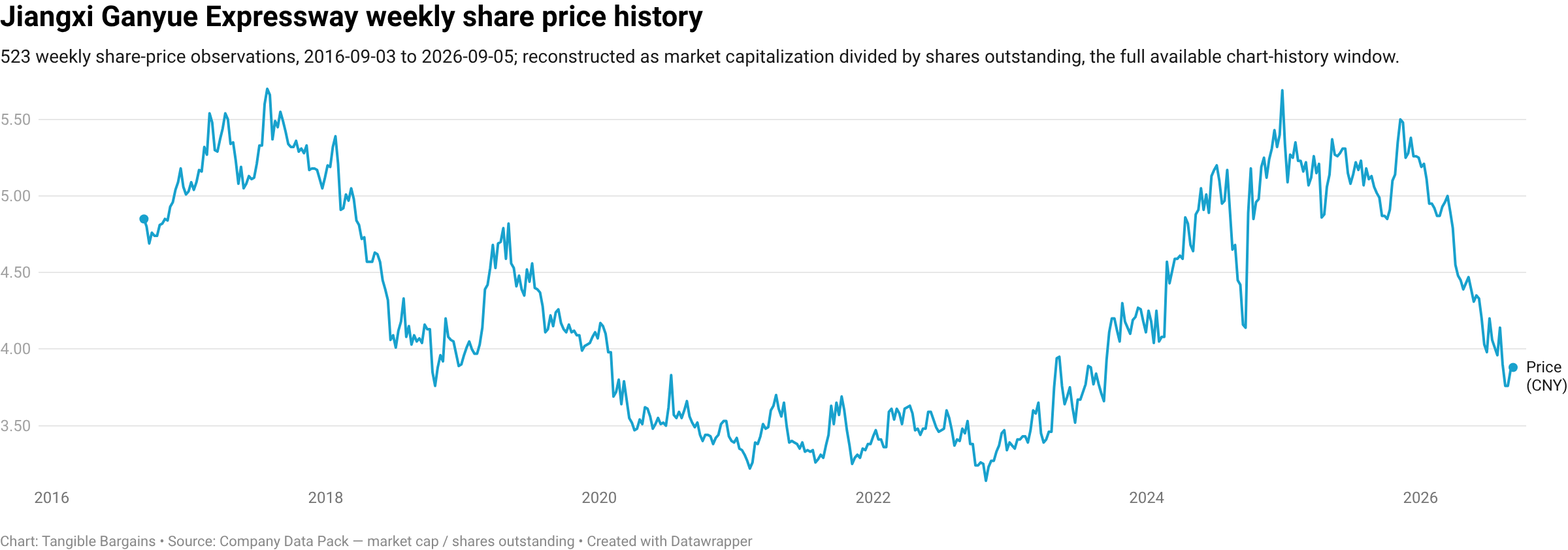
Full 41-quarter distribution: min 0.454×, p25 0.519×, median 0.615×, p75 0.681×, p90 0.829×, lower-quartile mean (mean of every observation at or below p25) 0.491×, upper-quartile mean (mean of every observation at or above p75) 0.805×, max 0.902×. Today's 0.471× sits at roughly the 5th percentile of this series — still near the bottom of its own ten-year range, though not the literal minimum (that was 0.454×, in Q3 2022).
Annual check (supplementary):
Year-end price, TBV per share, and P/TBV, in CNY: 2019-12-31, 4.13, 6.6693, 0.62×. 2020-12-31, 3.42, 6.7438, 0.51×. 2021-12-31, 3.43, 6.9119, 0.50×. 2022-12-31, 3.39, 7.1435, 0.47×. 2023-12-31, 4.11, 7.5023, 0.55×. 2024-12-31, 5.61, 7.9356, 0.71×. 2025-12-31, 5.19, 8.2986, 0.63×. Today (2026-08-28): 3.86, 8.1876, 0.471×.
The annual points sit inside the fuller quarterly range and would have understated the true floor (0.454×, a quarter this coarser series never sampled). The quarterly series is the governing history.
Sell Range and Buy-Below
Sell Range is [median, upper-quartile-mean] × current TBV/share, over the same 41-quarter series: CNY 5.03 – 6.59 (0.61× – 0.81× TBV). Neither coherence flag fires: the range does not start below the current price, and the current price is not above it — today's price sits well below the whole range.
Buy-Below uses the same 41-quarter distribution as Sell Range. The lower-quartile mean is CNY 4.02 (0.49× TBV, 10.2-yr own-history). The result sits below the Sell Range floor by construction; the universe-wide matrix still governs the sizing tier and Buy More Below.
Buy More Below: not reachable — Big is already the largest size on the matrix, so no next size up exists at any price.
Add-More Trigger (new): CNY 2.64 (0.32× TBV). A single, entry-anchored review price for adding to this specific position — entry CNY 3.87, 2026-08-26, minus one 0.15-P/TBV-point step — distinct from Buy-Below/Buy More Below, which read off the universe-wide grid from today's price rather than this position's own entry point. It is a guideline for revisiting the thesis if the price gets there, never a mechanical buy signal, and never applied to sizing or the tier.
At CNY 3.86, the stock trades below its own Buy-Below (4.02) and well below the bottom of its own Sell Range (5.03), with a real gap between the two.
Scenario Table
The anchor for every row is the company's own P/TBV window and, on the earnings leg, an EV/EBITDA cross-check: enterprise value at CNY 3.86 is CNY 19,922.4m (market capitalisation CNY 9,014.7m plus financial borrowings CNY 12,321.7m plus minority interests CNY 1,893.9m less cash CNY 3,307.9m). EBITDA basis. Reported FY2025 EBITDA of CNY 3,130.1m includes a CNY 286.7m pre-tax fair-value gain on the securities book that this report treats as non-operating everywhere else; only the mark-inclusive construction prints the 6.4× multiple below. Stripping the mark gives adjusted EBITDA of CNY 2,843.4m and EV/EBITDA of 7.01× (a second, independent construction from an operating-income line lands close by, at 6.77×) — still the cheap end of the sector's normal 7×–10× range, just on the correct, comparable basis.
Severe downside: tolling periods shortened by policy, a further CNY 1.0bn of securities and property write-downs, multiple stays at the window floor — 0.42× TBV of CNY 7.75, giving CNY 3.26, -16% versus today's CNY 3.86. Bear: traffic flat, no Zhangji extension granted, securities book falls a further 20%, multiple stays at today's level — 0.47× TBV of CNY 8.05, giving CNY 3.78, -2%. Base: toll revenue grows 1-2%, capex normalises, securities book stable, multiple reverts to the seven-year median — 0.55× TBV of CNY 8.30, giving CNY 4.57, +18%. Bull: Zhangji tolling period re-determined at 30 years, securities book recovers, multiple reaches the top-quartile mean — 0.67× TBV of CNY 8.60, giving CNY 5.76, +49%.
Stated explicitly. Current price CNY 3.86 (2026-08-28), market capitalisation CNY 9,014.7m (USD 1,341m at USD/CNY 6.7217, the single reference rate used in this report and applied nowhere except the decision figures). Intrinsic value range, base case: CNY 4.57 – 5.45. Margin of safety, both levels stated: at the current price against tangible book per share of CNY 8.1876, the equity-level discount is 52.9%; at the enterprise level, where net debt per share (CNY 3.8596) is almost exactly the share price itself, EV/tangible capital is 0.663× and the real discount is 33.7%, about a third smaller than the headline number. Both belong in the same sentence; the 52.9% figure should never travel alone. Buy-Below: CNY 4.02 (0.49× tangible book, own-history basis) — see above. Sell Range: CNY 5.03 – 6.59 — see above. Buy More Below: not reachable — Big is already the largest size on the matrix, so no next size up exists at any price. Add-More Trigger (held position only): CNY 2.64 — new, see above. Cheapness type: asset-value cheap, with a statistically cheap overlay — the discount is to a real, depreciating, cash-generating road network, not to a normalised earnings stream, and the earnings leg agrees rather than carrying the case.
13. Risk Matrix
Controlling shareholder directs capital to non-core, related-party uses. Evidence: CNY 863.5m equity and CNY 140m subordinated debt in a related-party securities house; CNY 811.7m of cash at the parent finance company; CNY 49.97m/yr paid to the parent to operate the company's own roads. Severity high, probability high (already occurring). Financial impact: CNY 466.2m fair-value loss in H1 2026 alone. Valuation impact: sustains the 0.47× discount, the main reason the tier is Standard not Big. Mitigant: disclosed, capped and priced at stated market floors, 100% investor-question response rate. Monitor: the FY2026 related-party transaction cap and any increase in the securities book.
Toll policy change — rates, tolling periods or charging method. Evidence: the company names it as risk factor 2; the Third Plenum decision to "optimise toll road policy"; the 1998 non-parallel-road undertaking already allowed to lapse. Severity high, probability medium. Financial impact: the toll segment is CNY 1,822.6m of H1 revenue at 51% margin. Valuation impact: a shortened tolling period cuts the depreciable life and the asset value directly. Mitigant: provincial control of the operator cuts both ways; Changjiu and Changzhang extensions already granted. Monitor: the Zhangji tolling-period application and any provincial toll-rate consultation.
Securities-book volatility swamping reported earnings. Evidence: H1 2026 attributable profit -72.81% while recurring profit -14.27%; CNY 466.2m fair-value loss; CNY 97.7m OCI loss on Xinda. Severity medium, probability high (recurring). Financial impact: up to about CNY 1.09bn of listed equity marked each period. Valuation impact: keeps the P/E leg unusable and depresses sentiment. Mitigant: non-cash; recurring profit and the dividend are unaffected. Monitor: Guosheng Securities share price and any disposal announcement.
2027 maturity wall. Evidence: CNY 2,896.7m of MTNs due April-July 2027 plus CNY 1,805.4m of paper due December 2026 to February 2027. Severity medium, probability low. Financial impact: refinancing cost; CNY 12.0bn programme registered. Valuation impact: minimal while AAA holds. Mitigant: AAA rating; July 2026 notes priced at 1.51%/1.55%; cash CNY 3,307.9m. Monitor: rating actions and interbank spreads at each roll.
Loss-making Changtong subsidiary. Evidence: equity CNY 363.1m against registered capital CNY 4,500m; H1 net loss CNY 97.8m after CNY 44.2m; CNY 1,989.9m shareholder loan. Severity medium, probability high (already occurring). Financial impact: roughly CNY 100-200m a year of drag at the group level. Valuation impact: removes part of the toll cash flow the discount is priced against. Mitigant: 42.31% of the loss accrues to minorities; the roads themselves are young. Monitor: the half-yearly Changtong net result and any recapitalisation.
Sichuan Xinye retrial outcome. Evidence: Supreme People's Court retrial heard July 2025, judgment awaited; CNY 55.09m already collected and enforcement terminated. Severity low, probability medium. Financial impact: up to a CNY 143m claim value plus a possible CNY 55.09m clawback. Valuation impact: under 1% of tangible book. Mitigant: two lower courts already found for the company. Monitor: the Supreme People's Court judgment.
Traffic-forecast estimate revision. Evidence: the sole key audit matter; the 2026 revision cut H1 net profit CNY 37.94m and would have cut 2023-25 by about CNY 120m a year. Severity medium, probability medium (revised every three years). Financial impact: CNY 953.0m of FY2025 road depreciation is set by this estimate. Valuation impact: a downward traffic revision lowers earnings without touching cash. Mitigant: third-party forecaster; auditor back-tests prior forecasts. Monitor: the next three-yearly re-forecast and monthly toll revenue announcements.
Governance discount is permanent. Evidence: 47.84% state concert-party control; no buyback in 26 years as a listed company; no insider ownership at all. Severity medium, probability medium. Financial impact: none directly. Valuation impact: the 0.47× could simply persist — the value trap case. Mitigant: dividend raised twice since the FY2022 cut, payout 31.03%. Monitor: any buyback authorisation and the payout ratio at the FY2026 result.
14. Red Flags, Yellow Flags, and Green Flags
🟢 Green Flags
Tangible book of CNY 19,121.3m against a CNY 9,014.7m market capitalisation, of which CNY 26,400.4m is owned road and only CNY 44.4m (0.2% of TBV) is right-of-use.
Operating cash flow of CNY 1.9bn–CNY 3.4bn in each of the last seven fiscal years; FY2025 free cash flow CNY 1,284.9m covered the CNY 397.0m dividend 3.2 times.
Dividend raised from CNY 0.10 (FY2022) to CNY 0.16, then CNY 0.17 and CNY 0.17, paid 8 July 2026; a 4.40% yield with cumulative distributions above CNY 6.7bn since the 2000 listing.
AAA issuer rating maintained, 26 Ganyue MTN001 priced at 1.51% on 27 July 2026, and FY2025 finance costs down 32.43% to CNY 211.0m.
Share count unchanged at 2,335,407,014 for at least seven years, with no options, no convertibles and no dilutive instruments of any kind.
🟡 Yellow Flags
Five board and senior-management changes between 25 November 2025 and 21 July 2026, including the general manager, all explained only as "personal reasons" or "work transfer", with no successor general manager named.
Zero director and officer share ownership, and no equity incentive plan of any kind — nobody running the company owns any of it.
Return on equity of 6.6% in FY2025 and never above 7.1% in the seven-year window: the discount is to a low-return asset, not a mispriced compounder.
The accounting-estimate change of 7 August 2026 would have reduced FY2023–FY2025 net profit by about CNY 120m a year had it applied then, so the normalized EPS used here is modestly flattered.
Changtong carries equity of CNY 363.1m against registered capital of CNY 4,500m and lost CNY 97.8m in the half.
🔴 Red Flags
Added — this was named as a thesis-killer elsewhere in this report but had dropped out of the Red Flags list itself in the earlier analysis: CNY 5,278.7m (27.6% of tangible book) was capitalised in the first half on the Zhangji road expansion, whose concession re-approval is not yet confirmed by any primary or secondary source read for this report. If refused, a large part of that CNY 5.28bn depreciates over the roughly seven years remaining on the existing Changtai concession term instead of over a fresh one.
The largest financial asset, CNY 863.5m of Guosheng Securities stock, is in a counterparty that appears in the company's own related-party dealings table, alongside a CNY 140m subordinated loan to the same counterparty running to 2030 — and it produced a CNY 466.2m fair-value loss in six months.
CNY 811.7m of group cash, a quarter of the total, is on deposit with the controlling shareholder's captive finance company against a CNY 850m daily cap.
The controlling shareholder is paid CNY 49.97m a year to operate the company's own toll, maintenance, safety and rescue centres under a 2025–2027 agreement.
The 1998 undertaking not to build parallel roads within 50 km has been allowed to lapse on policy grounds, explained publicly rather than compensated — the moat was removed by the party that controls the company.
A CNY 1,989.9m related-party borrowing is classified as non-current while the related-party note gives its maturity as 7 September 2026.
⚡ Must-Watch Catalysts
The application to re-determine the Zhangji tolling period, expected once the full line opens; the company's own accounting work assumes 30 years.
The FY2026 result and dividend declaration, expected late March 2027 on the pattern of the last three years — no results date has been announced.
Monthly vehicle toll service revenue announcements, published around the 10th to 16th of each month.
The Supreme People's Court retrial judgment in the Sichuan Xinye matter.
The December 2026 and February 2027 super short-term paper maturities, and the CNY 2,896.7m of MTNs falling due between April and July 2027.
FINAL VALUE-INVESTING RECOMMENDATION
Verdict: BUY — STANDARD
Current Price: CNY 3.86 (2026-08-28); market capitalisation CNY 9,014.7m (USD 1,341m at USD/CNY 6.7217). Schloss Universe Filters (qualification filter): PASS. P/TBV 0.471× against the 1.00× cutoff. Debt test on financial borrowings, CNY 12,321.7m, equals 58.3% of total equity of CNY 21,129.4m (64.1% of parent equity); on the wider total-liabilities measure, CNY 16,844.1m equals 79.7% of total equity; lease liabilities of CNY 45.4m kept separate. Both below 100%, so no sector allowance is needed. Piotroski F-Score: 6/9. Eligible. Failed signals: ROA improved, leverage did not increase (corrected to Piotroski's canonical non-current-liabilities-over-assets basis, which rose 23.34% to 27.06%), and gross margin improved. Floor rule did not fire. P/TBV (derived): 0.471× (filing TBV/share CNY 8.1876 at 2026-06-30; price CNY 3.86 at 2026-08-28). Normalized P/E: 9.06× on normalized EPS of CNY 0.4260, the seven-year average of attributable profit (CNY 994.8m), trajectory tested as stable (avg5 over avg-window 1.07). Graham-flavoured, not literally Schloss. Cash Return (dividend plus buyback yield): 4.40% — dividend CNY 0.17 per share for FY2025 paid 8 July 2026; buybacks nil. Cheapness Tier — Numbers Only (tier calculation): base cell Big (P/TBV at or below the 0.50× row, normalized P/E in the 12× or lower column), unmodified — the shareholder-yield and capital-allocation review flags are disclosed for a human to weigh and are never applied to the tier itself. The mechanical readout is Big. Capital-Allocation Warnings (capital-allocation review): 2 fired, 3 borderline, 0 clear. Fired: (1) control without offsetting minority protection — 47.84% state concert-party stake under the provincial state-asset regulator (the "no independent-director veto" evidentiary limb is withdrawn; a Board Strategy and Investment Decision Committee does exist; the warning still fires on concentration alone); (2) capital routed to parent-mandated, policy-driven or low-return projects — CNY 863.5m of equity and CNY 140m of subordinated debt in a related-party securities house, CNY 811.7m of cash at the parent finance company, CNY 49.97m a year paid to the parent to operate the company's own roads. Borderline: the FY2022 dividend cut, since more than restored (my own judgment: 31.03% payout adequate as-is); the scale of related-party dealing, disclosed and priced at stated market floors; and non-answers to shareholders, upgraded from "not fired" — the original clean read relied on a response-rate count (21 questions, 100% response), not on reading the answers for substance. Tier vs. Published Verdict: the mechanical base cell is Big. The published verdict of Standard is my own disclosed judgment call on top of that reading, not a formula output — I weigh the two fired capital-allocation warning above as real enough to hold one notch below what the matrix alone says. Intrinsic Value Range: CNY 4.57-5.45 per share (base case; 0.55× to 0.67× tangible book on the stock's own annual-observation distribution, cross-checked above against the fuller 41-quarter series). Margin of Safety: 52.9% below tangible book value per share of CNY 8.1876 at CNY 3.86 (equity level); 33.7% at the enterprise level, where net debt per share is almost exactly the share price itself. Buy-Below Price: CNY 4.02 (0.49× TBV, 10.2-yr own-history).39. Now read off the same 41-quarter own-history distribution as Sell Range (the lower-quartile mean) rather than the universe-wide matrix grid, which had landed the original figure above the bottom of this stock's own Sell Range — see the valuation discussion above. Buy More Below: not reachable — Big is already the largest size on the matrix, so no next size up exists at any price. Add-More Trigger (held position): CNY 2.64 (0.32× TBV), new, did not exist in the earlier analysis. Entry-anchored review price for adding to this specific position (entry CNY 3.87, 2026-08-26); a guideline, never a mechanical signal, never applied to sizing or the tier. Sell Range: CNY 5.03-6.59 (0.61× to 0.81× TBV).49-5.45. 41 quarterly observations, 2016-06-30 to 2026-06-30 (the earlier annual sell range used only 7 annual observations); percentiles by ascending sort with linear interpolation, upper-quartile mean over observations at or above p75. No coherence flag fires. Position Sizing Guidance: Standard — the house starting point for a Standard tier under a hypothetical general mandate, not advice to any individual holder, and subject to the single-country and sector concentration limits that apply to any one name. Expected Holding Period: three to five years — long enough for the Zhangji tolling-period application, two more dividend cycles and a mean reversion in the multiple. Downside Risk: bear case CNY 3.78, severe downside CNY 3.26 — roughly 2% and 16% below the current price. The floor is a CNY 19.1bn tangible book of owned road, with CNY 4,726.7m of cash and marketable securities against CNY 12,321.7m of borrowings. Balance-Sheet Risk: manageable but explicitly fragile — financial borrowings 32.4% of assets and 58.3% of total equity, EBITDA interest cover 9.97×, no overdue debt, AAA maintained. Gross debt to adjusted EBITDA 4.33×, net 3.17× as reported, 3.46× net excluding the related-party finance-company deposit — nearer the "Elevated" boundary than the headline coverage ratios alone convey. Creditworthiness: strong. AAA issuer rating with stable outlook maintained; 100% loan repayment and interest payment rates; new money raised at 1.39% to 1.55% during 2026. Governance Risk: high (2 fired, 3 borderline — see the Capital-Allocation Warnings above for what changed). Accounting Quality Risk: adequate — unqualified opinion from Zhongshenzhonghuan CPAs, one key audit matter (road-asset depreciation), full pro-forma disclosure of the 2026 estimate change, but the largest number in the accounts rests on a management-commissioned traffic forecast whose sensitivity is not disclosed. Refinancing Risk: low. CNY 1,805.4m of super short-term paper matures December 2026 to February 2027 and CNY 2,896.7m of medium-term notes between April and July 2027, against CNY 3,307.9m of cash, a CNY 12.0bn registered programme and several undrawn multi-billion bank facilities. Key Catalysts: Zhangji tolling-period re-determination, with 30 years assumed in the company's own accounting work; the FY2026 result and dividend, expected late March 2027 on the recent pattern though no date has been announced; monthly toll revenue disclosures; any recovery or disposal of the Guosheng Securities position; the Supreme People's Court retrial judgment. Primary Thesis Killers: a toll-policy change that shortens tolling periods or cuts rates; further large fair-value losses on the related-party securities book, or an increase in its size; the governance discount proving permanent after 26 listed years with no buyback and no insider ownership; refusal of the Zhangji extension, which would strand a large part of the CNY 5,278.7m just capitalised — narrowed but not closed: a rating agency's 2025 table (discussed earlier in the business overview) now confirms seven of the eight roads run 7 to 23 more years, but does not itself confirm the Zhangji/Changtai re-determination specifically.
VALUE INVESTOR MUST-WATCH LIST
The Zhangji tolling-period application, filed once the full line is open; the accounting-estimate announcement of 11 August 2026 already assumes a 30-year re-determined term, so a shorter grant is both an earnings and an asset-value event.
Monthly vehicle toll service revenue announcements, published around the 10th to 16th of each month; the run rate to beat is CNY 1,807m for the half, up 0.62%.
The Guosheng Securities share price against the CNY 11.00 mark of 30 June 2026 on 78,500,053 shares — every CNY 1.00 of movement is CNY 78.5m of pre-tax profit.
Any change in the size of the financial-investment book, or a disposal of the Guosheng position; an increase would be a direct escalation of the second capital-allocation warning.
The CNY 811.7m balance held at the controlling shareholder's finance company against its CNY 850m daily cap, and the annual continuing risk-assessment report on that finance company.
Appointment of a general manager — the post has been vacant since Xu Zhihua resigned on 27 May 2026.
The FY2026 dividend declaration expected with the annual report in late March 2027: CNY 0.17 held or raised confirms the policy, while a cut would fire the third capital-allocation warning and take the tier down again.
The CNY 1,989.9m related-party borrowing whose stated maturity is 7 September 2026 while it is carried as non-current; the FY2026 annual report should resolve the classification.
The December 2026 and February 2027 super short-term paper maturities and the CNY 2,896.7m of medium-term notes due April to July 2027, and the pricing achieved on each roll.
Changtong's half-yearly result — a CNY 97.8m loss in H1 2026 after CNY 44.2m a year earlier, on equity of CNY 363.1m.
The Supreme People's Court retrial judgment in the Sichuan Xinye matter, including any clawback of the CNY 55.09m already received.
The next three-yearly traffic re-forecast and any interim revision to the unit-traffic depreciation rate.
Corrected: CNY 5.03, the bottom of the corrected Sell Range where the sell question becomes live, and CNY 6.59, the top, above which the shares trade beyond their own demonstrated top-quartile multiple. CNY 4.02, the corrected Buy-Below, and CNY 2.64, the Add-More Trigger for this specific position, are the two price levels on the other side worth watching.
Any authorisation of a share buyback, which would be the first in 26 years as a listed company and would materially change the capital-allocation read.
SOURCES AND DILIGENCE GAP LOG
Successfully Accessed:
2026 Interim Report (144pp, unaudited) | interim, primary | H1 ended 2026-06-30 | filed 2026-08-10 | https://pdf.dfcfw.com/pdf/H2_AN202608101827808571_1.pdf — verbatim exchange-filed PDF; balance-sheet and current-liability totals cross-footed line by line
2025 Annual Report (179pp, audited) | annual, primary | FY ended 2025-12-31 | filed 2026-03-31 | https://static.cninfo.com.cn/finalpage/2026-03-31/1225056936.PDF — original PDF from the exchange's designated disclosure venue; both balance-sheet years cross-footed
Independent auditor report of Zhongshenzhonghuan CPAs, within the 2025 Annual Report | annual, primary | FY ended 2025-12-31 | 2026-03-31 | same URL — unqualified opinion; checked for going-concern material uncertainty
2025 Annual Report Summary (10pp) | annual, primary | FY ended 2025-12-31 | 2026-03-31 | https://static.cninfo.com.cn/finalpage/2026-03-31/1225057026.PDF
2023 Annual Report (170pp, audited) | annual, primary | FY ended 2023-12-31 | 2024-03-25 | https://pdf.dfcfw.com/pdf/H2_AN202403251628078575_1.pdf — FY2022 and FY2023 statements and notes
2023 Annual Report Summary | annual, primary | FY ended 2023-12-31 | 2024-03-26 | https://static.cninfo.com.cn/finalpage/2024-03-26/1219402252.PDF
2021 Annual Report Summary | annual, primary | FY ended 2021-12-31 | 2022-03-28 | https://pdf.dfcfw.com/pdf/H2_AN202203281555558373_1.pdf — FY2019 to FY2021 key figures
2026 First Quarter Report (19pp, unaudited) | exchange filing, primary | Q1 ended 2026-03-31 | 2026-04-28 | https://stockmc.xueqiu.com/202604/600269_20260428_NFZK.pdf
Announcement on Change in Accounting Estimate (Lin 2026-038) | exchange filing, primary | effective 2026-01-01 and 2026-02-01 | 2026-08-11 | https://pdf.dfcfw.com/pdf/H2_AN202608101827808570_1.pdf
2026 Interim Report's directors/senior-management shareholding disclosure and its related-party transactions disclosure | insider activity, primary | H1 2026 | 2026-08-10 | as above
2025 annual general meeting resolutions as reported in the 2026 Interim Report | proxy, primary, partial | AGM 2026-06-18 | 2026-08-10 | as above
Exchange monthly closing-price history for 600269, 2016-03 to 2026-08 | price history | SECONDARY | https://q.stock.sohu.com/hisHq?code=cn_600269&period=m
Closing quote 2026-08-28: CNY 3.86, market capitalisation CNY 9,014,671,074.04 | price history | SECONDARY | https://push2delay.eastmoney.com/api/qt/stock/get?secid=1.600269 — market capitalisation divided by price reproduces the filed share count exactly
Press coverage of the H1 2026 result (fair-value loss, Guosheng position, bond stock) | news | SECONDARY | 2026-08-12 | https://jx.ifeng.com/c/8vVSqYvwL4O — lead only; every figure used was re-verified in the interim report
H1 2026 profit warning coverage (guidance CNY 180m to 260m attributable) | news | SECONDARY | 2026-07-14 | https://m.10jqka.com.cn/20260714/c678168841.shtml
Exchange announcement index for 600269 | index | SECONDARY | 2026 | https://np-anotice-stock.eastmoney.com/api/security/ann?stock_list=600269 — used only to locate documents, each of which was then opened at the filing host
USD/CNY reference rate 6.7217 at 2026-08-28 | FX | SECONDARY | https://tradingeconomics.com/china/currency — applied only to the decision figures
Diligence Gaps — Data Not Found or Estimated:
Going Concern — checked in the independent auditor report within the 2025 Annual Report: no such note or language present (a finding, not a gap). Only the boilerplate responsibility paragraphs appear, with no material-uncertainty paragraph and no key audit matter on going concern.
Maintenance capex [ESTIMATED] — the filings report total capex only and do not split maintenance from expansion. Owner earnings, discussed earlier in this report, use an assumed CNY 300–400m a year of maintenance capex. It matters because it is the difference between reported free cash flow of CNY 1,284.9m and normalized owner earnings of roughly CNY 2.6bn; the valuation does not rest on it, since the tier is set by P/TBV and the normalized P/E is computed from reported earnings, not from owner earnings.
Goodwill and other intangibles for FY2019 to FY2021 [ESTIMATED] — not separately sourced, and held at the FY2022 filed level of CNY 147.33m when building the P/TBV history. The effect on tangible book per share in those three years is under 1% and cannot move the median or top-quartile statistics materially.
Individual director and senior-management compensation [UNAVAILABLE] — interim reports do not disclose it, and the FY2025 annual report's remuneration detail was not extracted. It matters for capital-allocation warning 5, which is recorded as BORDERLINE rather than fired partly for that reason.
The 2025 preliminary results bulletin and the 2026-07-14 profit-warning announcement [UNAVAILABLE as primaries] — both identified but not opened. The first is fully superseded by the audited annual report; the second is reported here only through secondary coverage and no figure from it is used in the analysis.
The 2021 Annual Report full text [UNAVAILABLE] — the document exceeded the fetch tool's size limit, so FY2019 to FY2021 figures come from the 2021 Annual Report Summary, which carries the three-year key-figures table but not the full statements or notes. This is why total debt, capex and gross margin are blank for those three years in the fundamentals table.
Classification of the CNY 1,989.9m shareholder loan to Changtong [INFERRED] — carried within non-current long-term payables while the related-party note gives a maturity of 7 September 2026. The filings do not reconcile the two, so an undisclosed extension is inferred; it is flagged above and on the Must-Watch list rather than resolved.
Next results date [UNAVAILABLE] — no earnings-calendar entry was located. Late March 2027 is inferred from the 2024-03-25, 2026-03-31 and 2026-01-17 filing pattern and is labelled as an inference wherever it appears.
Overall Data Quality Rating: EXCELLENT — the audited annual report and the latest interim were both opened and read as primary documents at the exchange's designated disclosure venue or in verbatim mirrors of it, in Chinese and translated where used; the litigation, debt, related-party, subsequent-events, leases, segment and auditor-opinion notes were all located in the primary text, and going concern was checked and confirmed absent. The gaps above are real but none of them touches a figure the verdict rests on.