

1. Scorecard
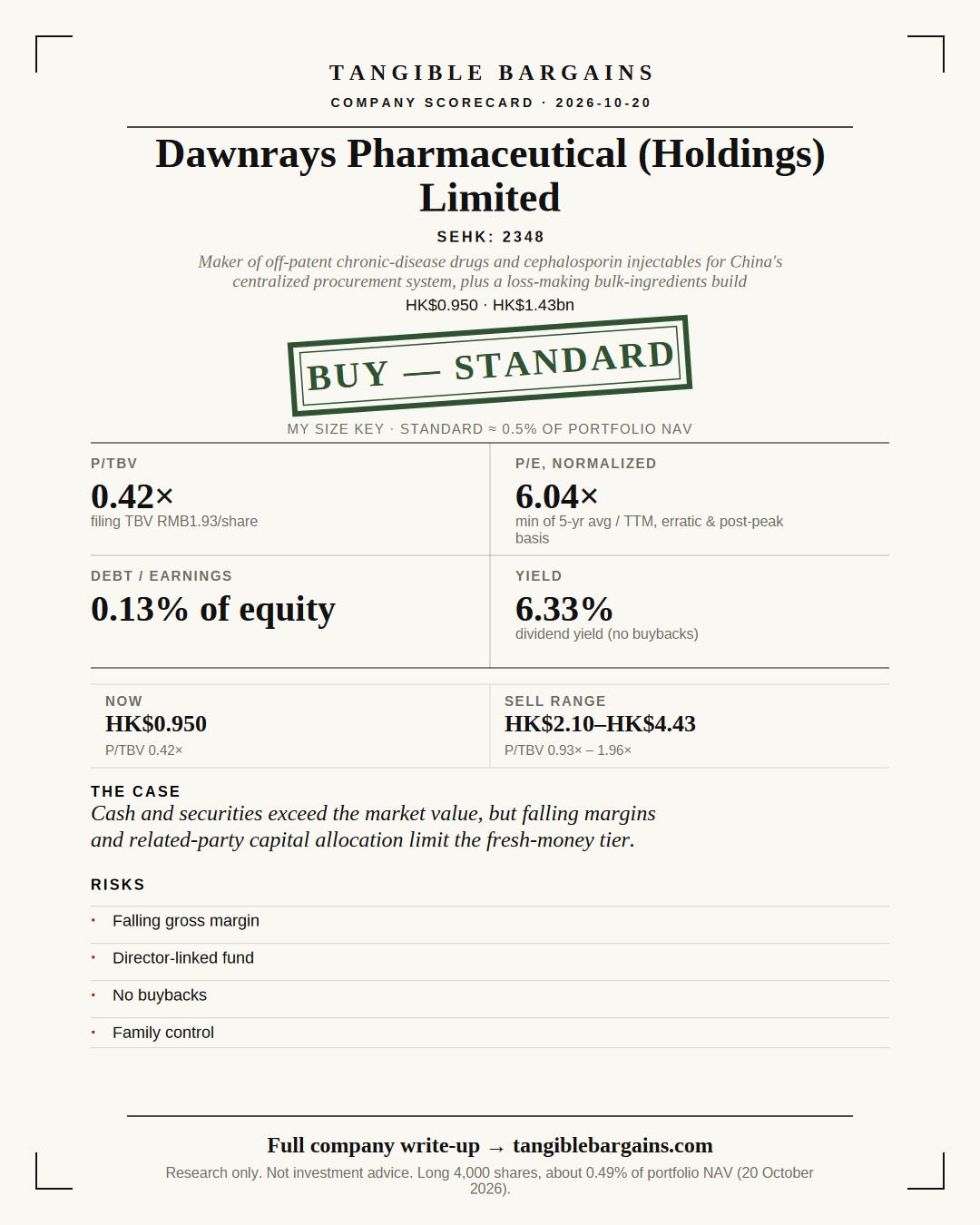
Verdict: BUY — STANDARD.
Actionable now: Yes — accumulate at ≤ HK$1.32 (price HK$0.950 as of 20 October 2026).
Position: Long 4,000 shares, about 0.49% of portfolio NAV (20 October 2026).
2. Argument
The short version
Dawnrays makes off-patent prescription medicines for mainland China, plus a loss-making bulk-ingredients business. At HK$0.950 on 20 October 2026, net cash and marketable securities still exceed the market value of the company. The shares are also below half of filing tangible book. This is asset-value cheap, not compounder cheap.
The operating business is moving the wrong way. First-half revenue fell 13.4%, gross margin has declined from 60.5% in FY2022 to 49.7% in FY2025, and the reported profit increase included a RMB21.1 million mark-to-market gain. The harder problem is who controls the cash. A family holds roughly 47% of the register, the ordinary dividend was cut 26%, and RMB100 million was committed to a fund linked to a sitting director's group without disclosure of the fees or carry.
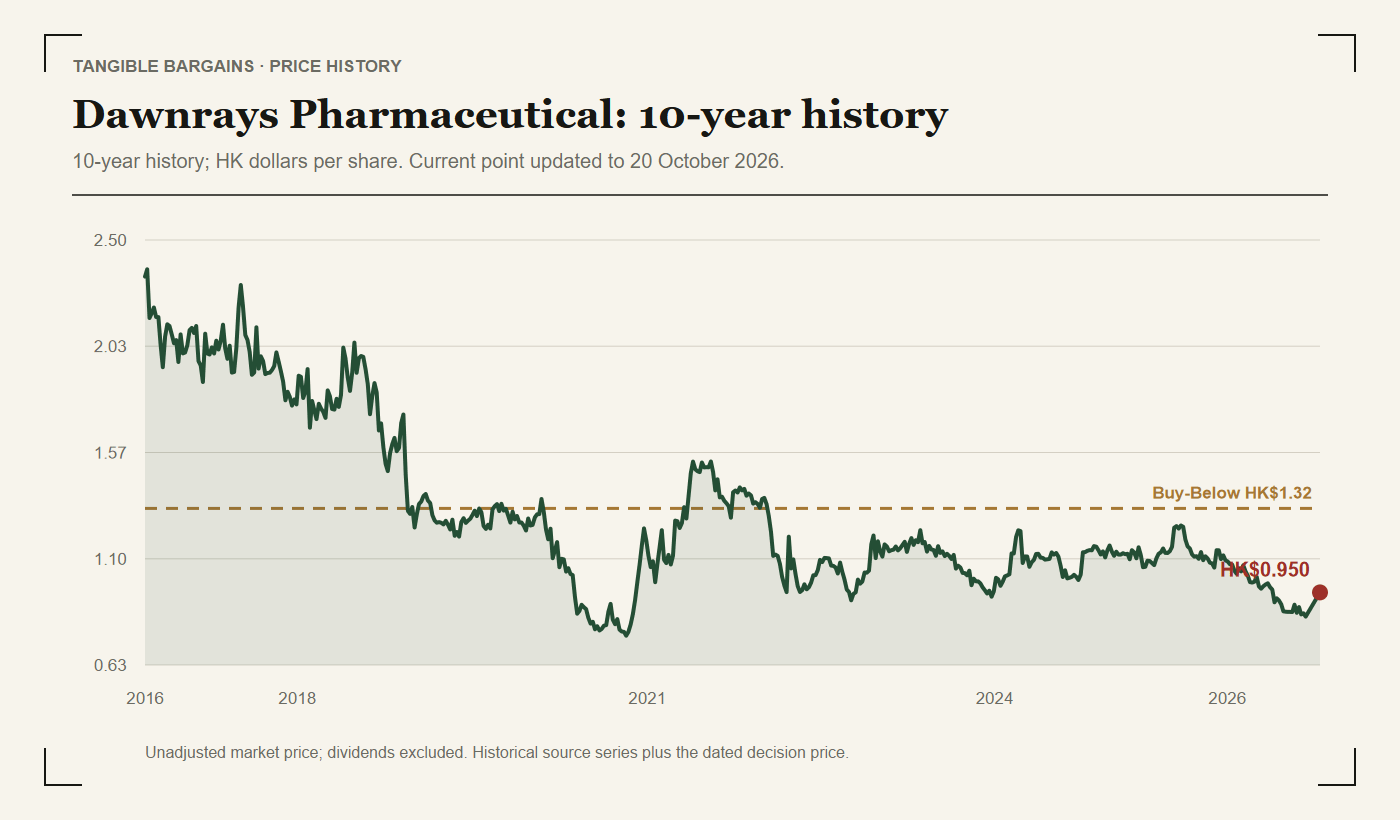
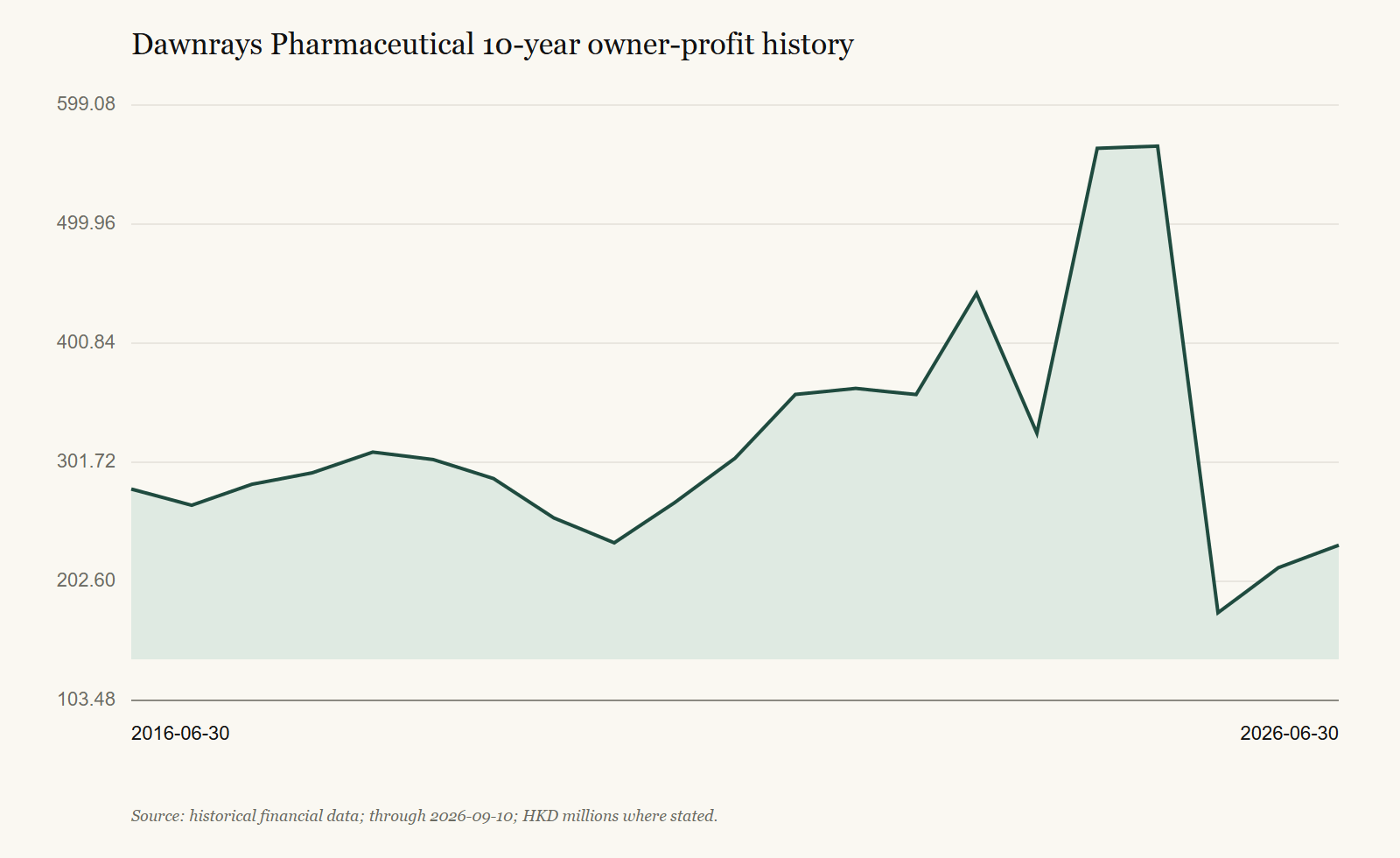
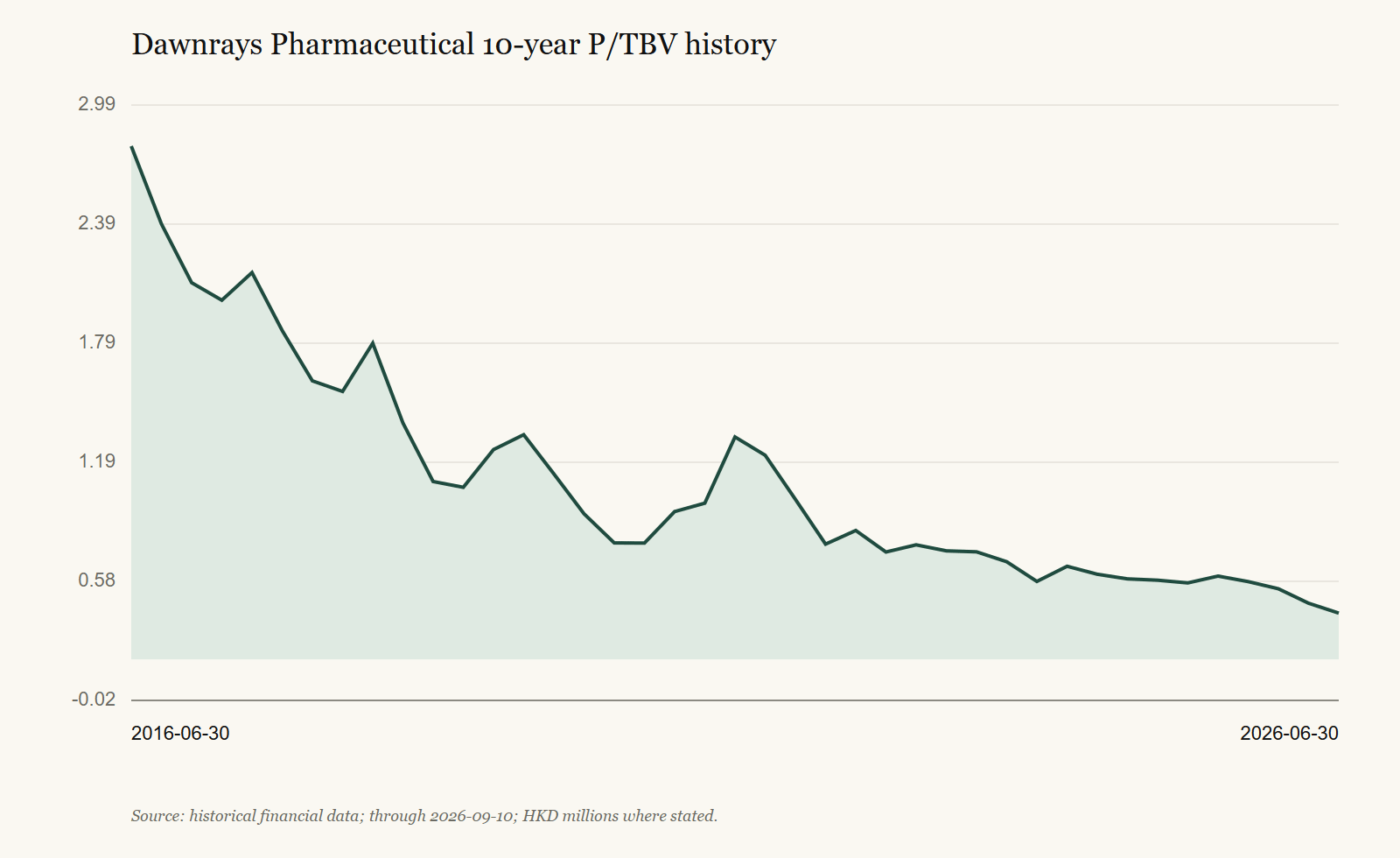
The 10-year history shows where the dated decision price sits. It is context for the valuation, not evidence that a fallen share must rebound.
What the pharmaceutical business actually sells
Finished prescription drugs produced 93.1% of first-half revenue. The main products are chronic-disease tablets, including antihypertensives and cholesterol medicines, plus cephalosporin injections and the antiviral Entecavir. Almost all sales are in mainland China. The buyer is ultimately the state-directed hospital and distribution system, so tender outcomes matter more than brand loyalty.
The remaining business makes pharmaceutical intermediates and bulk active ingredients. It supplied only RMB37.6 million of external first-half sales and lost RMB39.7 million at the segment level. Dawnrays invested heavily to integrate backward into these ingredients, but its unit costs remained above market and the promised cost advantage has not appeared. That is the operating mistake sitting beside the cash pile.
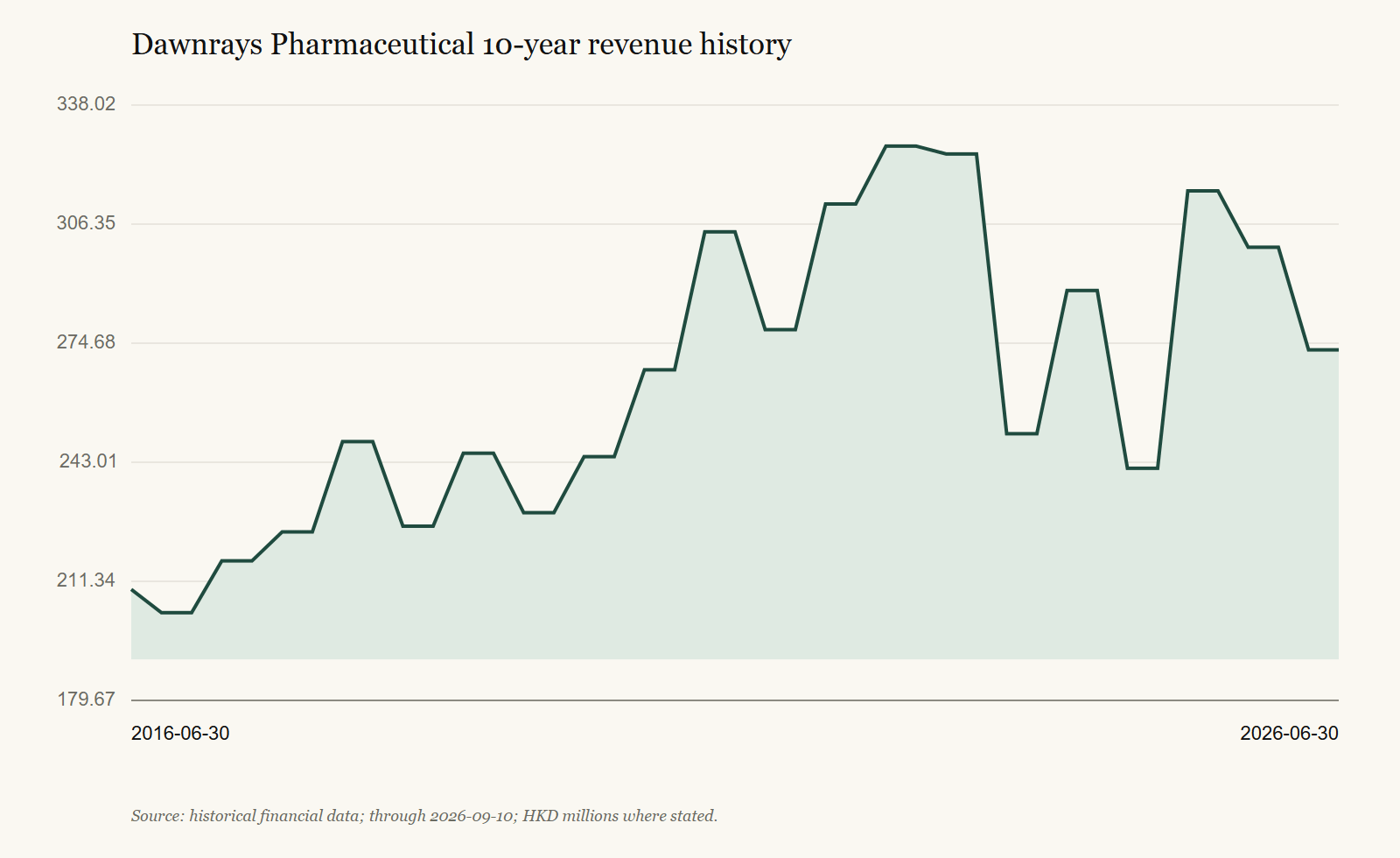
The control problem in one picture
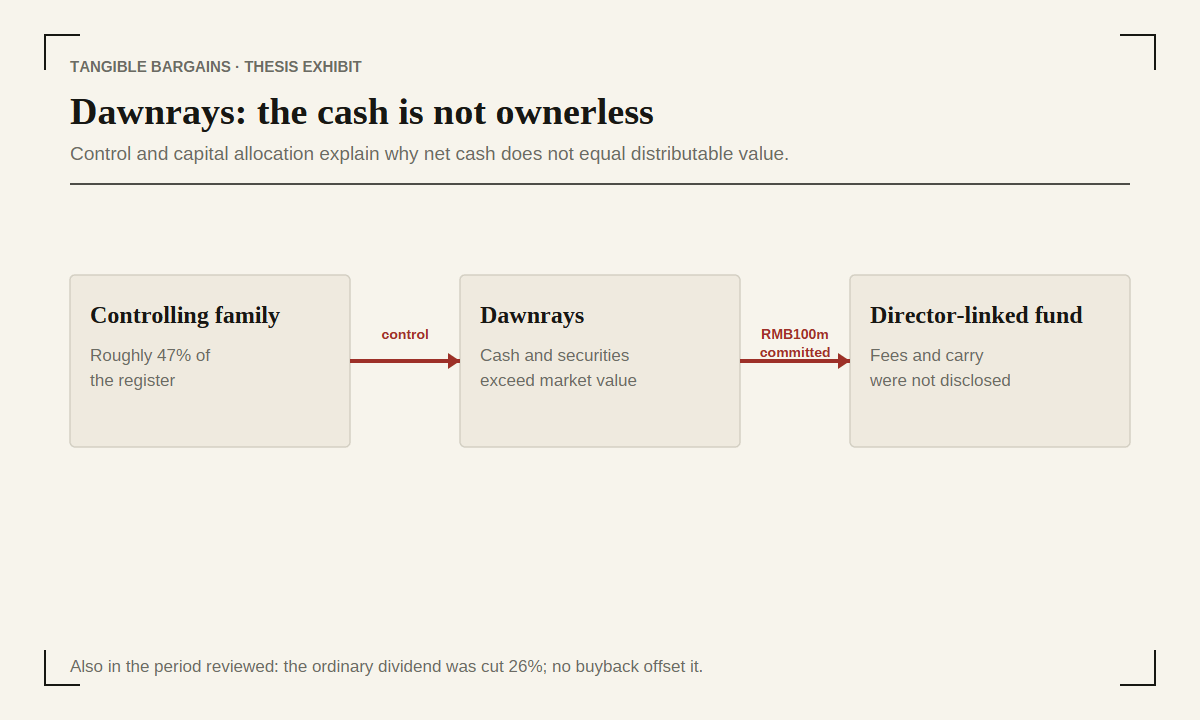
The balance sheet is liquid. The minority holder's claim on it is not frictionless.
Why it qualifies
Net cash and securities alone exceed the whole market capitalization, leaving enterprise value negative.
The shares trade at 0.421x tangible book, below the entire ten-year P/TBV history.
Net current asset value is RMB1.15 per share, above the current price after every liability is included.
The declared dividend yield is 6.33%, even though no shares have been repurchased.
The cash is strong; the earning power is weaker
The ten-year record separates the asset case from the business case. Centralized drug procurement has increased volumes for some products while repeatedly cutting prices. Gross margin fell from 60.5% in FY2022 to 49.7% in FY2025. First-half 2026 revenue fell 13.4%, and the reported profit increase depended partly on a RMB21.1 million mark-to-market gain rather than better drug economics.
The balance sheet can absorb that deterioration for a long time. Cash, deposits and securities exceed the market capitalization, borrowings are negligible, and net current asset value remains above the share price. The question is not solvency. It is whether management returns surplus capital before procurement pressure and low-return projects consume more of it.
Why it is not a clean bargain
Gross margin has fallen for four straight years as centralized procurement removes pricing power.
Several hundred million renminbi has gone into bulk-medicine capacity that is still loss-making three years later.
The ordinary final dividend was cut 26% while the balance sheet remained cash rich.
The company committed RMB100 million to a venture fund sponsored by groups connected to a sitting non-executive director, with fees and carry undisclosed.
A controlling family owns roughly 47% of the register, and the record does not commit it to returning the cash.
How a minority holder gets paid
The direct return is the 6.33% dividend. The cleaner route would be an actual repurchase under the existing 10% mandate, because buying stock below net cash would transfer value to the holders who remain. A sale or wind-down of the loss-making bulk-ingredients investments could also make the balance sheet more usable. If none of those happens, the minority holder is relying on mean reversion toward the stock's own book-value history while the controlling family continues to sit on the cash. The discount can close, but the record does not promise that it will.
The scorecard's sell range is RMB1.80 to RMB3.79, or HK$2.10 to HK$4.43. The lower end is the credible working exit because the historical median was earned when return on equity was about 12%, versus 6.3% in FY2025 and roughly 7.2% annualized in the first half of 2026. The top of the range requires an earnings recovery that has not yet appeared.
Family control makes realization uncertain. A cheap balance sheet is not the same as distributable cash when the controller can retain it, invest it in loss-making capacity, or route it into a fund with undisclosed economics. A buyback, a restored ordinary dividend, or an explicit capital-return policy would be more persuasive than another year of nominal book-value support.
What would change the view
An actual share repurchase under the 10% mandate.
A further dividend cut or a dividend suspension.
The next results showing bulk-medicine breakeven or another period of losses and inventory write-downs.
New disclosure about the RMB100 million fund commitment, its economics, or similar related-party investments.
Gross margin falling materially below the current level after another centralized-procurement round.
The shares reaching RMB1.80, or about HK$2.10, where the low end of the sell range becomes actionable.
Sources and gaps
The analysis uses the audited FY2025 report, the June 2026 interim announcement, meeting materials, and the company's own price history. The announcement behind the fund commitment could not be opened, so the transaction's full economics remain unavailable.
3. Numbers that matter
The June 2026 balance sheet showed RMB1,592 million of cash, deposits and marketable securities against a market value that was lower even after translating the Hong Kong share price. Filing tangible book was RMB1.93 per share. The current HK$0.950 price is about 0.42 times that anchor. Buy-Below is HK$1.32, the lower-quartile own-history entry capped below tangible book. The working Sell Range remains HK$2.10 to HK$4.43, but the low end is the credible exit while return on equity stays far below its old level. First-half revenue fell 13.4%, and the four-year gross-margin slide remains the operating fact to watch. The main sources are the audited FY2025 report, the June 2026 interim announcement, shareholder-meeting materials, and the company's price history. The fund announcement itself was not retrievable, so its economics remain an explicit gap.
Research only, not investment advice.