

1. Scorecard
2. Argument
The short version
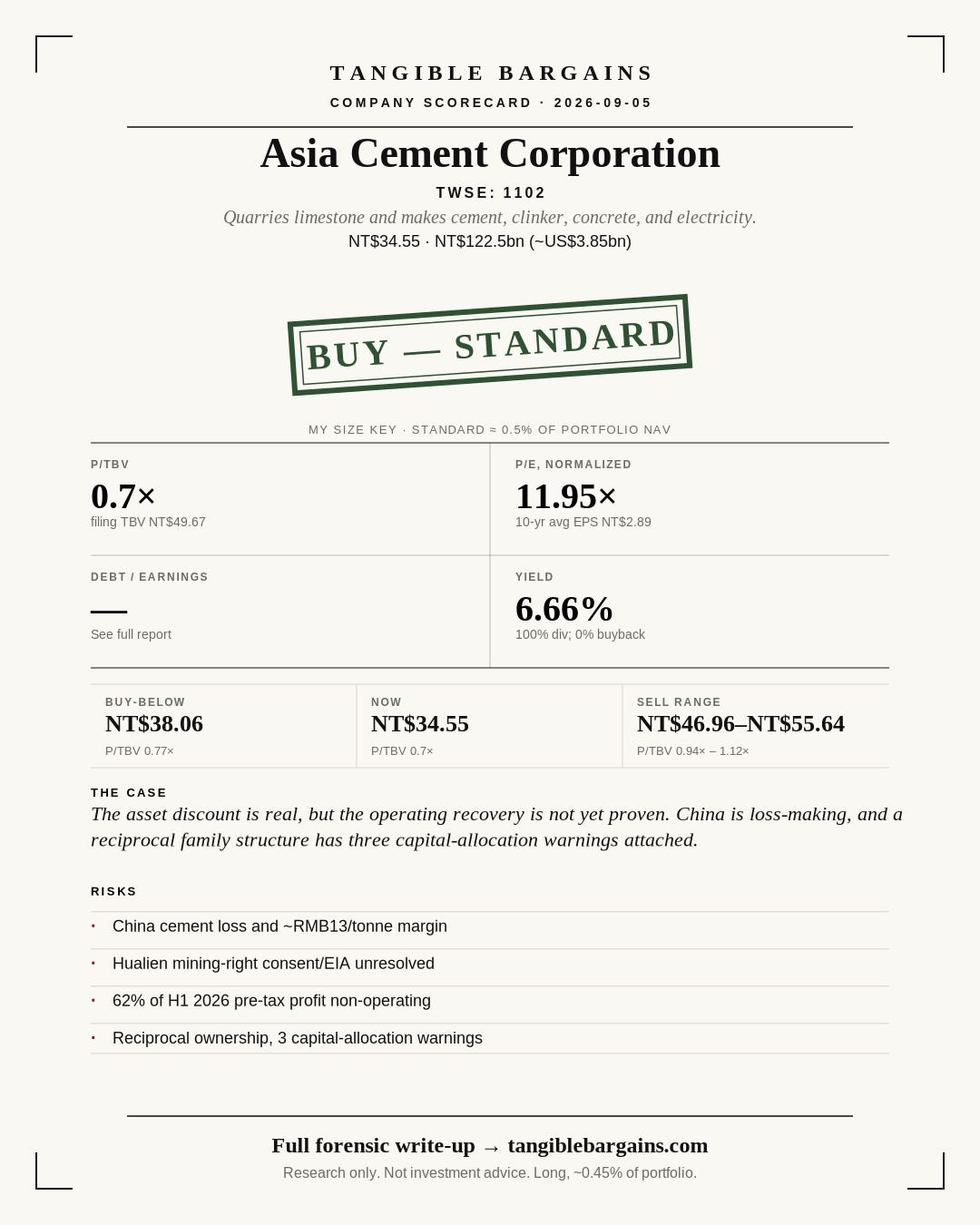
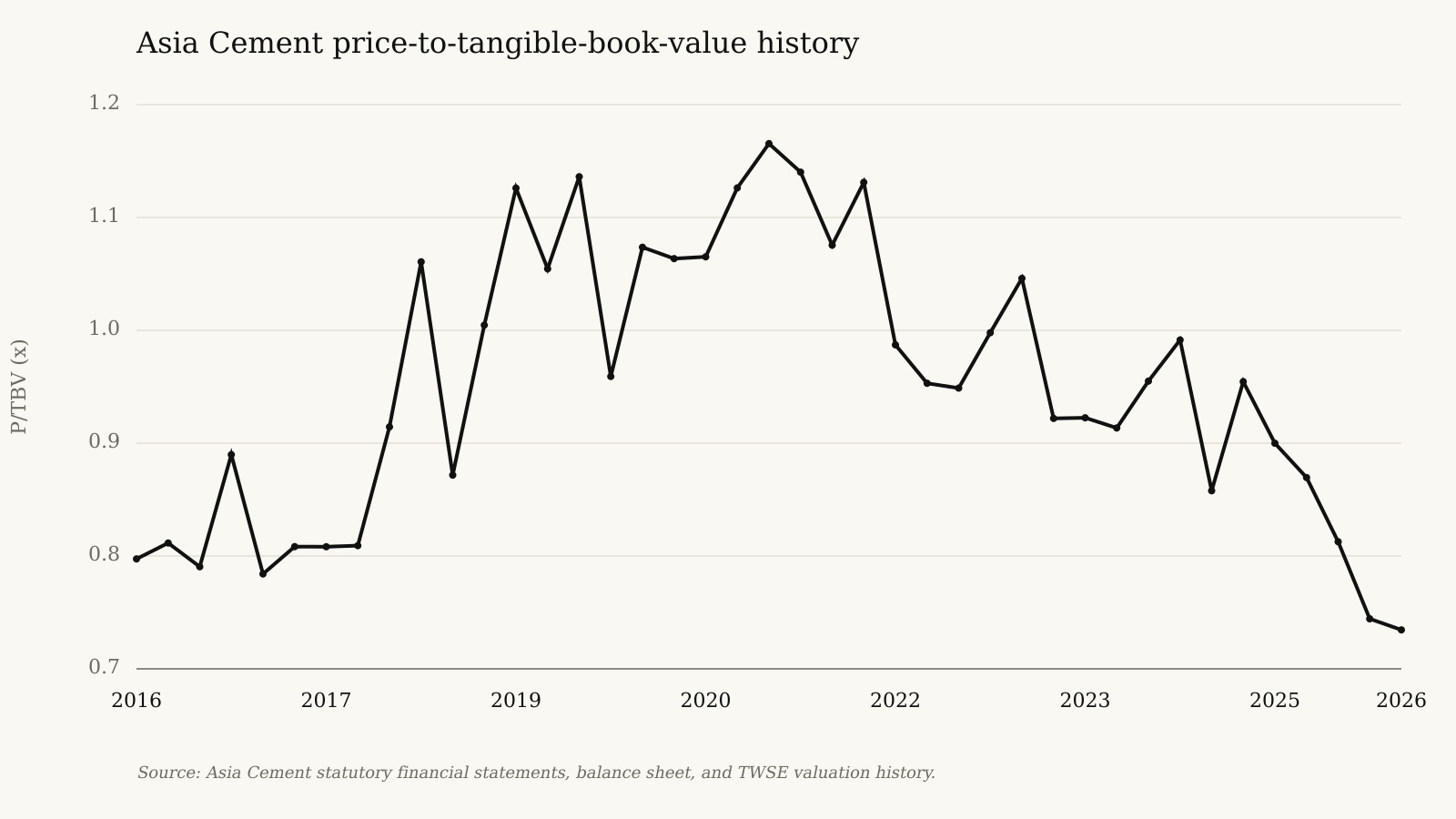
Asia Cement quarries limestone and makes cement, clinker, concrete, and electricity. At NT$34.55, it trades at 0.696x filing tangible book of NT$49.67, the lowest point in its 10-year history. The dividend yield is 6.66%, the company has never bought back a share, and the Piotroski F-Score is 7/9. Those are the numbers that got it onto the desk.
The catch is that the operating business earns only 5.6% on equity. China is loss-making, and 62% of first-half 2026 pre-tax profit came from outside operations. The Hualien mining-right consent and environmental review are unresolved, while a reciprocal family structure carries three capital-allocation warnings.
The verdict is BUY - STANDARD. Buy-Below is NT$38.06 from the stock's own history. The Sell Range is NT$46.96 to NT$55.64, but the lower end is the more credible exit unless return on equity recovers above roughly 9%.
Why it qualifies
Filing-derived tangible book is NT$49.67 a share against a NT$34.55 market price.
The 6.66% shareholder yield is entirely dividend, with no buybacks.
The Piotroski F-Score is 7/9, with all nine signals computable.
Cash and financial assets of about NT$97bn sit against NT$94.4bn of financial borrowings.
Why it is not a clean bargain
Return on equity fell from 12.0% in 2019 to 5.6% in 2025 while equity grew.
The Chinese cement operation is loss-making, with gross margin around RMB13 a tonne.
Non-operating income supplied 62% of first-half 2026 pre-tax profit.
The Hualien mining-right extension was revoked by final judgment, and the current consent and environmental review are not complete.
Reciprocal ownership and related-party capital use produce three capital-allocation warnings.
What would change the view
A sustained recovery in Chinese per-tonne gross margin from RMB13 toward the RMB25 needed for the base case.
Clear progress through the Hualien environmental review and Truku consultation.
Operating profit recovering while the share of non-operating gains falls materially.
The stock reaching NT$46.96, the low end of the Sell Range, where the sell question becomes live.
Sources and gaps
The analysis uses the company's FY2025 annual report, the Q2 2026 statutory filing, and exchange price history. Individual insider transactions for the last twelve months and an earnings-call transcript were unavailable. The Hualien permitting history is drawn from company materials and secondary reporting; the live Taipower matter is the smaller civil claim remanded in May 2025. See the full report for the source ledger, calculations, and complete diligence-gap log.
3. Backup and sources
This last layer is the full working file: every source, calculation, and gap, kept so the argument above can be checked. The scorecard and the argument are the synthesis. Open this only if you want to check the work.
Asia Cement Corporation (TWSE: 1102)
Published 5 September 2026. Analysis based on the 28 August 2026 close and the 30 June 2026 statutory balance sheet. Long, approximately 0.45% of portfolio.
Verdict: BUY — STANDARD
Asia Cement is cheap on tangible book, adequately covered by its dividend, and not yet earning enough on that book to deserve a large position. The investment case is an asset discount with a cyclical recovery option attached. The operating recovery is not proven.
1. Executive summary
Asia Cement quarries limestone and makes cement, clinker, ready-mixed concrete, and electricity. The group operates two Taiwanese plants, several mainland Chinese cement subsidiaries, a gas-fired independent power plant that sells electricity to Taiwan Power Company, and a substantial portfolio of listed and unlisted financial investments.
At NT$34.55, the shares trade at 0.696x filing tangible book value of NT$49.67 per share. That is the lowest point in the 41-observation, roughly ten-year P/TBV history used here. The declared FY2025 dividend of NT$2.30 gives a 6.66% yield. The company has never bought back a share. The Piotroski F-Score is 7/9.
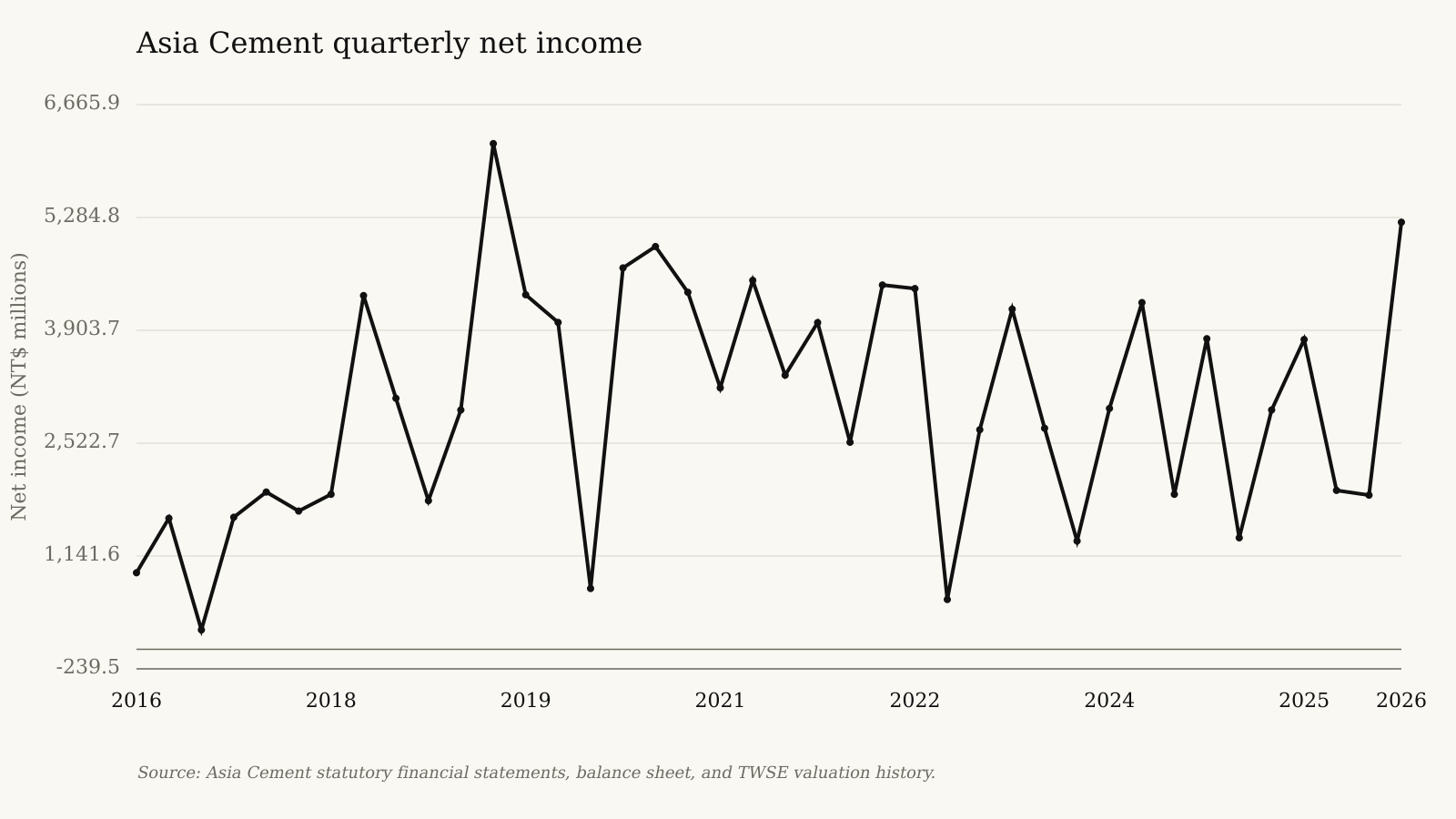
The cheapness is entirely an asset discount, not an earnings discount. Tangible book per share has risen from NT$35.68 at the end of 2016 to NT$49.67 today, but return on equity fell from 12.0% in 2019 to 5.6% in FY2025. Normalized earnings are NT$2.89 per share, producing an 11.95x normalized P/E. That sits inside the stock's historical earnings band, so the earnings leg is fair rather than cheap.
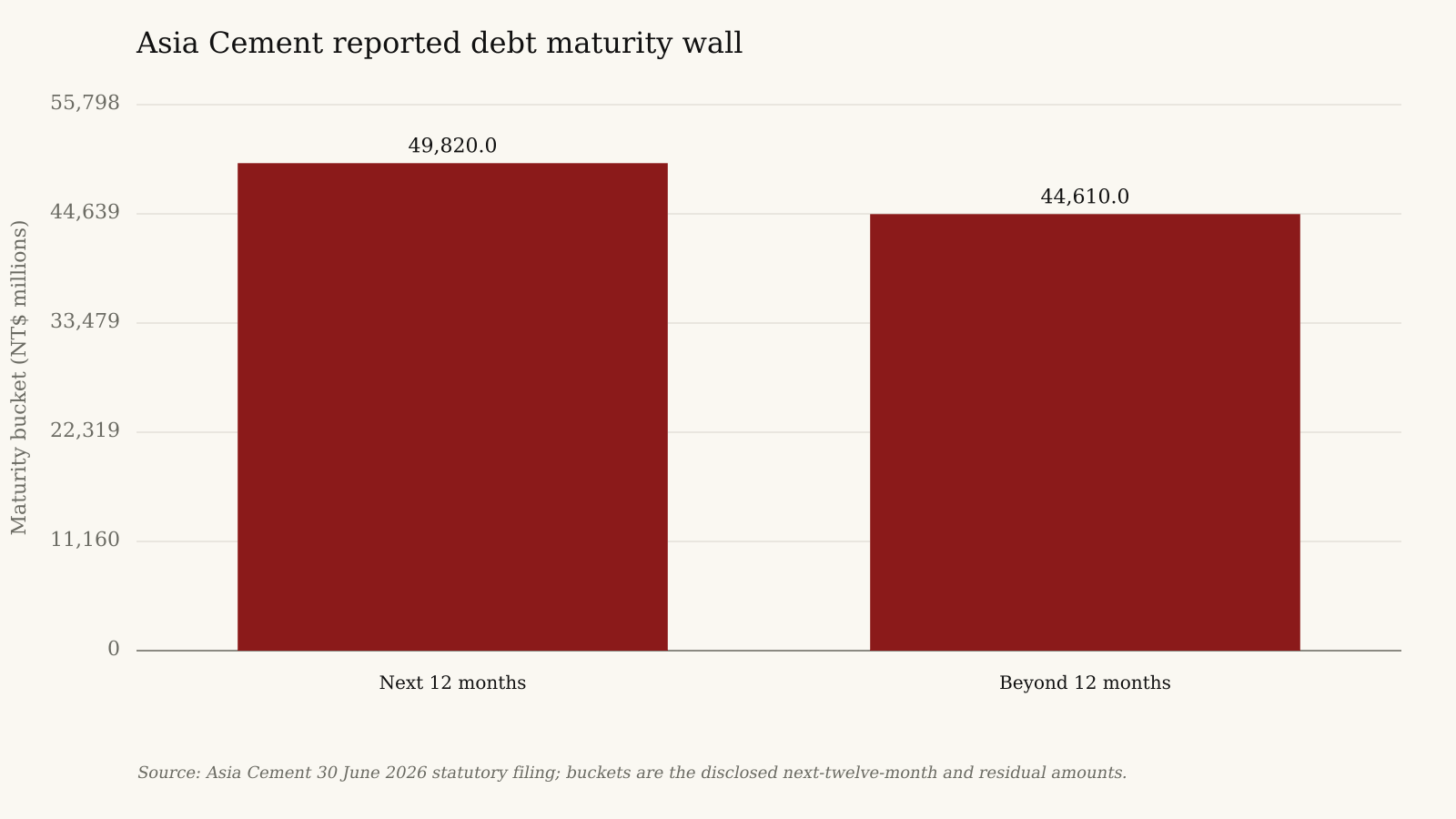
The balance sheet is conservative in aggregate. Financial borrowings are NT$94.4bn against NT$208.4bn of total equity, while cash and financial assets total NT$97.0bn. The refinancing risk is real because NT$49.8bn, or 53% of gross borrowings, matures within twelve months. The group has continued to issue domestic bonds, and the bonds trade close to carrying value.
The reasons to keep the position at Standard size are the Chinese cement loss, the unresolved Hualien mining-right consent and environmental review, the fact that 62% of first-half 2026 pre-tax profit came from outside operations, and a reciprocal family structure with three capital-allocation warnings. The stock can work from here, but the discount will not close by itself.
2. Business and market overview
At the parent-company level, cement and clinker account for 94% of sales. At the consolidated level, the group is more diversified. FY2025 segment revenue was approximately NT$46.7bn for Cement, NT$17.2bn for Power, NT$0.8bn for Investment, NT$0.3bn for Engineering, NT$2.1bn for Transportation, NT$3.4bn for Stainless steel, and NT$0.5bn for Leasing. Consolidated revenue was NT$71.0bn and segment result was NT$8.4bn.
The geographic split matters. FY2025 revenue was 65% Taiwan, 31% mainland China, and 4% elsewhere. Non-current assets were NT$55.8bn in Taiwan and NT$35.0bn in China. Taiwan Power Company was the only customer above the 10% disclosure threshold, taking NT$17.2bn, or 24% of consolidated revenue, from the Chia Hui Power plant under long-term capacity and energy contracts.
Taiwan's domestic cement market is protected by logistics and local production, but imports are taking share. Asia Cement sold 3.33 million tonnes domestically in 2025, equal to 33.8% of domestic producers' sales and 24.0% of island consumption. Imports reached 4.06 million tonnes, up 14.2%, and represented roughly 29% of consumption. A domestic duopoly therefore competes with a growing import channel.
Input and regulatory costs are moving against the business. The Hualien mineral tax increased from NT$10 to NT$70 per tonne, and the group has accrued a national carbon fee since 2025. The group is largely self-sufficient in limestone, but it buys slag, iron sand, gypsum, coal, and other inputs under a mixture of short- and long-term arrangements.
The consolidated balance sheet is more financial than industrial. Roughly NT$217bn of the NT$337bn asset base is cash, financial investments, equity-method investments, or investment property rather than kilns and other operating assets. That makes the asset base easier to value than the operating earnings stream. It also means the buyer is purchasing a securities-and-affiliates portfolio wrapped around a cyclical cement business.
3. Competitive position and industry cycle
Asia Cement's real advantages are limestone access, port and river logistics, and the scale of its Taiwanese production base. The Hualien plant sits beside the company's own limestone reserves and a deep-water port, and the group owns transportation subsidiaries. The Chinese plants also have access to captive limestone and river logistics.
The advantages are narrow. Cement is sold to specification, switching costs are low for ready-mixed customers, and Taiwan Power buys electricity under contract rather than because of a differentiated product. There is no meaningful network effect. Taiwan has the characteristics of an efficient-scale market, but the growing import channel is eroding that protection. China is a commodity market with structural overcapacity.
The return record confirms the limitation. Return on common equity was 12.0% in 2019, 10.0% in 2020, 9.6% in 2021, 7.5% in 2022, 6.4% in 2023, 7.1% in 2024, and 5.6% in 2025. Equity increased while the return earned on it declined. The moat classification is therefore Narrow. Asia Cement can preserve capital at acceptable rates, but it has not compounded that capital at attractive rates for the last several years.
The Chinese business is near a trough, but a trough is not a recovery. Consolidated gross margin was 29.8% in 2020 and 23.6% in 2021, fell to 13.0% in 2022 and 2023, and recovered only to 15.8% in 2025. First-half 2026 gross margin was 13.6%. Management commentary reported mainland per-tonne gross margin falling from approximately RMB40 to RMB13, with the Chinese cement operation moving from a NT$518m profit to a NT$386m loss. The group said national demand fell about 10% while its own volumes fell only 1% to 2%.
Taiwanese cement operating profit also fell 19% in the first half of 2026, as the domestic market contracted under selective credit controls. The recovery case needs mainland margin to move materially above RMB13 to RMB15 per tonne and needs Taiwan's logistics advantage to offset imports. Those are possible outcomes, not current facts.
4. Management, governance, and capital allocation
Douglas Tong Hsu has chaired Asia Cement for decades and also chairs the wider Far Eastern Group. Lee Kun-Yen is the responsible manager and Yang Yu-Ling is chief accounting officer. The chairman and chief executive are separate people and are not related according to the annual report.
The board elected in May 2026 contains ten directors and five independent directors. The previous board included eight institutional-investor directorships, all held by Far Eastern entities, alongside four independent directors. The chairman was returned. A third-party report says the chairman's son joined the board for the first time, but that detail was not confirmed in a filing reviewed for this report.
Three capital-allocation warnings are material:
Control without enough minority protection. Asia Cement owns 22.92% of Far Eastern New Century directly, or 31.24% including entities controlled by directors. Far Eastern New Century owns 19.89% of Asia Cement. The structure is reciprocal, and every non-independent seat on the prior board was held by a group entity. Five independent directors and functioning committees are meaningful mitigants, but they do not remove the conflict created by the cross-holding.
Capital routed to related-party or low-return uses. The group subscribed approximately NT$687m to related-party capital increases in FY2025 and donated NT$425m to a group university across FY2025 and the first half of 2026. The group also carries a large portfolio of securities and equity-method investments whose blended return is below the return shareholders would want from the asset base.
A recent dividend cut. The FY2023 dividend was NT$2.10, down from NT$2.30. Dividends have since recovered to NT$2.20 and NT$2.30, so this is not a distress pattern, but the cut falls inside a three-year review window.
The related-party note is extensive and says transactions are on terms equivalent to unrelated-party transactions. In the first half of 2026, related-party revenue was NT$2.09bn and related-party operating costs were NT$1.06bn. Related-party receivables rose from NT$1.03bn at the end of 2025 to NT$3.99bn at 30 June 2026, including NT$1.62bn owed by Far Eastern New Century. Asia Cement also held NT$5.87bn on deposit at Far Eastern International Bank and borrowed NT$720m from it.
The group has paid dividends every year examined and has never repurchased a share. The tradeoff is that retained capital has been directed into securities, related-party equity, Chinese capacity, and group guarantees. Endorsements and guarantees for subsidiaries totalled NT$49.5bn at the latest filing.
5. Ownership, subsidiaries, and joint ventures
Asia Cement had 3,546,562,881 ordinary shares outstanding at 30 June 2026. There is one class of ordinary share and one vote per share. The ten largest holders represented 40.21% of the register, while the residual free float was 59.79%.
The largest holder was Far Eastern New Century at 19.89%, followed by the Far Eastern Medical Foundation at 5.15%. Identifiable Far Eastern-affiliated holders inside the top ten represented approximately 30.9%. The ordering of several ETF and investment-company lines was inferred from the descending sequence in the annual report, but the counts reconcile to the reported top-ten total.
The share count needs care. Shares held by equity-method associates are treated as treasury shares for earnings-per-share purposes, which is why first-half 2026 basic EPS uses 3,339,502 thousand weighted shares rather than the 3,546,563 thousand issued. Dividends are declared on the full issued count. The FY2025 dividend totalled NT$8.16bn, equal to NT$2.30 multiplied by the issued shares.
The main operating entities are:
Asia Cement China Holdings, the consolidated Chinese cement platform, in which Asia Cement owns 67.73% directly and 72.27% including director-controlled entities.
Chia Hui Power, the gas-fired independent power plant and the borrower under the group's only disclosed financial covenant package.
Ya Tung Ready-Mixed Concrete, the Taiwanese downstream concrete business.
Yuan Long Stainless Steel, a wholly owned and loss-making stainless-steel business.
Far Eastern New Century, an equity-method associate and reciprocal holder of Asia Cement.
U-Ming Marine Transport, an equity-method associate that contributed materially to first-half 2026 earnings.
China Shanshui Cement, a minority equity-method investment carried at NT$15.24bn at the end of 2025. Its FY2025 share of loss was NT$812m.
Non-controlling interests were NT$23.94bn, or 11.5% of total equity, and sit mainly in the Chinese platform. Assets pledged for borrowings were NT$33.12bn, including NT$15.14bn of investment property and NT$6.99bn of equity-method investments.
6. Historical financial quality and normalized earnings
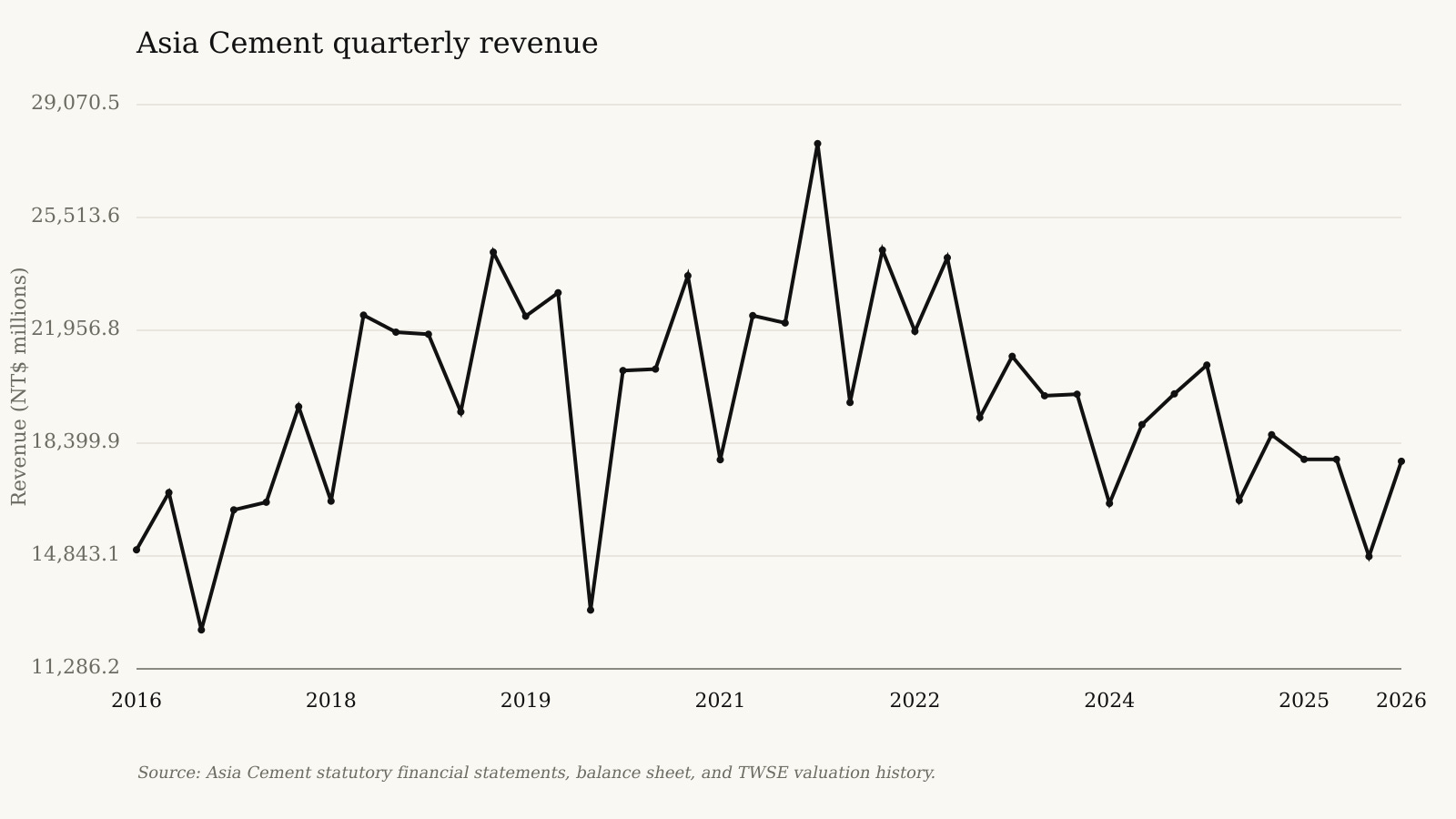
The long record is mixed. Revenue rose from NT$60.9bn in 2016 to a peak of NT$90.3bn in 2022, then fell to NT$71.0bn in 2025. Operating income was NT$22.1bn in 2019 and NT$8.4bn in 2025. Gross margin fell from 29.8% in 2020 to 13.0% in 2022 and 2023 before recovering to 15.8% in 2025.
Tangible book per share moved in the opposite direction. It increased from NT$35.68 at the end of 2016 to NT$49.09 at the end of 2025 and NT$49.67 at 30 June 2026. This is the central financial tension: the asset base grew while the operating return on that base deteriorated.
Cash conversion is adequate over a cycle but volatile. Free cash flow averaged approximately NT$13.5bn a year from FY2018 through FY2025. FY2025 operating cash flow was NT$16.84bn, capital expenditure was NT$4.04bn, and free cash flow was NT$12.80bn. The large annual swings come from working capital and the securities portfolio moving through operating cash flow.
A conservative owner-earnings calculation for FY2025 is net income attributable to owners of NT$10.03bn, plus depreciation of NT$3.90bn and amortisation of NT$0.27bn, less capital expenditure of NT$4.04bn. That produces NT$10.16bn, close to reported free cash flow. Maintenance capital expenditure is not separately disclosed, so using total capital expenditure is the conservative choice.
Normalized earnings are based on the ten-year average of profit attributable to owners. That average is NT$10.25bn, or NT$2.89 per share on the issued share count. The five-year average is 1.19 times the ten-year average, which is not enough to classify the earnings series as structurally growing. The normalized P/E is therefore 11.95x.
The quality issue is the earnings mix. Non-operating income and expense contributed 33% of FY2025 pre-tax profit, 50% of FY2024 pre-tax profit, and 62% of first-half 2026 pre-tax profit. First-half 2026 net profit attributable to owners rose 66% to NT$7.11bn while revenue fell 7%. NT$4.77bn of NT$7.66bn pre-tax profit came from outside operations. The reported earnings recovery is therefore a securities and associate-income recovery, not a cement recovery.
7. Piotroski F-Score
The Piotroski F-Score is 7/9 for FY2025 compared with FY2024. The company passed on positive net income, positive operating cash flow, cash flow above net income, lower leverage, improved liquidity, no dilutive issuance, and improved gross margin. It failed on return on assets and asset turnover.
The two failed signals describe the same problem. Revenue fell 6.9% and profit fell 22% against a balance sheet that shrank only 2.3%. This is a revenue and utilization problem, not a solvency, liquidity, accrual, or dilution problem. That is a better failure pattern than a score supported by deteriorating leverage or cash quality.
The score is useful but not decisive. It says the balance sheet and cash conversion are currently sound. It does not say that the Chinese cement business has recovered or that the group is allocating new capital at attractive returns.
8. Balance sheet, debt, and refinancing
Financial borrowings were NT$94.43bn at 30 June 2026. Lease liabilities were separately disclosed at NT$1.50bn and are not included in the financial-borrowing figure used for the absolute debt test. Financial borrowings were 45.3% of total equity and 28.0% of total assets. Cash and financial assets totalled NT$96.96bn, slightly more than gross financial borrowings.
The borrowing mix was approximately NT$33.4bn of short-term bank lines, NT$7.2bn of commercial paper, NT$6.6bn of long-term bank loans, and the balance in domestic unsecured bonds. Interest rates were generally between 0.60% and 2.46%.
FY2025 operating EBITDA was NT$12.57bn. It covered gross finance costs of NT$1.51bn by 8.3 times and net interest costs by 27.6 times after interest income. Those ratios support a Conservative balance-sheet classification, although gross interest coverage by itself is closer to Manageable.
The risk is rollover rather than immediate solvency. NT$49.82bn, or 53% of financial borrowings, matures within twelve months. The group issued NT$4.3bn of domestic bonds in the first half of 2026 and NT$18.8bn during FY2025, at 0.60% to 2.10%. The bonds were marked at NT$47.18bn against NT$47.30bn of carrying value, a small discount that suggests the domestic market remains comfortable with the issuer.
The only disclosed financial covenants sit at Chia Hui Power. The NT$10.5bn syndicated facility has a 150% total-liabilities-to-net-worth limit and a 1.5x principal-and-interest coverage requirement. Chia Hui's standalone statements were not obtained, so subsidiary-level headroom cannot be confirmed. The equivalent group-level liabilities-to-equity ratio was 61.9%, well inside the limit.
9. Real estate, leases, and hidden assets
Right-of-use assets were NT$5.12bn, or 2.9% of tangible book value, against lease liabilities of NT$1.50bn. They are disclosed but not stripped from tangible book value. At this scale, tangible book is not a lease illusion.
Investment property is more important. The balance was NT$39.20bn at 30 June 2026, or 22.3% of tangible book, and it is carried at appraised fair value rather than historical cost. The auditor treated the valuation as a key audit matter. There is no large hidden revaluation waiting to appear in book value. Much of the uplift is already present.
The property portfolio includes unleased land in Kaohsiung and Taipei valued using land-development analysis, plus leased property valued using discounted rental cash flows. First-half rental income was NT$242m, approximately a 1.2% annualized yield on the carrying value, and NT$154m of fair-value gains went through the income statement.
Taiwanese rules require cumulative net fair-value increases on investment property to be appropriated to a special reserve. That reserve was NT$67.61bn, or 36.7% of equity attributable to owners, and is reversible only as properties are used or sold. The fair value is real, but the reserve makes the full amount less immediately distributable than ordinary operating cash.
The asset composition is therefore a qualification on the value case. Cash and short-term investments were NT$76.74bn, long-term investments were NT$125.41bn, and owned property, plant, and equipment was NT$41.41bn. The tangible book is liquid in parts, appraised in parts, and operational in parts. It should not be treated as a single homogeneous pile of cash.
10. Legal, regulatory, and environmental matters
The Hualien mining-right issue is the largest asset-value risk. The extension was revoked by a final judgment in 2021. A 2023 amendment to Taiwan's Mining Act requires Indigenous consent and environmental impact assessment steps. The company has continued to describe extraction as possible within the existing mining land, but the consent and environmental process remains unresolved.
The risk is not only legal. Hualien supplies limestone to the Taiwanese operating base. A failure of the process could force imported clinker or other feedstock, reduce the value of the mining rights, and impair the economics of the plant. The current value case therefore assumes the process remains workable, not that the permit issue has disappeared.
Chia Hui Power also faces a revived civil claim from Taiwan Power Company. Taiwan Power's claim is approximately NT$767m plus interest, and the Supreme Court remanded the matter for rehearing on 12 May 2025 after Asia Cement's group company had won at earlier stages. No provision was judged necessary in the reviewed financial statements. The amount is manageable against group equity, but the claim is relevant because Taiwan Power is the plant's sole customer.
The Hong Kong High Court dismissed the claims against Asia Cement in the China Shanshui conspiracy action on 12 May 2025, with costs indicated on the indemnity basis. That matter is not a current thesis problem.
The group has also accrued a carbon fee. The balance was NT$23m at 30 June 2026 after the company was designated as a high-carbon-leakage business. The current amount is small, but the cost can rise as preferential treatment changes and carbon-reduction requirements tighten.
11. Accounting quality and diligence limits
The FY2025 audit opinion from Deloitte & Touche was unmodified. The audit identified substantive key audit matters, including expected credit losses on Chinese trade receivables and the valuation of investment property. The 30 June 2026 interim review carried a qualified conclusion covering entities holding 10.4% of group assets. That is not a finding of fraud, but it lowers the confidence that a reader should attach to every consolidated number.
The company does not disclose segment assets, liabilities, and capital employed in enough detail to calculate a clean cement-only return on capital. The group-level return record is therefore more reliable than any claim about the standalone economics of the Taiwanese cement plants.
Several diligence limits remain:
Individual dated insider trades for the last twelve months were not obtained. The annual report provides shareholding comparisons over a longer period, including a small personal sale by one director, purchases by another director, and stable or rising institutional positions.
An earnings-call transcript was not obtained. Management's comments on per-tonne margins and demand came from secondary coverage of the August 2026 investor conference.
Chia Hui Power's standalone financial statements were not obtained, so covenant headroom is stated at group level as a proxy.
FY2016 and FY2017 gross profit and operating income were not used because the older presentation could not be independently reverified. Revenue, net income, equity, and tangible-book figures for those years did reconcile.
The reported first-time appointment of the chairman's son was not confirmed from a primary filing.
These gaps affect diligence confidence, not the arithmetic of the current P/TBV, normalized EPS, dividend yield, or balance-sheet figures used in the decision.
12. Valuation and decision points
The tangible-book calculation is straightforward. Equity attributable to owners was NT$184.42bn. Goodwill of NT$2.61bn and other intangibles of NT$5.66bn were deducted, leaving tangible book value of NT$176.16bn. Dividing by 3,546.563 million issued shares gives NT$49.6706 per share. At NT$34.55, the stock trades at 0.696x P/TBV.
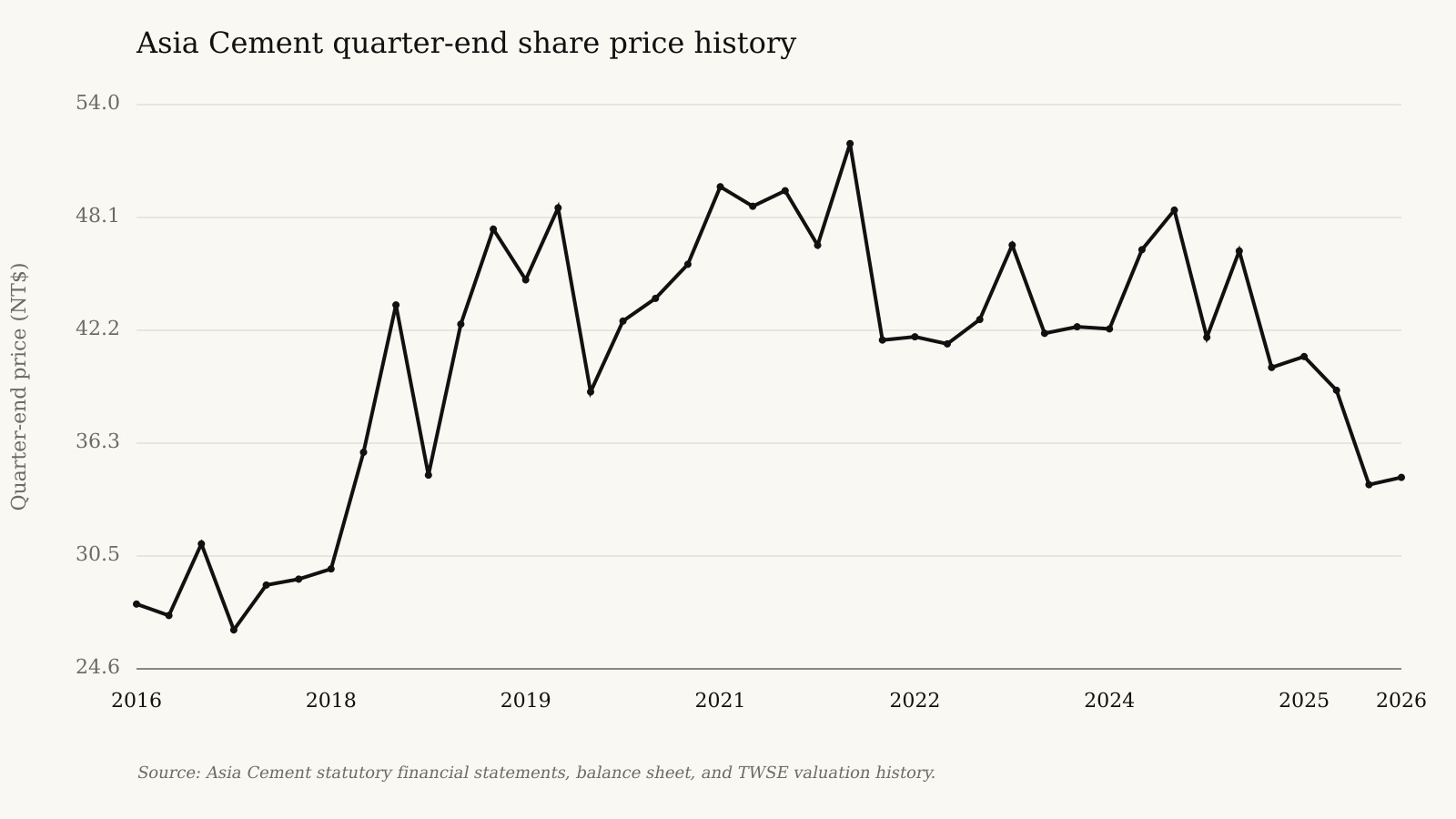
The P/TBV history contains 41 quarterly observations over roughly ten years. The lower-quartile mean is 0.766x, the median is 0.945x, and the upper-quartile mean is 1.120x. The current ratio is below the lower-quartile mean and below the historical median. This is a real asset discount, not a rounding artifact.
The earnings leg is less generous. Normalized EPS is NT$2.89 and normalized P/E is 11.95x. That is inside the stock's historical earnings band. Trailing P/E is lower at 9.54x, but trailing profit is flattered by the non-operating gains described above. The current earnings multiple should therefore not be treated as evidence that the operating business is unusually cheap.
The current decision figures are:
Buy-Below: NT$38.06, equal to 0.766x tangible book. This is the lower-quartile mean of the company's own P/TBV history and is the appropriate company-relative entry reference.
Buy More Below: NT$32.29, equal to 0.65x tangible book. This is the deeper fresh-money level for a larger position under the valuation grid.
Sell Range: NT$46.96 to NT$55.64, equal to 0.945x to 1.120x tangible book. The lower end is the more credible exit while return on equity remains around 5.6%. The upper end becomes defensible only if return on equity recovers above roughly 9%.
The stock's operating enterprise value is less flattering. Market capitalisation of approximately NT$122.5bn, plus NT$94.4bn of borrowings, less NT$97.0bn of cash and financial assets, produces an enterprise value near NT$119.9bn. Against FY2025 operating EBITDA of NT$12.6bn, that is roughly 9.5x. A cement business at a cyclical low is not obviously cheap on this measure. This is why the book discount supports a Standard position rather than a concentrated one.
The peer comparison points in the same direction. On the exchange's conventional book-value measure, the other Taiwanese cement major traded near 0.79x book with a 3.29% dividend yield and no meaningful trailing P/E, while Asia Cement traded near 0.66x book with a 6.66% yield and a 9.54x trailing P/E. Asia Cement is cheaper and more income-covered, but the discount is partly the market's response to its lower operating returns and more complicated asset structure.
13. Risk review
Hualien mining rights. Severity is High and probability is Medium. Failure of the consent and environmental process could impair up to NT$5.28bn of mining rights and disrupt the limestone feed for the Taiwanese plants. The mitigants are the company's claim that extraction can continue within existing mining land and its stated reserve life. Monitor consent meetings, environmental milestones, and any renewed approval.
Chinese cement and receivables. Severity is High and probability is High. The Chinese cement operation was loss-making in the first half of 2026, with per-tonne margin falling to approximately RMB13. Mainland property weakness also makes trade-receivable losses a live accounting risk. Monitor per-tonne margin, volumes, receivable ageing, and new expected-credit-loss charges.
Dependence on non-operating gains. Severity is High and probability is High. Non-operating items supplied 62% of first-half 2026 pre-tax profit. A flat securities market or weaker associate income would pull reported earnings back toward the lower normalized base. Monitor the operating versus non-operating split every quarter.
Reciprocal ownership and related-party capital use. Severity is Medium and probability is High. The cross-holding and related-party transactions can direct capital toward group objectives rather than the highest-return use for Asia Cement shareholders. Five independent directors and formal committees help, but the structure remains a permanent governance discount. Monitor new share subscriptions, donations, related-party receivables, and changes in the cross-holding.
Refinancing. Severity is Medium and probability is Low under current conditions. More than half of borrowings mature within twelve months, but the group has cash and financial assets exceeding gross borrowings and has continued to issue domestic bonds. Monitor bond coupons, commercial-paper rates, short-term bank lines, and the next refinancing cycle.
Investment-property valuation. Severity is Medium and probability is Medium. A 20% reduction in the NT$39.2bn investment-property portfolio would reduce tangible book value by roughly NT$2.2 per share. The independent appraisal and special reserve are mitigants, but fair value is not the same as cash received. Monitor annual appraisal assumptions and comparable land prices.
Power-plant customer concentration and litigation. Severity is Medium and probability is Medium. Taiwan Power accounts for 24% of consolidated revenue, and the Chia Hui civil claim remains in rehearing. The claim is modest against group equity, but a contract or tariff dispute would matter more than the claim amount alone. Monitor the rehearing and power-tariff policy.
Taiwan imports and carbon costs. Severity is Medium and probability is High. Imports were roughly 29% of 2025 consumption and rose 14.2%. Carbon fees are small today but can rise. Monitor import volumes, domestic cement pricing, the carbon-fee rate, and the company's blended-cement programme.
14. Final recommendation and watch list
BUY — STANDARD. Asia Cement is a reasonable purchase at NT$34.55 because the tangible book is real, the balance sheet is sound in aggregate, the dividend is meaningful, and the shares trade below the lower end of their own P/TBV history. The stock is not a large-position candidate because the operating return is weak, China is loss-making, much of current profit is non-operating, and the ownership structure creates a permanent minority-shareholder concern.
The practical framework is simple. Buy-Below is NT$38.06. A deeper fresh-money level is NT$32.29. If the shares reach NT$46.96, the sell question becomes live. Hold for the upper end near NT$55.64 only if return on equity has recovered above roughly 9% and the Chinese operation is earning rather than consuming capital.
The most important items to watch are:
Chinese cement margin per tonne, especially any move above the RMB13 to RMB15 floor toward RMB25.
Huanggang Line 2, scheduled to start in the third quarter of 2026, and the remaining Chinese capital programme.
The Hualien consent and environmental-review process.
The Taiwan High Court rehearing of the Chia Hui and Taiwan Power claim.
The operating versus non-operating split of third-quarter 2026 profit.
Mainland receivable ageing and expected-credit-loss charges.
Related-party receivables, especially the NT$1.62bn owed by Far Eastern New Century.
Any new related-party share subscription, group donation, or change in the reciprocal cross-holding.
The next domestic bond issue and the rollover of NT$33.4bn of short-term bank lines.
The FY2026 dividend decision expected in March 2027.
Sources and methodology note
The primary financial sources were the Asia Cement 2025 annual report, the 30 June 2026 interim statutory filing, and the FY2025 audited statutory filing. Price history and exchange valuation data came from the Taiwan Stock Exchange daily data and per-stock valuation data. The company's mining-right FAQ was also reviewed. Management's per-tonne margin commentary and the Hualien chronology were checked against secondary coverage and are identified as such in the relevant discussion.
This report is research, not investment advice. The author is long Asia Cement, approximately 0.45% of portfolio.