

1. Scorecard
2. Argument
The short version
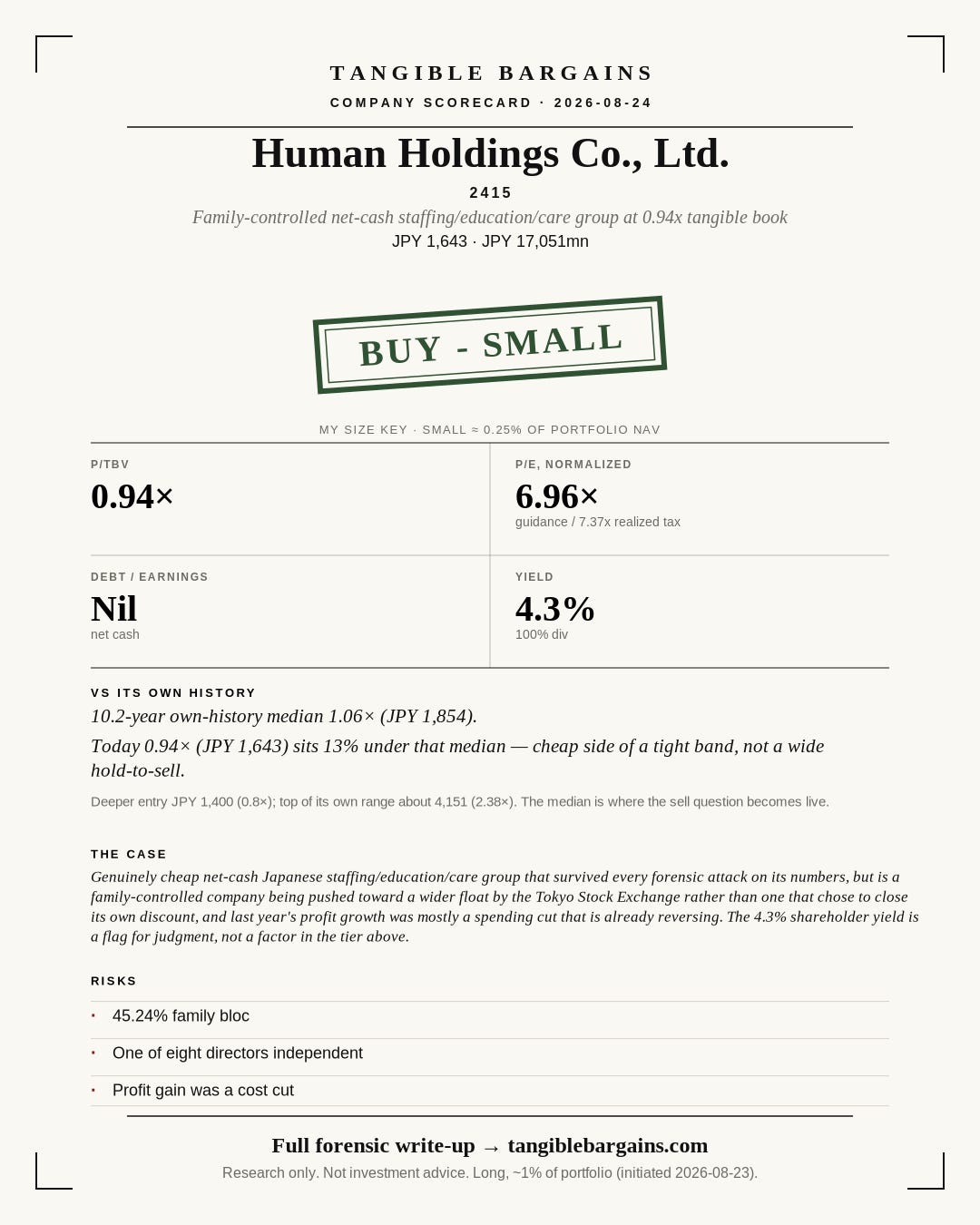
Human Holdings runs three Japanese service businesses under one holding company: staffing, for-profit education, and elder care. At ¥1,643 the shares trade at 0.941x tangible book value, with net cash equal to roughly 116% of the market capitalization and a 4.3% dividend yield. The report's forensic checks turned up no deferred-revenue manipulation, no receivables stretch, no hidden lease liability, and no goodwill inflating the tangible-book number.
The company is controlled by the Sato family, a confirmed 45.24% bloc that could run as high as 60.45% once several unconfirmed corporate vehicles are counted. Only one of eight board seats is independent, below the exchange's own governance minimum. For roughly two years the company operated under a formal Tokyo Stock Exchange plan to widen its tradable-share ratio after it fell short of the requirement, using a self-tender and a share cancellation sourced specifically from officers and their relatives. That plan was confirmed complete as of March 2025.
Last year's profit growth was also thinner than the headline suggests. Net income fell even as revenue and operating profit rose, mostly because the effective tax rate rose 8.3 points. Most of the operating-profit gain came from cutting advertising and bonus spending, and that cut is already reversing this year.
Why it qualifies
Trades at 0.941x tangible book value, with net cash worth about 116% of the market capitalization.
No dilution of any kind, and capital allocation has been share-reducing: 609,201 shares, 5.5% of the register, were cancelled in December 2023.
Revenue recognition passed every test run against it: contract liabilities, receivables, and days-sales-outstanding all behaved normally.
Goodwill is negligible, and as a Japanese GAAP filer the company carries no capitalized lease liability inflating tangible book.
A 4.3% dividend yield, backed by 47.3x interest coverage on a company with far more cash than debt.
Why it is not a clean bargain
A confirmed 45.24% family ownership bloc, possibly as high as 60.45%, with only one independent director out of eight, below the exchange's own governance minimum.
The company's float-widening moves were compelled by a Tokyo Stock Exchange listing rule, not chosen voluntarily, and the shares used in the 2023 self-tender came specifically from officers and their relatives.
117% of last year's operating-profit increase came from cutting advertising and bonus spending rather than the underlying business, and the bonus cut is already reversing.
The effective tax rate rose 8.3 points last year, and next year's guidance implicitly assumes it partly comes back down.
Officer compensation was never read, and the note that otherwise clears related-party dealings specifically excludes director pay by rule.
Funded debt rose 14.6% in a single quarter with no explanation found, and the filing that would clarify it could not be retrieved.
What would change the view
The next two quarterly results tested against management's full-year guidance, especially whether the tax rate and the reversing bonus cut behave as guided.
Retrieval of the officer-compensation section of the annual filing, currently unread.
Retrieval of the quarter's detailed results filing, which would explain the 14.6% rise in funded debt.
Confirmation of whether the four unnamed corporate vehicles holding a combined 12.06% are affiliated with the family, which would move the real control stake toward 60.45%.
Any tender offer, buyout proposal, or renewed listing-conformance issue involving the company.
Sources and gaps
The full report draws on the company's own annual and interim filings and two primary exchange notices. Several items remain unread or unconfirmed, including officer compensation, the newest quarterly filing, and the identity of some large shareholders. Where a fact could not be confirmed, the full report says so directly rather than estimating it.
3. Backup and sources
This last layer is the full working file: every source, calculation, and gap, kept so the argument above can be checked. The scorecard and the argument are the synthesis. Open this only if you want to check the work.
Company: Human Holdings Co., Ltd. (ヒューマンホールディングス株式会社) Ticker: 2415, Tokyo Stock Exchange, Standard Market As of: August 24, 2026, price ¥1,643 (Aug 24, 2026 close) Verdict: BUY - SMALL — a mechanical readout, not a recommendation. The base P/TBV × normalized-P/E cell alone, unmodified. The shareholder-yield and governance signals are reported as flags for a human to weigh, never applied to the tier. Tier and sizing are a human judgment call; see Position Disclosure below. Buy-Below: ¥1,400 (0.80× tangible book, 10.2-yr own-history) — see the valuation discussion below. Sell Range: ¥1,854 – 4,151 (1.06× – 2.38× tangible book). The top of this range reflects a valuation era the stock has not approached in over five years; read the annotation below before treating it as a near-term target. Add-More Trigger (held position): ¥1,393 (0.80× tangible book), a review price for adding, not a mechanical trigger. Position: Long, ~1% of portfolio (initiated 2026-08-23). Moat: None / Weak (staffing is a commodity; education is a fading legacy segment with two growing niches; nursing care is regulated utility-like). Balance-sheet risk: Net Cash (Conservative). Accounting quality: Adequate, with named gaps discussed below. Governance risk: High (family bloc 45.24%, possibly to 60.45%; one outside director of eight, below Corporate Governance Code Principle 4-8's minimum of two).
Primary sources reviewed: the FY2026/3 annual securities report (Yūhō), filed with EDINET June 24, 2026; the half-year securities report for H1 FY2026/3, filed November 14, 2025; the FY2026/3 full-year kessan tanshin results, filed May 15, 2026, including FY2027/3 guidance; the TSE listing-conformance plan (filed 2023-05-15) and the listing-conformance achieved notice (filed 2025-04-24), both retrieved and read in full; large-shareholding change reports No. 8 (2023-03-16) and No. 11 (2024-06-26), from secondary coverage, primaries not opened; the company's IR site, EDINET-sourced structured extraction, IRBank, and a second source for FY2027/3 guidance. Data quality: GOOD, with a named cap. No primary filing for the exact buyback share counts, the distribution prices, or the Q1 FY2027/3 tanshin was opened; see the sources and diligence-gap discussion at the end of this report.
Human Holdings Co., Ltd. (TSE: 2415) — Value Investing Analysis
1. Executive Summary
Human Holdings is a Japanese holding company running three businesses: staffing/HR services (59% of sales, ~89% of segment profit), for-profit education (26% of sales, the weak link), and elder-care services (13% of sales, small but improving). At ¥1,643/share it trades at 0.941x tangible book value, ~6.96x forward earnings on guidance (7.37x on last year's realized tax rate), and a 4.3% dividend yield, with net cash of ¥19,775.1mn — roughly 116% of its ¥17,051mn market capitalization. That is a genuinely rare setup for a profitably operating, dividend-paying business, and every forensic attack the adversarial panel could run against the reported numbers failed: no deferred-revenue manipulation, no receivables stretch, no capitalized-cost flattery, no hidden lease liability or goodwill inflating tangible book, no dilution. The cheapness is real.
The story around those numbers is materially different from a first read of the filing alone. This is a controlled company — a confirmed 45.24% family bloc, potentially as high as 60.45% depending on the affiliation of several corporate vehicles that could not be confirmed — with only one outside director on a board of eight, below the Corporate Governance Code's minimum of two. For roughly two years (2023–2025) the company operated under a formal Tokyo Stock Exchange continued-listing conformance plan, because its tradable-share ratio (~21%) sat below the 25% requirement for the Standard market. A self-tender in autumn 2023 acquired ~500,000 shares from officers and their relatives; a December 2023 cancellation retired 609,201 shares (5.5% of the register); and two further off-auction distributions of insider stock followed in 2024. All three actions are named in the company's own primary filings as the mechanism for curing the shortfall, and a follow-up filing confirms conformance was achieved as of 2025-03-31, at a 26.9% tradable-share ratio. The exchange-driven pressure is therefore spent, not live — but the point stands that for two years the only thing that ever moved this company's ownership structure came from the exchange, not from the company choosing on its own initiative to widen its float or reduce family control.
Earnings quality is also weaker than a surface read suggests. Reported net income fell 15% in FY2026/3 despite revenue, operating profit, and ordinary profit all rising — but the mechanical driver isn't purely one-off items. The effective tax rate rose 8.3 points (28.25% → 36.62%) on structural items (subsidiary rate mix, a larger valuation allowance, loss of a carryforward benefit) that FY2027/3 guidance implicitly assumes will partly reverse; on last year's actual tax rate, forward P/E is 7.37x, not 6.96x. Separately, 117% of last year's operating-profit improvement is accounted for by cuts to advertising and the bonus provision — underlying costs actually rose faster than gross profit — and the Q1 FY2027/3 operating-profit decline (~5.9%) is that bonus line reversing.
On balance: a genuinely cheap, balance-sheet-clean, dividend-paying business, wrapped in a governance structure that has shown exactly one mechanism for change (exchange compulsion, now apparently resolved) and an earnings trend that is more mixed than the headline suggests. The mechanical BUY - SMALL readout reflects the price and quality inputs alone (P/TBV, normalized P/E); the dividend yield and the governance risk are both stated above as separate flags, not folded into the tier — what that's worth to you, and at what size, is a human judgment call.
2. Post-Filing Events Bridge
2023-05-15 (TDnet, primary, retrieved 2026-08-24): filed a formal TSE continued-listing conformance plan. Tradable-share ratio was 20.85% against the 25.00% Standard-market requirement; the remedy was urging officers and relatives within two degrees of kinship to gradually sell holdings, targeting conformance by March 2025. This reframes every capital-structure move that follows as compliance-driven, not discretionary. Materiality: High.
2023-09-11 to 2023-10-10 (secondary aggregator; population confirmed by the 2025-04-24 primary): a self-tender acquired roughly 500,000 shares from company officers and their relatives within two degrees of kinship, at roughly 0.68x book, around ¥457mn, with no financial-statement impact until cancellation. Corroborated multiple ways, though exact terms are not primary-sourced. Materiality: High.
2023-12-22 (secondary aggregator, TDnet index title): cancellation of 609,201 treasury shares, the roughly 500,000 just acquired plus roughly 109,201 pre-existing, reducing issued shares from 10,987,200 to 10,377,999, a 5.5% reduction. Share-reducing capital allocation. Corroborated; the primary PDF was not opened. Materiality: High.
2024-06-21 (secondary aggregator): an off-auction distribution of 518,300 shares (roughly 5.0% of issued) by officers and relatives at ¥1,349, a 1.96% discount to market, a further float-widening step in the conformance plan. Corroborated; the primary PDF was not opened. Materiality: Medium.
2025-04-24 (TDnet, primary, retrieved 2026-08-24): filed notice confirming TSE listing-conformance achieved, with the tradable-share ratio progressing 20.8% (2023-03) to 21.2% (2024-03) to 26.9% (2025-03), clearing the 25% requirement. This closes the listing and delisting risk as of the most recent measurement date. Materiality: High.
2026-08-07 (scheduled, company IR calendar): Q1 FY2027/3 earnings released; operating profit reported down roughly 5.9%, confirming the bonus-provision reversal thesis discussed below. Confirmed via secondary coverage; the primary tanshin was not opened due to access failures. Materiality: High.
No litigation, credit-facility change, or large-shareholding change beyond the items above was identified between the June 2026 annual filing and August 24, 2026.
3. Business and Market Overview
Human Holdings is a pure holding company founded in 1985, listed since 2004, headquartered in Shinjuku, Tokyo, managing roughly 14 subsidiaries and 2 affiliates across four reporting lines: Staffing/HR (¥60.7bn revenue, 59% of sales, ~89% of segment profit, run mainly through Human Resocia), Education (¥26.4bn revenue, 26% of sales, weakest segment, run through Human Academy and Human Star Child), Nursing care (¥12.9bn revenue, 13% of sales, run through Human Life Care), and Other (¥2.6bn revenue, 2% of sales — a professional basketball club and a nail-salon chain).
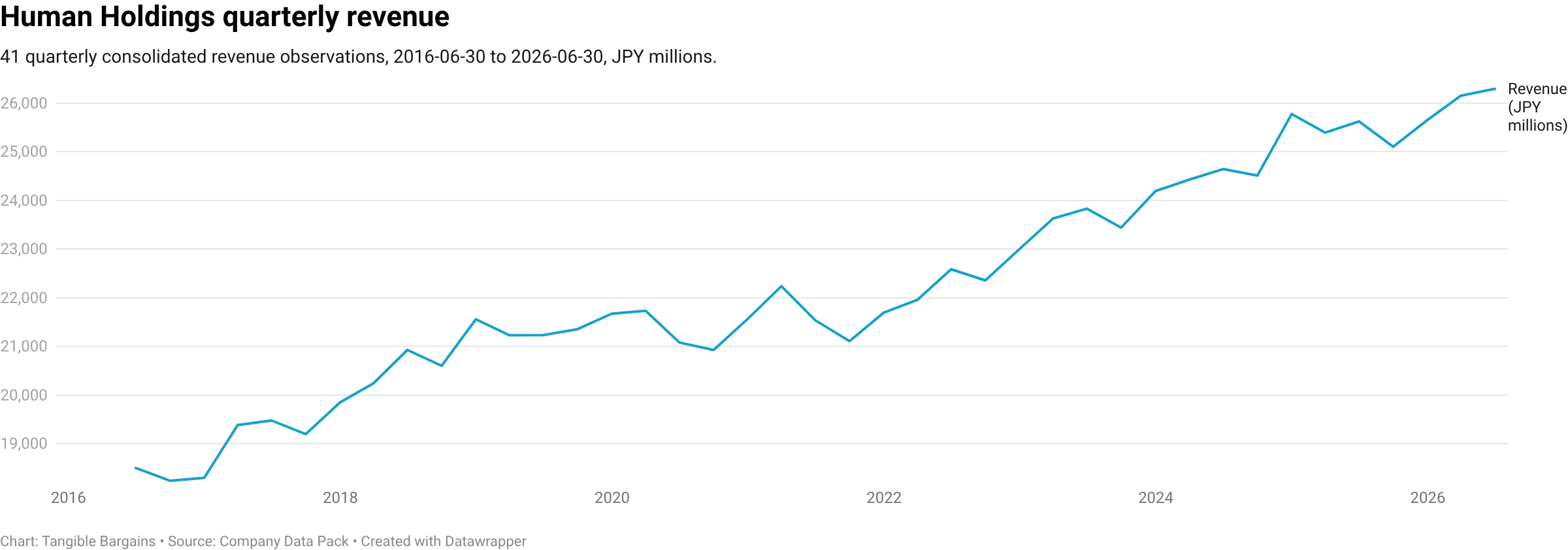
FY2026/3 consolidated revenue was ¥102,539.3mn, up 2.2% year over year, with operating profit of ¥3,614.1mn (3.5% margin) and ordinary profit of ¥3,887.6mn. Three secular tailwinds work in the company's favor: a chronic Japanese labor shortage supporting staffing demand and pricing; rising demand for Japanese-language education from foreign nationals under loosened immigration rules; and an aging population needing more elder care. Working against it: a shrinking pool of Japanese youth is eroding the full-time vocational-college business, and low unit economics across headcount-driven staffing and regulated nursing-care reimbursement cap margins structurally. This is a stable-cash-generating conglomerate of thin-margin, labor-intensive service lines, not a growth compounder.
4. Moat, Competitive Position, and Industry Cycle
Moat classification: None/Weak, with narrow, defensible niches inside an otherwise commoditized structure.
Staffing: No moat. Commoditized and license-gated, with many competitors (Recruit, Persol, Pasona, regional players). A modest "education → staffing" pipeline advantage exists but isn't durable. Segment profit grew 7.5% year over year on Japan's structurally tight labor market.
Education: Narrow, eroding moat in the adult-reskilling/Japanese-teacher-training niche (recently strengthened by conversion of "Japanese-language teacher" into a national licensure). No moat in the full-time vocational-college business, directly exposed to Japan's shrinking 18-year-old cohort. Segment profit fell materially year over year.
Nursing care: No moat beyond local licensing and facility density; heavily regulated pricing via Japan's long-term-care insurance fee schedule. Margins recovered on staffing/utilization improvements but the segment remains structurally low-margin.
Overall: not a capital compounder. The appeal is valuation and balance-sheet strength, not franchise quality.
5. Management, Governance, and Capital Allocation
Board. Eight directors as of 2026-06-24 (seven at the 2026-03 filing date; the June addition was an internal director, so independence went from 1-in-7 to 1-in-8). One outside director — below Corporate Governance Code Principle 4-8, which requires at least two independent outside directors for Standard-market issuers. Statutory kansayaku model with three kansayaku; no nomination or compensation committee; no 独立役員 designated on the company's own governance page. The company's own CG report was not read for this run.
Ownership concentration. Confirmed top holders as of the 2026-03 record date: Yūgen-gaisha Parents 22.27%, Shingo Sato 9.64%, Tomoya Sato (President & CEO, personally) 8.31%, Koichi Sato 5.02% — a confirmed family bloc of 45.24%. Four additional corporate vehicles (Office Aguri, JPSKN, Kobee, Harvest — 12.06% combined) carry Sato-adjacent naming patterns whose affiliation could not be confirmed; if affiliated, the bloc rises to 57.3%. The top-ten register was found to be missing a line — an individual holder, 野村愛 (Ai Nomura), at 3.15% — which, if also family-affiliated, would put the ceiling at 60.45%. No trust bank, custody bank, pension fund, or foreign institution appears anywhere in the top ten.
President's personal holding does not reconcile. The president's stake is reported at 30.58% (parents 22.27% + personally 8.31%), reproducing exactly from a June 2024 large-shareholding change report. But 1,078,000 shares less the 518,300 distributed in June 2024 leaves 559,700 (5.39%), against the reported 862,412 (8.31%) — a ~302,000-share gap. Either an insider re-acquisition occurred that hasn't been disclosed, or one of the two secondary sources describing this is wrong. Unresolved; the 30.58% figure carries an at-risk flag.
Capital allocation is share-reducing, not merely non-dilutive. The autumn 2023 self-tender and December 2023 cancellation retired 609,201 shares (5.5% of the register) at roughly 0.68x book (~¥914/share, ~¥457mn), on a ~52.1% total-return payout that year. Two readings are both supported and neither is established: constructively, management acted on its own discount below book; adversely, the ~500,000 shares acquired came specifically from company officers and their relatives within two degrees of kinship — confirmed by the primary 2025-04-24 filing — not the open market, and company cash may have lifted the family bloc roughly two points (43.2% → 45.2%) in the process. The stated policy otherwise is a 30% consolidated payout ratio; FY2026/3 dividend was ¥69/share (¥65 ordinary + ¥4 one-off 40th-anniversary special), down from ¥75.50/share the prior year on a like-for-like ordinary basis. No stock options or convertible instruments are outstanding.
Insider selling is real, ongoing, and non-informational in motive. Change Report No.8 (2023-03-16) shows an estate-planning transfer of the president's personal stake into his own asset-management vehicle, not a market disposal. Change Report No.11 (2024-06-26), filed one day after an off-auction distribution announcement, shows the vehicle buying (21.59% → 22.27%) while the president personally sold (9.81% → 8.31%), at a 1.96% discount to market — disclosed motive is the listing rule, not a view on value. The supply overhang into a thin float is real; the "insiders think the shares are cheap" reading is not supported and is explicitly withdrawn.
Red flag to monitor: the March 2026 resignation of the director responsible for the underperforming Education segment (concurrently representative director of the main Education subsidiary), replaced by an internally-sourced successor at the June 2026 AGM.
6. Corporate Ownership, Subsidiaries, and Joint Ventures
Eight consolidated subsidiaries, several small non-consolidated overseas entities, and two equity-method affiliates. Human Resocia (Staffing, 100%, FY2025/3 revenue ¥58,362mn, net income ¥1,980mn), Human Academy (Education, 100%, ¥20,881mn revenue, ¥423mn net income), Human Life Care (Nursing, 100%, ¥12,336mn revenue, ¥229mn net income), plus Human Global Talent, Human Star Child, Human Academy Europe SAS, Human Planning, and Dashing Diva International. Relationship-company stock impairment losses of ¥80.4mn (FY2026/3) and ¥70.5mn (FY2025/3) were recorded against small overseas ventures (Malaysia, US) — a recurring, individually-immaterial pattern worth monitoring. No upstream guarantees or cross-default provisions identified; all named consolidated subsidiaries are wholly owned.
7. Historical Financial Quality and Normalized Owner Earnings
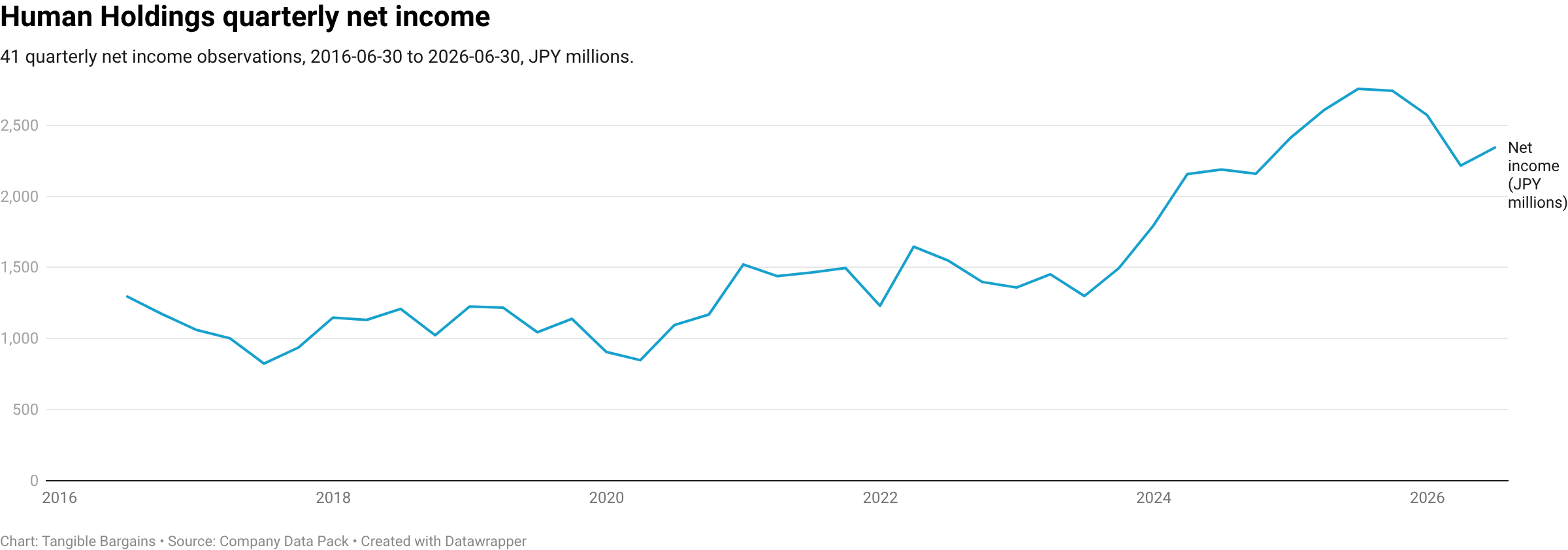
Three years not shown on that chart: ordinary profit was ¥3,294mn (FY2024/3), ¥3,576.2mn (FY2025/3), ¥3,887.6mn (FY2026/3); operating cash flow was ¥4,621mn, ¥1,523.1mn, ¥3,282.6mn; the equity ratio was 31.5%, 35.7%, 37.5%; EPS was ¥202.20, ¥251.21, ¥213.60; and book value per share was ¥1,554.52, ¥1,743.70, ¥1,882.08.
The net-income bridge has three legs, not one. FY2026/3's ordinary profit rose (+¥311.4mn), but net income fell, because of a net extraordinary swing of −¥447.8mn (income −¥140.1mn→¥0.6mn, loss ¥82.6mn→¥390.9mn) and a −¥253.9mn tax-charge increase from the 8.3-point effective-tax-rate rise. Both legs are structural to some degree — the tax-rate rise draws on subsidiary mix and a larger valuation allowance, not a pure one-off — and guidance implicitly assumes partial reversal. Ordinary profit, not net income, is the more reliable trend line, and it grew 8.7% year over year.
Operating-profit growth was mostly a spending cut. Advertising fell ¥174.4mn and the bonus provision fell ¥70.4mn — together ¥244.8mn, 117% of the ¥209.3mn operating-profit increase. Strip them out and underlying SG&A rose faster than gross profit. Q1 FY2027/3's ~5.9% operating-profit decline on "expanded human-capital investment" is that bonus line reversing.
Free cash flow is unstable, not merely low. FY2025/3 FCF was ¥42.2mn against dividends paid of ¥783.5mn (18.6x coverage shortfall that year); FY2026/3 FCF was ¥2,278.1mn. The two-year average FCF yield on current market cap is 6.8%, against a single-year FY2026/3 figure of 13.4% — both should be read together, not the higher number alone. Roughly ¥1.8bn of the FY2026/3 operating-cash-flow inflow is unexplained by earnings after eliminating the tuition float, receivables, and capitalization as candidate sources — genuinely open, not resolved.
Piotroski F-Score: 7–8 of 9. Signal 4 (CFO > net income) passes in FY2026/3, fails in FY2025/3 — a one-of-two-years pass. Signal 8 (gross-margin improvement) is published as indeterminate: the delta is +0.00038 percentage points, arithmetically exact but well inside the precision a management allocation between cost lines can actually support.
8. Balance Sheet, Debt, Covenants, and Refinancing Risk
As of March 31, 2026: current portion of long-term borrowings ¥2,860.4mn, long-term borrowings ¥6,496.3mn, total interest-bearing debt ¥9,356.7mn. Cash and equivalents ¥29,131.8mn, for a net cash position of ¥19,775.1mn, roughly 116% of market cap. Interest coverage 47.3x, equity ratio 37.5%.
No bonds, convertible instruments, or off-balance-sheet financing identified. Balance-sheet risk classification: Net Cash / Conservative. One open item: funded debt rose 14.6% in the June 2026 quarter (¥9,356.7mn → ¥10,722mn), against only a ¥1.0bn cash build. Netting the ¥716.1mn AGM dividend narrows the gap, and a seasonal tuition-float explanation is now unlikely because the float is flat year over year — the draw is unexplained and the Q1 tanshin that would clarify it was not read. A meaningful share of the ¥29.1bn cash balance is economically pre-funded by ¥9,893.2mn of contract liabilities (prepaid tuition), so it is not entirely "free" cash even though it carries no debt-service obligation.
9. Real Estate, Leases, and Hidden Assets
The company operates 600+ leased locations. Lease-note detail was not fully disclosed in the documents reviewed: the note discloses only ¥2,562.8mn of non-cancellable minimum lease commitments (¥353.8mn within one year), which is explicitly not the same quantity as annual rent expense — ¥8,033.1mn of the ¥22,736.2mn SG&A total is an unitemized residual with rent inside it, and annual rent expense itself is undisclosed. Three filing-derived indications the leased footprint carries real weight: guarantee and lease deposits of ¥2,269.4mn (up from ¥2,191.6mn), an implied asset-retirement obligation of ~¥1,095mn (grossed up from the related deferred tax asset), and FY2026/3 impairments falling overwhelmingly on buildings and structures at leased education and care sites. Together, these DTA and deposit items are 16.6% of the ¥18,126.1mn tangible book and are not realizable at carrying value in a wind-up scenario.
10. Capital Markets Access, Dilution, and Financing Flexibility
No shelf registration, ATM program, or rights offering identified. Share count is not flat across the period: it moved from 10,987,200 (pre-cancellation) to 10,377,999 (issued) via the December 2023 cancellation described above under governance — a share reduction, not the "flat for at least three years" picture a filing-only read produces. No dilutive instruments of any kind — positively confirmed via unchanged capital accounts, basic equalling diluted EPS on both routes, and an exhaustive net-assets decomposition leaving no room for a warrant/option component. Working capital and small bolt-on M&A continue to be funded from internally generated cash flow and modest bank borrowing.
11. Litigation, Regulatory, and Contingent Liability Risk
No specific pending litigation, regulatory investigation, fine, or contingent liability was disclosed in any section reviewed. Two independent Japanese-language sweeps — the original research and a second, separately-run adversarial-panel sweep across the parent, Human Academy, and the language-school subsidiary for administrative sanctions, lawsuits, labor-bureau action, or corrective guidance — returned nothing adverse in a licence-gated sector with a real enforcement record. This is "nothing found in the sections and searches reviewed," not an independently verified clean bill of health, and should not be re-run without new information.
12. Accounting Quality and Disclosure Review
Auditor: Same firm 24 years, partner rotation confirmed, firm rotation not required or expected under Japanese rules — single-sourced (two independent attempts to second-source failed) but a market norm in Japan, not an anomaly. Fees ¥61.4mn (FY2026/3) vs ¥59.9mn (FY2025/3).
Revenue recognition: passes every test run against it — contract liabilities flat relative to revenue growth, receivables flat with days-sales-outstanding falling, intangibles amortizing faster than additions.
Impairment/goodwill: goodwill is a trivial ¥45.1mn (0.09% of assets); no capitalized lease liability under J-GAAP — the two standard tangible-book inflations both refute cleanly.
Related-party disclosure: the FY2026/3 note reads 該当事項はありません (no applicable items) for both FY2025/3 and FY2026/3, and the transcription is not disputed — but four qualifiers now travel with that nil, replacing the single materiality caveat a first read would apply: (1) director remuneration, bonuses, and retirement allowances are categorically excluded from this note's scope under ASBJ Statement No. 11, so the nil says nothing about officer pay — the one governance section never read; (2) a share repurchase through public tender is a capital transaction and wouldn't appear here even if insiders tendered; (3) the note's window is two years and the self-tender/cancellation fall just outside it; (4) verification re-fetched the same source the original read used — one transcription checked against itself. Working the other way: the individual-related-party disclosure threshold is only ¥10mn, tight enough that the nil is genuinely informative about dealings with the Sato family personally — which threshold limb governs entities they control was not verified.
Officer compensation: entirely unread. A previously-circulated ¥300–400mn estimate has been withdrawn as unsupported; the only figure found (~¥52.84mn per director) comes from a low-quality aggregator and is not adopted. No estimate currently on file.
Overall accounting-quality classification: Adequate, with the related-party/officer-compensation gap now the single most consequential disclosure hole in the file, given the controlled-company ownership structure.
13. Valuation
Given the net-cash position, both a simple multiple read and a cash-adjusted read matter, and the adjusted-EV construction depends on a convention choice this house has now settled.
Snapshot (2026-08-24, price ¥1,643):
Market capitalization: ¥17,051mn
P/TBV: 0.941x (tangible book ¥18,126.1mn; TBV/share ¥1,746.5)
P/B on March 2026 book: 0.873x (BVPS ¥1,882.08)
Forward P/E: 6.96x on FY2027/3 guidance (EPS ¥236.08) / 7.37x on last year's realized 36.62% tax rate applied to guided ordinary profit — the guidance-implied figure is the more optimistic of the two and should be read alongside the higher one
Net cash: ¥19,775.1mn, ~116% of market cap
Dividend yield: 4.3%
FCF yield: 13.4% single-year (FY2026/3) / 6.8% two-year average — publish both, not the higher one alone
Simple enterprise value: −¥2,724mn (negative headline, but this construction ignores the ¥9,893mn of prepaid-tuition contract liabilities entirely and should not be published alone)
Adjusted excess cash and adjusted EV depend on a deferred-revenue convention with no single right answer. Gross-deferral (subtract 100% of contract liabilities) gives adjusted excess cash of ¥9,881.9mn and EV/EBIT of 1.98x. Cost-to-complete (subtract only the ~74.30% of the float that represents the actual cost to deliver, rather than its full face value) gives ¥12,424.5mn and EV/EBIT of 1.28x. Both readings are published here since neither is clearly the single right answer, but the more conservative gross-deferral figure (1.98x) is the one this report treats as primary.
Buy-Below and Sell Range
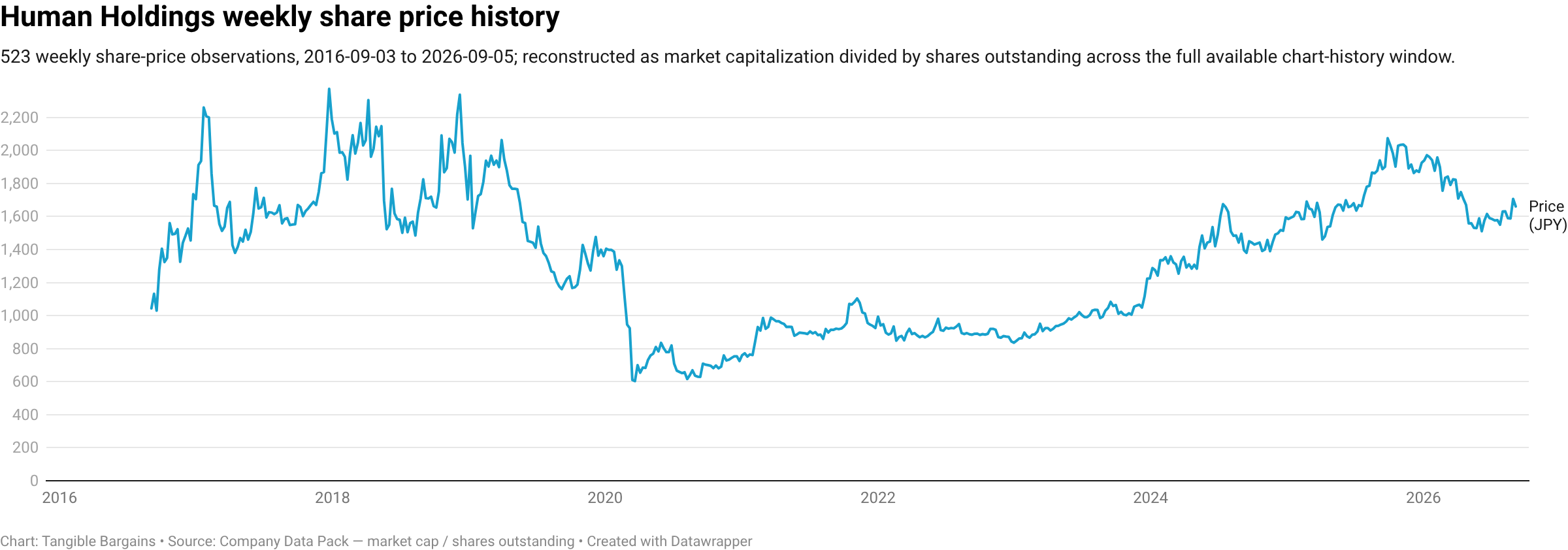
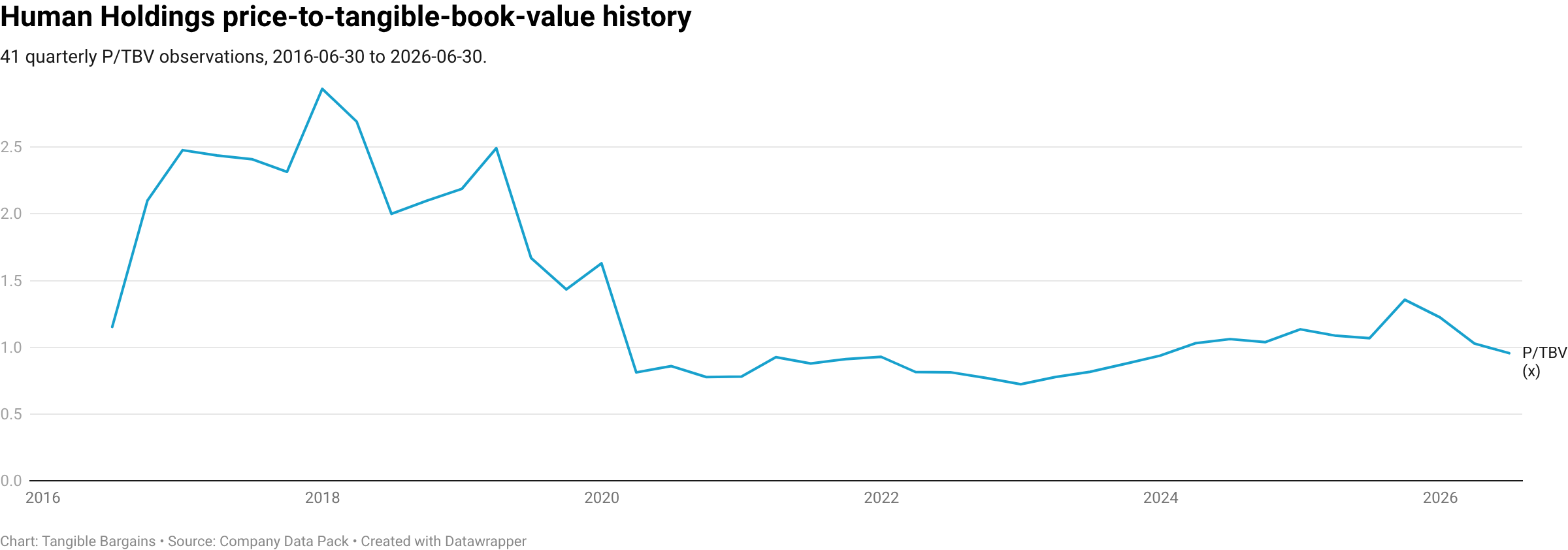
Both price targets are computed from the same source: 41 quarterly P/TBV observations, 2016-06-30 to 2026-06-30, cross-checked against the filing-derived current P/TBV before being trusted (provider series 0.946× vs. derived 0.941× at 2026-06-30, a 0.005-point gap, well inside the acceptance test).
Buy-Below: ¥1,400 (0.80× tangible book, 10.2-yr own-history) — the mean of every quarter in that history at or below the stock's own 25th percentile.
Sell Range: ¥1,854 – 4,151 (1.06× – 2.38× tangible book) — the median-to-top-quartile-mean of the same history. Read the top of this range with real caution. The stock has not traded above roughly 1.36× tangible book at any point in the last five years; the 2.38× top-quartile-mean is driven almost entirely by 2016–2019, when the shares regularly traded at 1.5×–2.9× book. That earlier valuation regime coincided with a materially different market environment for this stock, and nothing in the current filings suggests it is close to returning. The bottom of the range (1.06×) is more credible on its own terms — the stock touched 1.36× as recently as September 2025 — but the top should be read as a historical data point, not a near-term target. The mechanical range itself is not adjusted for this; only this annotation is added.
Add-More Trigger (held position only): ¥1,393 (0.80× tangible book) — a single, entry-anchored review price for adding to this specific position (entry ¥1,655, 2026-08-24), one 0.15-P/TBV-point step below entry. A guideline for revisiting the thesis if reached, never a mechanical buy signal, and never applied to sizing or the tier.
At ¥1,643, the stock sits between its own Buy-Below (¥1,400) and the floor of its own Sell Range (¥1,854) — above the level this report would call fresh-money cheap, but below where the sell question becomes live. That middle position is consistent with a mechanical tier that is already Small, not Big, on the numbers alone.
The mechanical tier readout (front matter) is the base P/TBV × normalized-P/E cell alone — P/TBV below 1.0x on a substantial-net-cash, positive-and-growing-ordinary-profit, Piotroski 7–8/9 business. The 4.3% yield is a separate flag, not an input to that readout.
14. Risk Matrix
Going-private on a depressed price. Evidence: a confirmed 45.24% family bloc, possibly up to 60.45%; no institutions in the top ten; company cash already used once to consolidate the position. Severity Medium. No mitigant disclosed. Monitor for any MBO or tender signal.
FY2027/3 guidance requires two things at once. Evidence: no repeat of FY2026/3's extraordinary losses, and roughly 370bp of tax-rate recovery, against a Q1 already down roughly 5.9% in operating profit. Severity Medium-High: forward P/E is 7.37x against the 6.96x headline if guidance underdelivers. Monitor Q2/Q3 FY2027/3 prints against guidance.
Operating momentum was a spending cut. Evidence: 117% of last year's operating-profit gain was two discretionary cost cuts, one already reversing. Severity Medium, roughly a ¥245mn/yr swing. Mitigant: underlying gross profit is still growing. Monitor the SG&A trend excluding discretionary lines.
Funded debt rose 14.6% in one quarter, unexplained. Evidence: ¥9,356.7mn to ¥10,722mn in June 2026; a seasonal explanation is weakened by a flat tuition float. Severity Low-Medium, impact unknown. Mitigant: the net-cash position provides a cushion. Monitor by reading the Q1 tanshin when accessible.
Related-party and officer-compensation blind spot. Evidence: this category is excluded by rule from the note this report otherwise treats as a green flag, and was never read. Severity Low-Medium, impact unknown. A threshold analysis suggests the nil is still informative for personal dealings. Monitor by retrieving the officer-compensation section before treating the related-party nil as fully clean.
Illiquidity and thin float. Evidence: no institutional holders in the top ten; TSE Standard, not Prime. Severity Medium. No mitigant. Size positions conservatively.
15. Red Flags, Yellow Flags, and Green Flags
🔴 Red Flags:
Controlled company: 45.24% family bloc confirmed, potentially 57.3% or 60.45%; no institutions in the top ten; one outside director on a board of eight, below CG Code Principle 4-8.
Listing-maintenance history: tradable-share ratio ~21% against a 25% TSE Standard requirement drove a formal conformance plan filed 2023-05-15; conformance appears achieved as of 2025-03-31, but has not been re-confirmed since.
The FY2026/3 net-income decline is only two-thirds extraordinary: ¥253.9mn of it is an 8.3-point structural rise in the effective tax rate that FY2027/3 guidance implicitly assumes partly reverses.
117% of the FY2026/3 operating-profit increase is an advertising and bonus-provision cut Q1 shows reversing.
Insider selling is real and ongoing as a supply overhang, driven by the listing-conformance mechanism rather than a view on value.
Funded debt up 14.6% in the June 2026 quarter, unexplained, with the Q1 tanshin unread.
Roughly ¥1.8bn of FY2026/3 operating cash inflow is unexplained by earnings after eliminating the three standard candidates.
🟡 Yellow Flags:
Free cash flow is unstable: ¥42.2mn (FY2025/3) vs. ¥2,278.1mn (FY2026/3) — several published metrics are one swing wearing different hats and reverse on the prior year.
16.6% of tangible book is a deferred tax asset already 55.6% written off plus landlord deposits recoverable only on lease exit against a ~¥1.1bn restoration obligation.
Annual rent expense is undisclosed; the leased footprint (600+ locations) is materially larger than the disclosed minimum lease commitment alone suggests.
~¥622mn of accrued, unfunded executive retirement allowance to a family-dominated board, outside the scope of the related-party note.
Officer compensation entirely unread — precisely the disclosure category the related-party nil excludes by rule.
Gross margin identical to four decimal places across two fiscal years — plausibly formulaic pass-through pricing in staffing, unconfirmed.
Auditor tenure 24 years, single firm — a market norm in Japan, single-sourced.
🟢 Green Flags:
Net cash of ¥19,775.1mn, ~116% of market cap, against ¥9,356.7mn of funded debt; interest coverage 47.3x.
Trading at 0.941x tangible book with the two standard inflations (right-of-use assets, goodwill) tested and refuted: J-GAAP filer with no capitalized lease liability, goodwill ¥45.1mn.
Revenue recognition passes every test available: contract liabilities flat, receivables flat, days-sales-outstanding falling.
Capital allocation is share-reducing: 609,201 shares (5.5%) cancelled December 2023 at roughly 0.68x book, on a ~52% total-return payout.
No dilutive instruments, positively evidenced.
Ordinary profit grew on revenue up 2.2% — modest growth, not a shrinking business.
No litigation, enforcement action, or licensing sanction surfaced in two independent sweeps of a licensed sector.
4.3% dividend yield.
Position and Verdict
Current price: ¥1,643 (2026-08-24). Position disclosure: Long, ~1% of portfolio (initiated 2026-08-23). Mechanical tier readout: BUY - SMALL, the base P/TBV × normalized-P/E cell alone, unmodified. Flags for the human tier judgment: shareholder yield 4.3% (at or above the 3.0% threshold, a +1 notch-equivalent) and governance risk High, neither applied to the tier above. Buy-Below: ¥1,400 (0.80× tangible book, 10.2-yr own-history). Sell Range: ¥1,854 – 4,151 (1.06× – 2.38× tangible book), top annotated in the valuation discussion above. Add-More Trigger (held position): ¥1,393 (0.80× tangible book), a review price, not a mechanical trigger. Balance-sheet risk: Net Cash / Conservative. Governance risk: High. Accounting quality risk: Adequate, with a named related-party and officer-compensation gap. Refinancing risk: Low (net cash, 47.3x interest coverage). Primary thesis killers: a related-party arrangement discovered to extract value from minority shareholders; renewed listing non-conformance; loss of a core operating license; a going-private move at a price that ignores the net-cash cushion.
Still Open
Nine items the research could not close, listed so nothing here reads as more certain than it is: who specifically tendered into the 2023 buyback (population confirmed, individuals not named); the president's personal-holding discrepancy (~302,000 shares); ~¥1.8bn of unexplained operating cash inflow; the 14.6% quarterly debt rise (narrowed, not resolved); whether the four unnamed corporate vehicles (12.06%) are family-affiliated; which related-party threshold limb governs family-controlled entities; audit firm tenure/fees (single-sourced); officer compensation (never read); and a small, recurring, permanently-unexplained secondary-source discrepancy in operating profit not worth further investigation.
SOURCES AND DILIGENCE GAP LOG
Successfully Accessed:
Documents successfully accessed: the annual securities report (Yūhō, EDINET doc. S100YIDK) for FY2026/3, filed 2026-06-24; the half-year securities report (EDINET doc. S100X4BW) for H1 FY2026/3, filed 2025-11-14; the full-year kessan tanshin for FY2026/3, filed 2026-05-15, via the TDnet-hosted Yahoo! Finance Japan archive; the TSE listing-conformance plan (doc. 140120230512570763), as of 2023-03-31, filed 2023-05-15, and the listing-conformance achieved notice (doc. 140120250424522241), as of 2025-03-31, filed 2025-04-24, both via a public TDnet archive mirror as primary PDFs; the company's IR site on an ongoing basis; and IRBank and traders.co.jp for the holder table, segment page, and a second source on FY2027/3 guidance.
Overall Data Quality Rating: GOOD. The two most consequential documents this run needed — the listing-conformance plan and its achieved-conformance follow-up — were retrieved and read as primary filings during human-gate review, closing the run's largest open question. The rating is capped below EXCELLENT because several other material facts (the exact buyback share counts and price, the two 5%-rule change reports, officer compensation, the Q1 FY2027/3 tanshin, and the company's own CG report) remain sourced from secondary aggregators or entirely unread.
Diligence Gaps — Data Not Found or Estimated:
Officer compensation section (役員の状況): never attempted. The single largest remaining gap given the related-party note's scope exclusion. [UNAVAILABLE]
Q1 FY2027/3 kessan tanshin: the only document that would explain the 14.6% quarterly debt rise and confirm the operating-profit decline directly. [BLOCKED] — TLS/decoding failures on every access route attempted.
The two 5%-rule large-shareholding change reports (No.8, No.11), primary: would separate genuine family selling from a co-holder leaving the joint-holding perimeter, and would resolve the president's-holding discrepancy. [UNAVAILABLE] — secondary coverage only.
Exact buyback/cancellation/distribution share counts and prices, primary: multiply corroborated from secondary sources and internal arithmetic, but no primary TDnet PDF for the 2023-09-08 tender or 2023-12-08 cancellation notices was opened (paywalled, undecodable, or 403'd on every route attempted). [UNAVAILABLE]
Corporate Governance Report (コーポレート・ガバナンス報告書): would show whether the company explains or disputes the CG Code Principle 4-8 shortfall. [UNAVAILABLE] — never attempted.
Detailed lease terms (ROU assets, weighted-average term, discount rate): explicitly omitted from tanshin/interim filings as a permitted simplification. [UNAVAILABLE]
Related-party threshold limb for director-controlled entities: which JPY threshold (individual vs. corporate) applies to entities the Sato family controls was not verified against the standard. [UNVERIFIED]
This report should be read as well-sourced but not fully exhaustive. An investor sizing a position beyond a starter/watchlist size should independently pull the officer-compensation and CG-report sections directly from EDINET (E05428) before committing further capital.
This report is for informational and research purposes only and does not constitute investment advice. It is not a substitute for independent due diligence, and the author is not a licensed financial advisor. All figures are in Japanese yen unless otherwise noted; no currency conversion to USD was performed.