

1. Scorecard
2. Argument
The short version
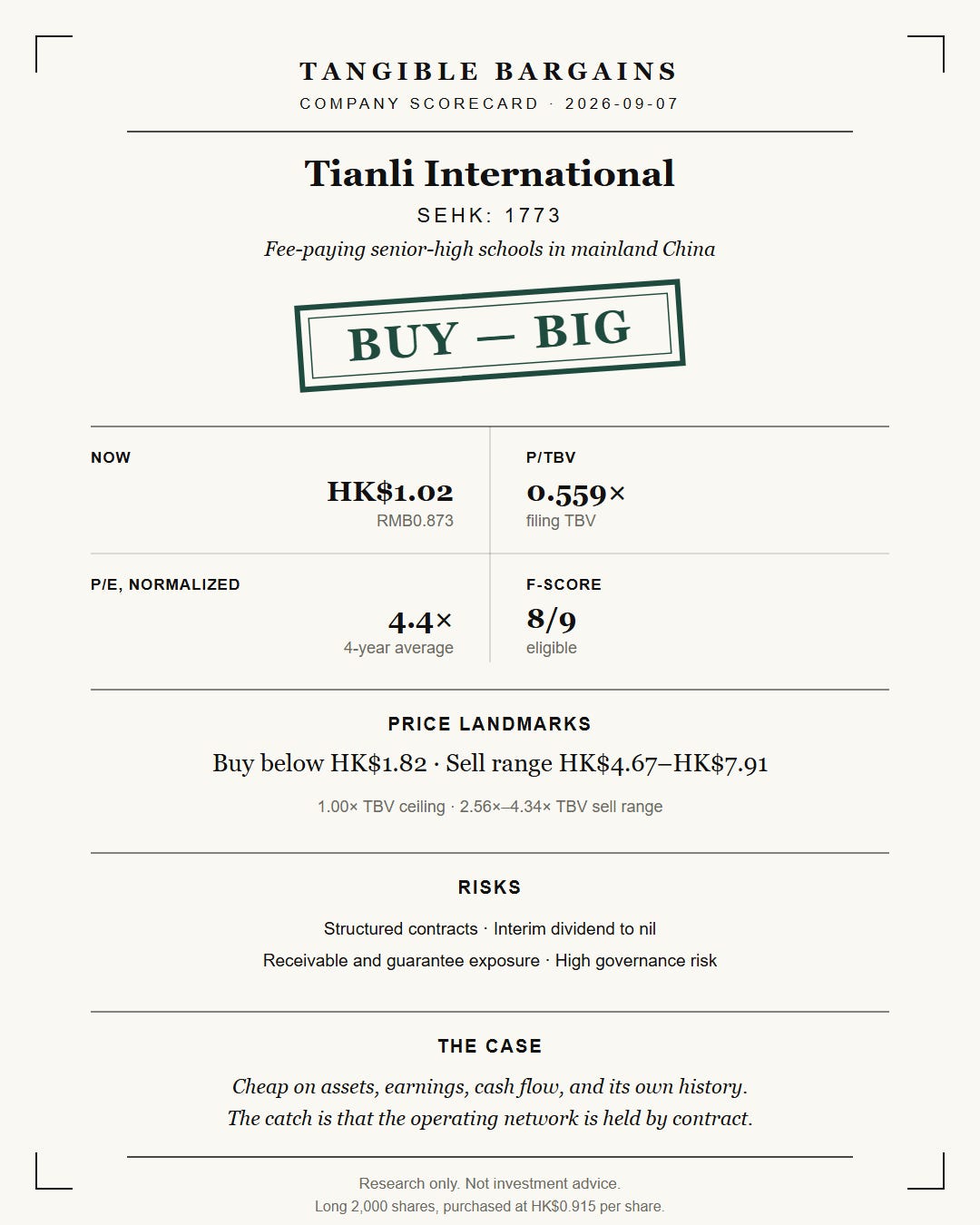
Tianli runs fee-paying senior-high schools across mainland China. At HK$1.02, the shares trade at 0.559x tangible book, against RMB1.5608 of filing tangible book per share, and at 4.4x normalized earnings. Revenue and profit were at multi-year highs in the latest half, and the F-Score is 8/9. The bargain is real.
It is also a contract-controlled operating network whose compulsory-education perimeter was broken by regulation once already. The board suspended the interim dividend even as profit rose, and the group still carries a large interest-free receivable and guarantees for the deconsolidated schools. The shares qualify for BUY - BIG on the numbers, but mainland-China exposure caps fresh-money entry at Standard.
Why it qualifies
At HK$1.02 the shares trade at 0.559x tangible book, versus RMB1.5608 per share, a 44.1% discount.
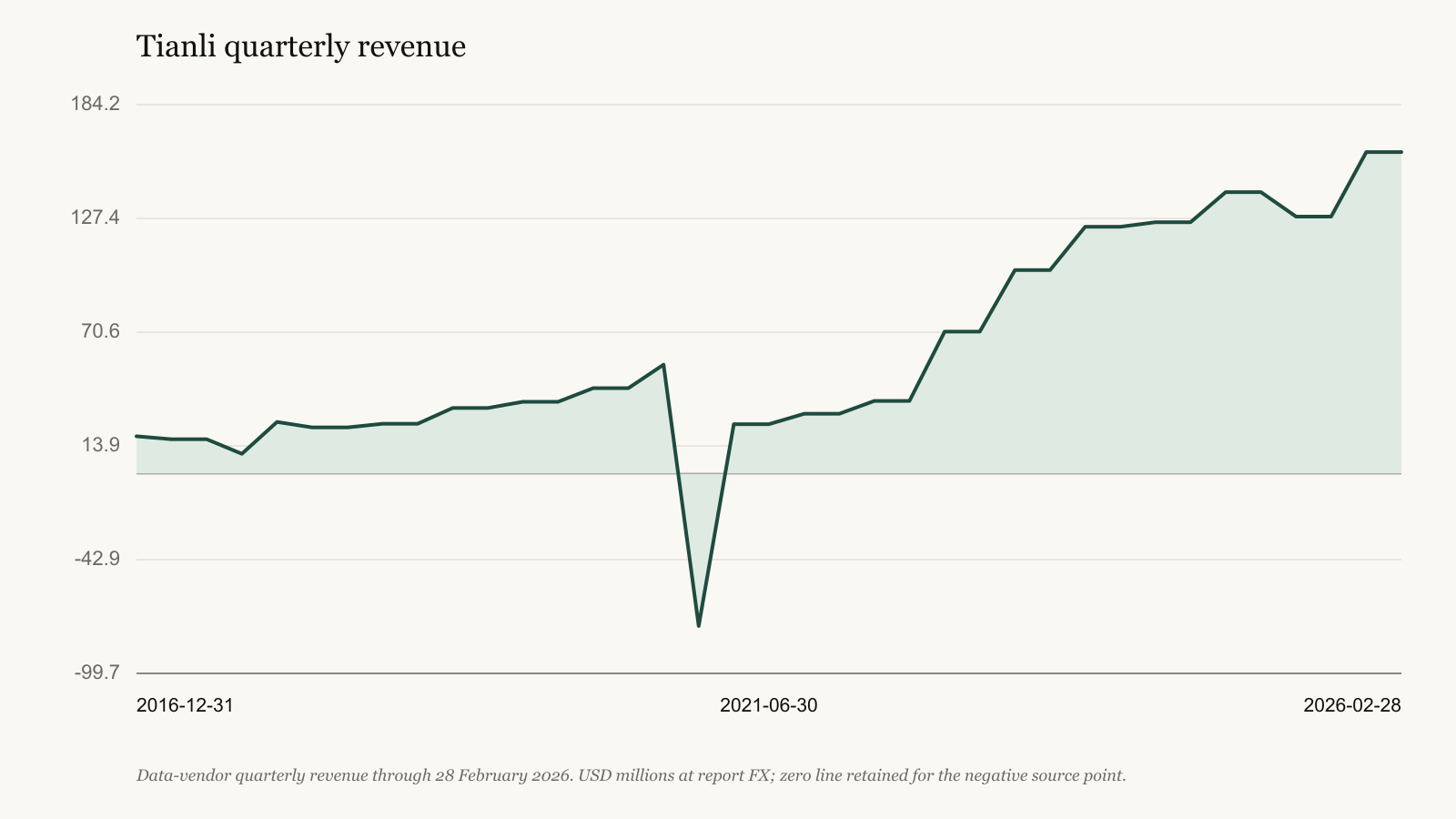
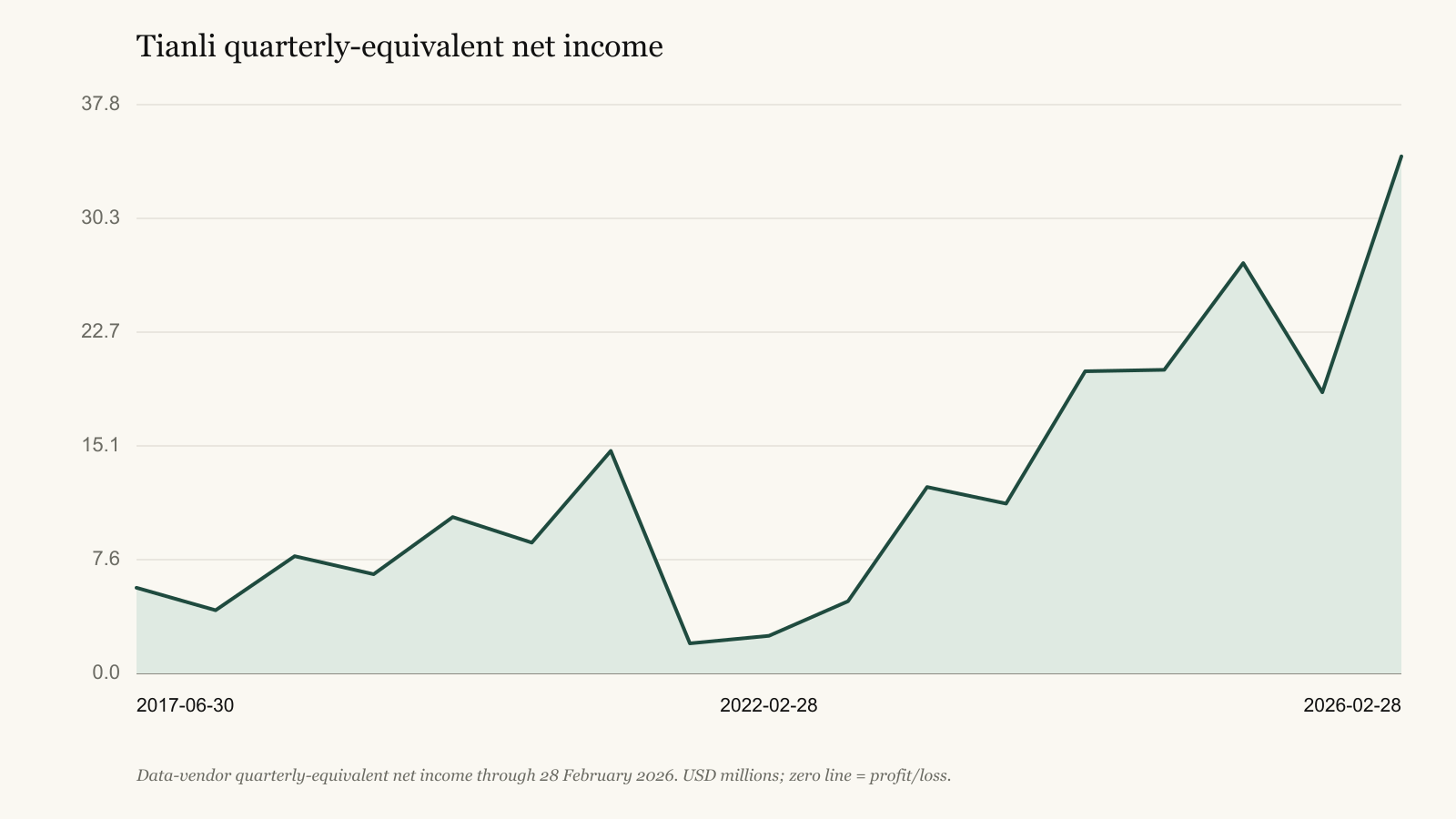
The latest half produced RMB2,142.8m of revenue and RMB471.4m of profit, up 14.2% and 21.0%.
FY2025 operating cash flow was RMB852.6m against RMB648.1m of profit and RMB403.6m of capex; the F-Score is 8/9.
The debt load is manageable on the reported numbers: RMB2,535.8m of bank borrowings, 10.1x EBITDA interest coverage, and RMB1,432.7m of undrawn committed facilities.
The chairman's vehicle bought 37,579,000 shares during the prior six months while the price was falling.
Why it is not a clean bargain
The group controls its PRC operating schools through structured contracts rather than equity, and regulation forced the deconsolidation of 30 compulsory-education schools in 2021, with a RMB1,085.2m impairment.
The deconsolidated Affected Business owed the group RMB873.3m interest-free and unsecured, while the group had provided RMB254.0m of guarantees for its bank facilities without consideration.
The interim dividend was nil despite profit rising 21.0%; cash was RMB449.3m and first-half capex rose to RMB540.2m, leaving a current ratio of 0.416.
The chairman is also chief executive, and his construction company builds schools on a cost-plus premium of 9% to 11%; first-half construction fees were RMB50.1m against RMB7.3m in the comparable period.
The history includes RMB100.0m of impairment reversals in FY2025 and RMB81.9m in the latest half, so reported profit and tangible book still need to be read alongside the regulatory perimeter and asset quality.
How a minority holder gets paid
A minority holder gets paid through cash distributions and a re-rating, if the business continues to operate and the market stops treating the contract structure as terminal. The dividend is the first route, although the nil interim payment means it must be re-established rather than assumed. The larger payoff is mean reversion toward the RMB4.00 - RMB6.77 sell range, with the lower end the more credible exit because the upper end reflects a valuation regime the cohort may no longer receive. The controlling shareholder's 46.13% stake and prior buying provide alignment, not a promise.
The RMB4.00 - RMB6.77 (HK$4.67 - HK$7.91) sell range comes from 29 observations of Tianli's own P/TBV history, not from a forecast or takeover assumption. The lower end is credible if the business keeps operating and the multiple returns to its historical median. The top is less credible on current earnings power because it requires a return to the stronger valuation regime seen earlier in the cohort, so it is an optimistic endpoint rather than the base exit case.
What would change the view
FY2026 results and the final dividend show whether the interim suspension was temporary or a change in distribution policy.
The Affected Business receivable stops growing, is repaid, or receives an appropriate allowance, while the related guarantees continue to fall.
Senior-high qualification and classification rules provide evidence that the structured contracts can continue to support the operating network.
The next filing shows debt maturities being refinanced without exhausting cash or committed facilities, and the current ratio recovers.
Related-party construction fees move back toward the cap trajectory and product mix, margins, and impairment reversals normalize.
Sources and gaps
The FY2025 annual report and Interim Report 2026 were read in full. The June to September 2026 exchange-announcement window and the post-February insider register were not reached directly, so those items remain identified as third-party or unverified where relevant.
3. Backup and sources
This last layer is the full detail: the sources, calculations, and open questions behind the argument above.
Field: Company; Value: Tianli International Holdings Limited
Field: Ticker; Value: SEHK:1773 (1773.HK), The Stock Exchange of Hong Kong Limited, Main Board
Field: Analysis Date; Value: 2026-09-07
Field: Current Price; Value: HK$1.02 (7 September 2026) = RMB0.873; market capitalization approximately HK$2.10bn (RMB1.79bn; US$269m)
Field: P / TBV; Value: 0.559× (derived: price ÷ filing TBV/share of RMB1.5608 at 28 February 2026)
Field: Verdict; Value: BUY, BIG
Field: Position disclosure; Value: Long 2,000 shares, purchased at HK$0.915 per share; trade date is not shown in the supplied screenshot
Field: Buy-Below; Value: RMB2.10 (HK$2.45), 1.35× TBV, 7.2-year own-history, qualified: above the 1.00× absolute ceiling, so the operative buy price is RMB1.56 (HK$1.82) at 1.00× TBV
Field: Sell Range; Value: RMB4.00 - RMB6.77 (HK$4.67 - HK$7.91), 2.56× - 4.34× TBV, 29 observations over 7.2 years
Field: Moat; Value: Narrow
Field: Governance Risk; Value: High (2 capital-allocation warnings fired)
Primary Sources Reviewed
Source: Annual Report; Detail: Annual Report 2025 (HKEX), incl. Independent Auditor's Report, Report of the Directors, Corporate Governance Report and audited consolidated financial statements, FY ended 31 August 2025, filed/published 2025-12-30
Source: Latest Quarterly; Detail: Interim Report 2026 (HKEX), incl. Independent Review Report and interim condensed consolidated financial statements, Six months ended 28 February 2026, filed/published 2026-05-15
Source: Proxy / MIC; Detail: Poll Results of Annual General Meeting held on 28 January 2026, AGM 2026, filed/published 2026-01-28
Source: Earnings Release; Detail: Not separately obtained, the FY2025 results announcement and the H1 FY2026 results announcement were superseded by the full Annual Report 2025 and Interim Report 2026, both read in full
Source: Insider Activity; Detail: Hong Kong SFO Part XV disclosure-of-interests record as reproduced in the Annual Report 2025 (as at 31 August 2025) and Interim Report 2026 (as at 28 February 2026). The standalone exchange disclosure-of-interests register for the period after 28 February 2026 was not reached
Source: Other Key Sources; Detail: SEHK:1773 last traded price HK$1.02 (7 September 2026, 16:08 HKT) and market capitalization HK$2.13bn; SEHK:1773 quote HK$1.025, YTD -56.93%, 5-day -7.24%, market cap HK$2.14bn, analyst consensus 2 covering brokers; HKD/CNY mid-market rate 1 HKD = 0.8559 CNY (7 September 2026); Discloseable transaction: subsidiary to acquire 10% of an art-education group for RMB104m plus RMB140.8m capital injection, taking the holding to 51% (announced 9-10 June 2026); Share retirement of 13,227,000 repurchased shares (16 June 2026); resignation of Ms Zhang Xiao as joint company secretary (31 August 2026); Broker note maintaining an Outperform rating with FY2026-28 revenue estimates of RMB3,915m/4,225m/4,499m and adjusted net profit of RMB741m/821m/901m; Sector context: Hong Kong-listed private-education issuers, 16 of 21 down more than 70% from peak and 11 trading below HK$1; Peer valuation context: a Hong Kong-listed private-education comparable trading on a 2.95x trailing P/E and an 11.3% dividend yield (April 2026)
Source: Data Quality; Detail: GOOD
Tianli International Holdings Limited, Value Investing Analysis
1. Executive Summary
Tianli International Holdings runs a network of fee-paying senior high schools in mainland China, 58 schools across 36 cities at the last annual reporting date, teaching roughly 54,000 high-school students during the year and about 60,000 at the start of the autumn 2025 term, and monetizes that network four ways: tuition and comprehensive education fees, sales of products into its own campuses, canteen and boarding logistics, and management and franchise fees from schools it operates for third parties. The verdict is BUY, BIG, with Governance Risk High and a structural-risk caveat a reader should weigh before the tier: the shares trade at HK$1.02 (7 September 2026) against a filing-derived tangible book value of RMB1.5608 per share (HK$1.82), a P/TBV of 0.559×, while the business behind that book grew revenue 14.2% and profit 21.0% in the most recent half year.
The gap between price and fundamentals is the whole story. In the six months to 28 February 2026 the group earned RMB471.4 million on RMB2,142.8 million of revenue; over the twelve months to that date it earned roughly RMB730.0 million, against a market capitalization of about HK$2.10 billion (RMB1.79 billion), a trailing multiple under 2.5×. The Piotroski F-Score is 8/9, the only failed signal being leverage, which rose as the group termed out short-dated bank debt. Operating cash flow was RMB852.6 million in FY2025 against RMB403.6 million of capital expenditure, and bank borrowings of RMB2,535.8 million are 76.3% of equity, comfortably inside the absolute debt filter. The margin of safety against tangible book is 44.1%. Right-of-use assets are 74.2% of tangible book value, so this is cheap against tangible book value rather than cheap against a liquidation floor.
The reasons to be careful are specific. The group does not own equity in its PRC operating schools; it controls them through structured contracts, and in 2021 that structure was legislated out from under the compulsory-education half of the business, forcing deconsolidation of thirty schools and a RMB1,085.2 million impairment. Those schools, the "Affected Business", remain entangled: the group is owed RMB873.3 million by them, interest-free and unsecured, has guaranteed RMB254.0 million of their bank borrowings for no consideration, and owes them RMB1,399.8 million. Two capital-allocation warnings fired: that continuing flow of capital and credit support to entities the group no longer consolidates, and the board's decision on 10 April 2026 to pay no interim dividend at all for the half year (against RMB5.78 cents a share a year earlier) in a period when profit rose 21%. The chairman, who is also chief executive, controls 46.13% of the shares and his own construction company builds the schools on a cost-plus-9-to-11% basis.
Data quality is GOOD. Both primary filings, the FY2025 annual report and the interim report to 28 February 2026, were read in full, and the litigation, debt, related-party and subsequent-events notes were reached in the primary documents. The gap is the six months since: exchange announcements from June to September 2026 and the substantial-shareholder register could not be opened directly, so that window rests on third-party summaries and is labeled as such throughout.
2. Business and Market Overview
The revenue base splits four ways. For FY2025 (year ended 31 August 2025), comprehensive educational services, tuition and the core teaching contract, were RMB1,868.0 million, up 7.0%; sales of products into the school network were RMB992.3 million, up 8.0%; comprehensive logistical services (canteen, boarding, campus services) were RMB613.0 million, up 2.6%; and management and franchise fees from 18 entrusted schools were RMB115.6 million, up 93.9% on the addition of eight schools under management (Annual Report 2025, Financial Review). Total revenue was RMB3,588.9 million, up 8.1%. In the half year to 28 February 2026 the mix shifted sharply: product sales rose 45.6% to RMB691.3 million while comprehensive educational services grew only 3.4% to RMB1,046.6 million and logistics fell 1.7%. Management and franchise fees rose 38.7% to RMB78.2 million. That mix shift matters, because product sales carry a visibly thinner margin, gross margin fell 2.4 points to 35.2% in the half, which management attributes directly to product revenue growing 45.6% against procurement cost growing 49.6% (Interim Report 2026, Management Discussion and Analysis).
The customer is the fee-paying family, so there is no customer concentration in the industrial sense; the concentration risk sits on the other side, in geography and regulation. The group is centered on Sichuan and spans 18 provinces and municipalities. There is one reported operating segment. Capital intensity is high and rising: owned property, plant and equipment was RMB5,046.4 million and right-of-use assets RMB2,379.5 million at 28 February 2026, together 74.1% of the RMB10,020.1 million balance sheet, and capital expenditure in the half year was RMB540.2 million against RMB218.1 million a year earlier. Revenue is seasonal, the company lists seasonality among its principal risks, and the fiscal year ends 31 August, aligning to the academic cycle.
Regulatory exposure is the defining feature, not a footnote. Senior high school is post-compulsory education and may lawfully be run for profit; compulsory education (grades 1 to 9) may not, and since 1 September 2021 private compulsory schools have also been barred from transacting with related parties. That single change removed thirty schools from the consolidation. The group's own regulatory commentary is candid that there are substantial uncertainties regarding the interpretation and application of the Implementation Regulations, and that national and local classification-management rules have still not been issued (Annual Report 2025, Regulatory Updates).
As of 9 to 10 June 2026: a subsidiary agreed to acquire 10% of an art-education group for RMB104 million and to inject a further RMB140.8 million of capital, taking the holding to 51%. The announcement itself was not opened; this is a third-party account and is not independently verified against the filing.* Alongside it, management is pushing an AI-education strategy, a self-developed large model that passed the national generative-AI service filing in June 2025, sold internally to cut teacher cost and externally through business, government and community channels.
Understandable? Yes, it is a school operator. Predictable? At the operating level, unusually so: enrolment is contracted a year at a time and prepaid, which is why contract liabilities of RMB952.7 million sit on the balance sheet. Cyclical? Not economically, but acutely policy-cyclical. Structurally advantaged? Only inside a regulatory perimeter the state has already moved once.
* Sourced from third-party reporting; not independently verified against source filings.
3. Moat, Competitive Position, and Industry Cycle
Against the five moat sources the evidence is mixed but not empty. Intangibles and brand are real and locally specific: the group has operated since 2002, and in the 2025 Gaokao roughly 90% of graduates from established schools cleared the undergraduate admission line and 58% cleared the first-tier line, with 399 offers from QS top-50 universities against 272 the prior year (Annual Report 2025, Management Discussion and Analysis). In a market where the product is measured once, publicly, by a national examination, verifiable results are the brand. Switching costs are high in the way that matters: a family that enrols a child in the first year of a three-year senior-high program is locked in by the examination cycle, not by contract. Cost advantage is asserted through a centralised, standardized management system that lets new campuses be opened to a template; the evidence for it is a gross margin that has held between 33.7% and 33.8% while revenue quadrupled from RMB884.4 million in FY2022 to RMB3,588.9 million in FY2025. Efficient scale operates city by city, a single high-quality private senior high school in a prefecture-level city faces limited direct local competition. Network effects are absent.
The classification is Narrow. It is a genuine moat producing genuine returns, return on equity was 21.8% in FY2025 and return on capital employed roughly 12.8% after tax, but it is licensed rather than owned. The group operates under approvals, permits and filings the state grants, through structured contracts rather than equity, and it does not own the underlying school sponsorship rights the way an owner of a factory owns the factory. A moat a regulator can drain with a single administrative instrument is narrow by construction, whatever its width in normal weather. The company itself lists eleven of its thirteen principal risks as some form of regulatory, licensing, capacity or admissions-standard exposure.
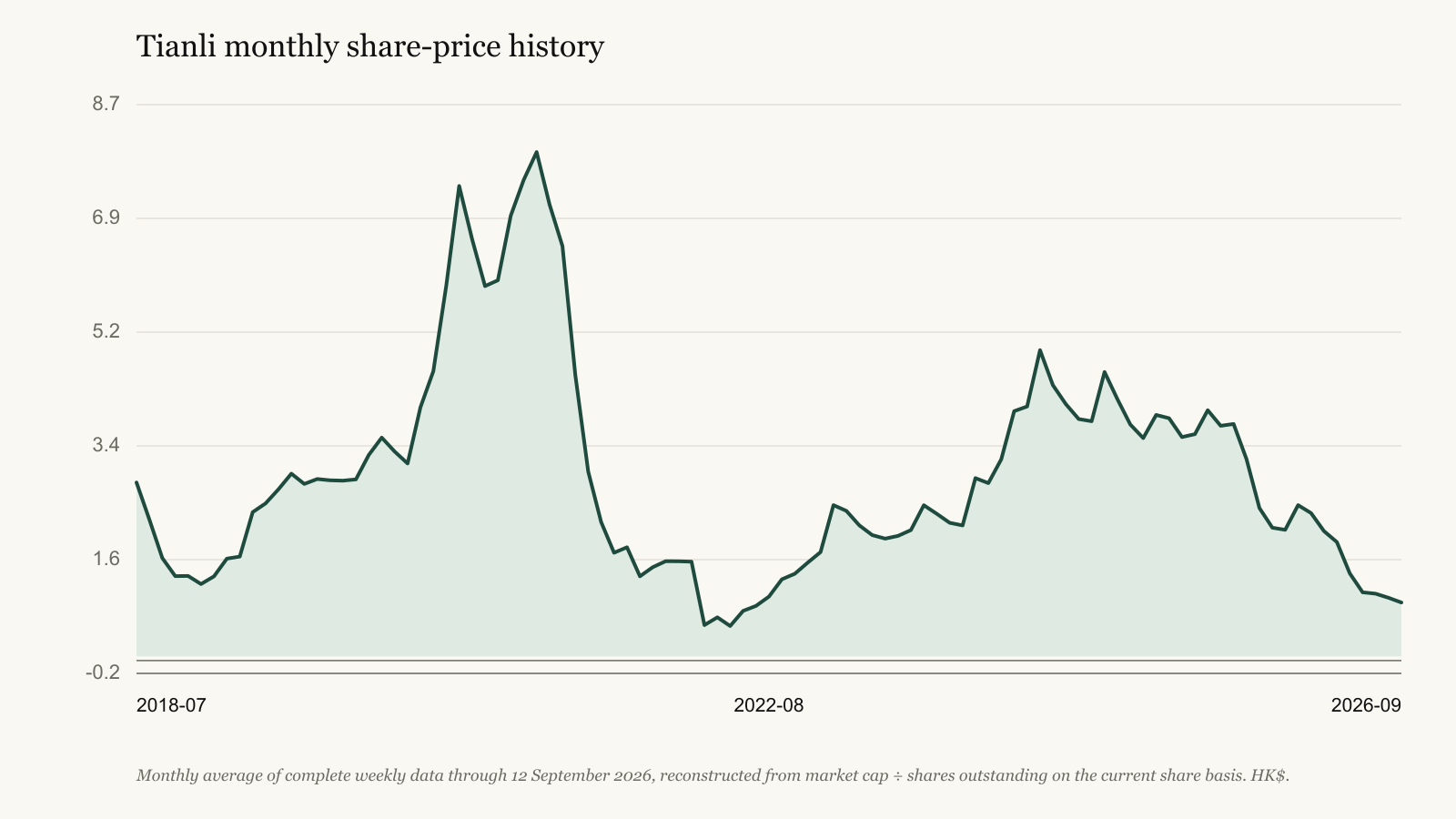
On the cycle, the operating and valuation cycles have separated, and this is the most important observation in the report. Operationally the group is not near a trough: high-school enrolment rose about 11% to roughly 60,000 at the start of the autumn 2025 term, revenue rose 14.2% in the most recent half, profit for the period rose 21.0% to RMB471.4 million, and full-time teacher headcount at self-owned schools rose from 2,446 to 2,610. The valuation cycle is a different matter. Across the Hong Kong-listed private-education cohort the de-rating has been near-universal, 16 of 21 listed names down more than 70% from their peaks and 11 trading below HK$1, and a listed peer was quoted on a 2.95× trailing earnings multiple and an 11.3% dividend yield in April 2026.* Tianli's own shares have fallen roughly 57% year to date and about 80% from the 12-month high of HK$5.05. The classification is Below mid-cycle: the business is at or near its own operating high while the multiple assigned to it sits at the bottom of its recorded range.
* Sourced from third-party market data and press coverage; not independently verified against source filings.
4. Management, Governance, and Capital Allocation
Mr Luo Shi, 52, founded the group in 2002, has been a director since January 2017 and has been both chairman of the board and chief executive officer since June 2018. That combination is an explicit, disclosed departure from code provision C.2.1 of the Corporate Governance Code, the only such deviation the company reports for FY2025. He also chairs the nomination committee. Mr Wang Rui, 44, has been chief financial officer, executive director and joint company secretary since January 2018, arriving from finance roles at Longfor, New Hope and China Vanke. Three independent non-executive directors sit on a board of eight, Mr Liu Kai Yu Kenneth (audit committee chairman, a chartered accountant and former exchange listing officer), Mr Yang Dong (an education academic) and Mr Cheng Yiqun (a PRC lawyer). Audit and remuneration are majority-independent and independently chaired; nomination is not.
As of 31 August 2026: Ms Zhang Xiao resigned as joint company secretary. The underlying announcement was not opened; this is a third-party account.* No reason has been verified from a primary source, and it is recorded here as an unexplained departure rather than assumed routine.
Insider ownership is high and, unusually, has been rising into the collapse. Mr Luo Shi's aggregate long position was 973,034,569 shares, 46.13%, at 28 February 2026, comprising 934,556,316 shares held through his wholly owned vehicle Sky Elite Limited, 30,000,000 held beneficially, 6,521,733 vested award shares and 1,956,520 held by his spouse (Interim Report 2026, Directors' and Chief Executive's Interests). Six months earlier, at 31 August 2025, Sky Elite held 896,977,316 shares (42.53%) and the aggregate family interest was 44.35% (Annual Report 2025, Substantial Shareholders' Interests). That is an increase of 37,579,000 shares, roughly 1.8% of the company, acquired by the controlling shareholder's vehicle between 1 September 2025 and 28 February 2026, while the shares fell from roughly HK$3.60 to under HK$3.00. Mr Wang Rui held 8,956,520 shares (0.42%), Mr Zhang Wenzao 1,702,000 (0.08%) and Mr Pan Ping 13,043,289 through his spouse (0.62%). The regime searched was the Hong Kong Securities and Futures Ordinance Part XV disclosure-of-interests record as reproduced in the interim and annual reports; the standalone exchange disclosure-of-interests register for the six months after 28 February 2026 could not be opened, so post-February insider transactions are not confirmed.
Pay is not the problem here. Total directors' and chief executive's remuneration was RMB12.0 million in FY2025, down from RMB27.1 million in FY2024, against profit of RMB648.1 million. Mr Luo Shi received RMB8.6 million, of which RMB7.3 million was the non-cash share-option charge and only RMB1.35 million cash pay; Mr Wang Rui received RMB2.5 million and the three independent directors RMB600,000 between them, unchanged. Running the share-based-compensation test explicitly: total equity-settled award and option expense was RMB25.5 million in FY2025 against net income of RMB648.1 million, a ratio of 3.9%, down from RMB41.4 million and 7.4% in FY2024. The ratio is below 10% and fell rather than doubled, so the numeric test does not fire.
Related-party dealing is where the scrutiny belongs, and the note was read in full in both primaries. Checking each relationship type rather than only the obvious one. Service and construction fees: Sichuan Nanyuan Construction, wholly owned by a holding company approximately 75.80% indirectly owned by Mr Luo Shi, builds and refurbishes the group's schools under a framework agreement running to 31 August 2027, priced at actual costs plus a premium in the range of 9% to 11%. The amounts were RMB223.0 million in FY2024, RMB60.7 million in FY2025 and RMB50.1 million in the six months to 28 February 2026 against RMB7.3 million in the comparable half, a 6.9 times increase, against annual caps that step down from RMB310 million (FY2025) to RMB210 million (FY2026) to RMB170 million (FY2027). Financial relationships: the group is owed RMB873.3 million by the deconsolidated Affected Business, unsecured and interest-free, and owes it RMB1,399.8 million on the same terms, repayable within one to three years; it also owes RMB54.3 million to Nanyuan Construction and RMB20.3 million to a subsidiary's minority holder. Guarantees: the group has guaranteed RMB254.0 million of the Affected Business's bank facilities across four schools and has no consideration received from those guarantees (Interim Report 2026, note 20(c)(5)). No nominee or back-to-back arrangement is disclosed. There is one contingent purchase obligation: the 20% minority in an acquired subsidiary may be put to the group on 7 September 2026 at not less than the acquisition-date valuation of its identifiable net assets.
Capital allocation over the lookback, consolidated into single totals rather than described program by program. Buybacks: the company repurchased 12,061,000 shares in FY2025 for HK$43.1 million (approximately RMB38.8 million) at prices between HK$3.13 and HK$4.10, a blended average of roughly HK$3.57, and a further 18,055,000 shares in the six months to 28 February 2026 for approximately RMB50.4 million. Across the two periods that is 30,116,000 shares for roughly RMB89.2 million (HK$99.0 million), a blended average of about HK$3.29, now marked at HK$1.02, a mark-to-market loss of roughly HK$68.3 million, or 69% of the capital deployed. Separately the award-scheme trustee sold 13,000,000 shares for HK$51.5 million during FY2025. Dividends: RMB9.68 cents per share declared for FY2025 (RMB5.78 interim plus RMB3.90 final), a 30% payout ratio held flat with FY2024, with RMB207.8 million of cash paid during FY2025. Then the break, on 10 April 2026 the board resolved to pay no interim dividend for the half year to 28 February 2026, against RMB5.78 cents a share a year earlier, in a period when profit for the period rose 21.0%. Mergers and acquisitions: no material acquisition or disposal in FY2025 or the interim period; RMB36.4 million of cash went to acquiring subsidiaries in FY2025, and a RMB8.8 million goodwill impairment was taken against a Gaokao-repetition school whose autumn 2025 enrolment fell after Sichuan changed its examination model. Capital programs reversed or impaired: the FY2021 impairment of RMB1,085.2 million on property and right-of-use assets occupied by the deconsolidated schools is still partly on the books, with RMB100.0 million reversed in FY2025 and RMB81.9 million in the interim half.
Working the five capital-allocation warnings one at a time:
Control without minority protection, NOT FIRED, borderline. The 46.13% stake is above the threshold, so the affirmative test applies rather than the percentage. The annual general meeting held on 28 January 2026 did put three director re-elections to a poll, one non-executive and two independent non-executive directors, each carried with between 99.74% and 99.97% support, alongside the auditor's re-appointment, the dividend, the general mandates and a special resolution amending the articles. A genuine annual director election is in the record, which is the mitigant the test looks for. Against it: chairman and chief executive are the same person, the nomination committee is chaired by that person, and control over the operating schools runs through contracts rather than equity. Borderline, not fired.
Capital routed to parent-mandated, policy-driven or low-return projects, FIRED. The interest-free receivable from the deconsolidated Affected Business has risen from RMB686.9 million to RMB873.1 million over two years, with RMB183.9 million of fresh advances in the most recent half against RMB80.2 million a year earlier, alongside RMB254.0 million of guarantees given for nothing. This is shareholder capital and shareholder credit supporting entities from which shareholders take no economic benefit, and the flow is increasing rather than running off.
Dividend cut or suspension within roughly the last three years, FIRED. The interim dividend went from RMB5.78 cents a share to nil in a half year when profit rose 21.0%, with no explanation in the interim report beyond the bare resolution of 10 April 2026.
Non-answers to direct shareholder questions, UNASSESSABLE. No earnings-call transcript or shareholder question-and-answer record was reached in this run. Absence of evidence here is not evidence of absence.
Outsized pay or off-market related-party deals, BORDERLINE. Pay fails the numeric test in the company's favor, as set out above, and cash compensation is modest against earnings. The related-party construction arrangement is disclosed, capped, approved by independent shareholders at an extraordinary general meeting and reviewed by the auditor under Chapter 14A of the listing rules, which is what a well-governed cost-plus arrangement looks like, but cost-plus pricing with a controlling shareholder's own contractor gives that contractor no incentive to control cost, and the 6.9 times half-on-half jump against a declining cap schedule is the specific thing to watch. Borderline.
Two warnings fired. Governance Risk: High (2).
5. Corporate Ownership, Subsidiaries, and Joint Ventures
Ownership, taken from the issuer's own Part XV disclosure-of-interests record as at 28 February 2026:
Holder: Sky Elite Limited (BVI, 100% owned by Mr Luo Shi); Shares: 934,556,316; % of issued: 44.31%
Holder: Mr Luo Shi, aggregate incl. spouse, trust and beneficial; Shares: 973,034,569; % of issued: 46.13%
Holder: First Beijing Investment Limited (investment manager); Shares: 344,079,000; % of issued: 16.31%
Holder: Norges Bank (beneficial owner); Shares: 105,994,000; % of issued: 5.03%
Holder: Mr Pan Ping (through spouse's vehicle Shang Long Limited); Shares: 13,043,289; % of issued: 0.62%
Holder: Mr Wang Rui; Shares: 8,956,520; % of issued: 0.42%
Holder: Mr Zhang Wenzao; Shares: 1,702,000; % of issued: 0.08%
Holder: The Core Trust Company Limited (award-scheme trustee, at 28 January 2026); Shares: 71,065,817; % of issued: 3.37%
There is a single class of ordinary shares of HK$0.1, one vote each, no dual-class structure, and no acting-in-concert or voting agreement disclosed as in force at the latest filing. Free float outside the controlling shareholder, the two disclosed institutions, the directors and the trustee is roughly 33%. First Beijing Investment Limited went from 12.00% to 16.31% over the same six months, a second large buyer alongside the chairman during the decline.
The structure below the listed company is not trivial, and it is the single most important thing in this report. The Cayman company owns Tibet Yongsi Technology Co., Ltd., a wholly foreign-owned enterprise, which controls the PRC operating entities through structured contracts, an exclusive business cooperation agreement, exclusive call options, school sponsors' and directors' rights entrustments, powers of attorney, spouse undertakings, equity pledges and a loan agreement, because PRC law prohibits foreign ownership of primary and middle schools and restricts foreign participation in senior high schools to Sino-foreign cooperation subject to a qualification requirement the group has not yet met and is still working towards. Economic benefits reach the group through those contracts, not through equity. The group states it is not aware of any non-performance of the structured contracts.
Structure: PRC operating entities (self-owned schools); Consolidation: Consolidated via structured contracts, no equity held; Economics: All revenue and profit
Structure: Affected Business (30 compulsory-education schools); Consolidation: Deconsolidated 31 August 2021; Economics: RMB873.3m receivable, RMB1,399.8m payable, RMB254.0m guarantees, nil profit
Structure: Associates (incl. Luzhou Tianli Kindergarten); Consolidation: Equity method; Economics: RMB13.1m carrying value; RMB0.6m loss in the half
Structure: Non-controlling interests; Consolidation: Consolidated; Economics: Negative RMB14.1m
Ring-fencing risk is concrete rather than theoretical: bank loans of RMB1,647.2 million are secured on the equity interests in certain subsidiaries and on the rights to educational service fees of certain schools, which places lenders ahead of the listed holding company on precisely the cash streams the structured contracts are designed to deliver upward. Minority leakage is immaterial, non-controlling interests are negative and small, but the group is exposed to the put option over the 20% minority of one acquired subsidiary described in the relevant discussion.
6. Historical Financial Quality and Normalized Owner Earnings
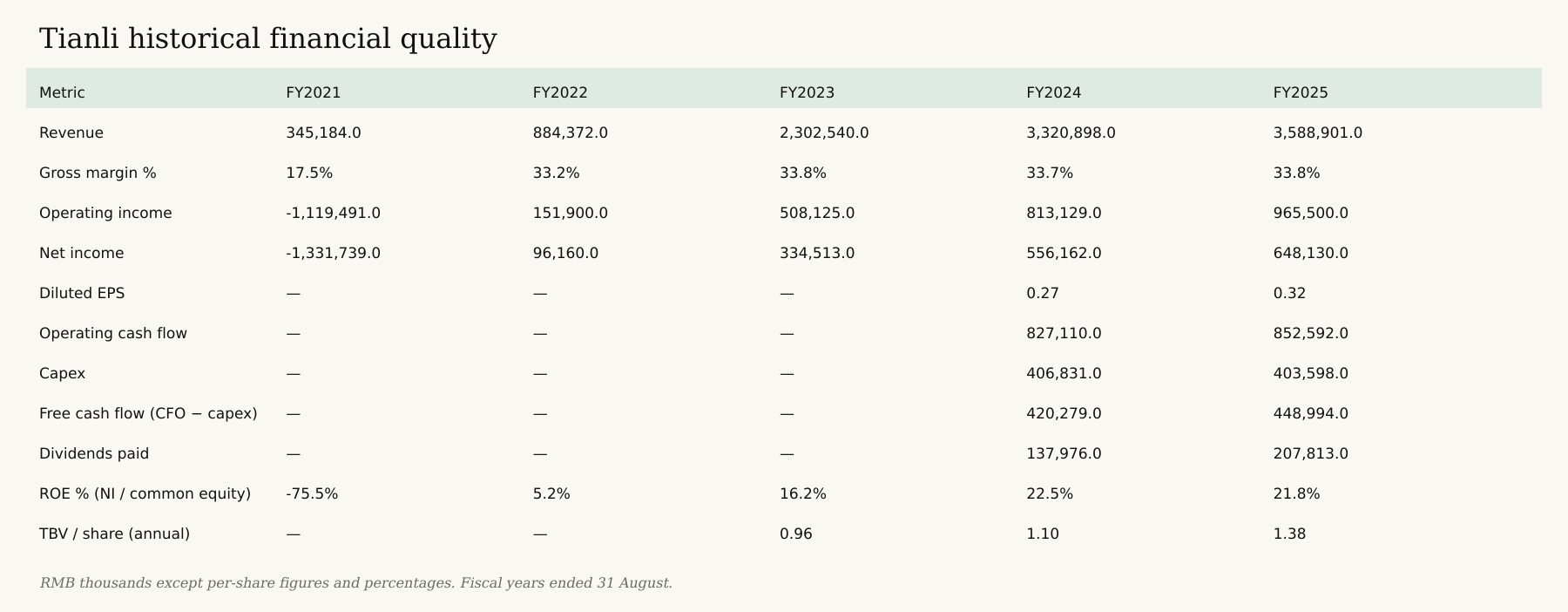
Fiscal years ended August 31; FY2025 refers to the year ended August 31, 2025.
Two things about this table need saying before any number is used. First, FY2021 is not a comparable year: it is an eight-month transition period ending 31 August 2021 whose result is dominated by the deconsolidation of the compulsory-education schools, a RMB1,085.2 million impairment plus RMB222.6 million of discontinued-operations losses, on a perimeter that no longer exists. Second, the growth from FY2022 to FY2025 is therefore the rebuild of a differently-shaped company, not organic growth from a small base. Revenue rose from RMB884.4 million to RMB3,588.9 million and net income from RMB96.2 million to RMB648.1 million over three years, while gross margin settled in a tight 33.7% to 33.8% band from FY2023 onward. That stability through a fourfold revenue increase is the strongest single piece of evidence for the operating model.
The cash record is good where it can be seen. Operating cash flow was RMB852.6 million in FY2025 against reported profit of RMB648.1 million, and RMB827.1 million in FY2024 against RMB556.2 million, conversion above 130% in both years, which is what a prepaid-tuition model should look like. Capital expenditure of RMB403.6 million and RMB406.8 million left free cash flow of RMB449.0 million and RMB420.3 million. In the six months to 28 February 2026 operating cash flow was RMB520.3 million against RMB52.8 million a year earlier, a swing the interim narrative does not explain; capital expenditure rose to RMB540.2 million from RMB218.1 million, so free cash flow in the half was negative and cash fell from RMB965.2 million to RMB449.3 million.
Normalized owner earnings. Working from the real cash-flow statement rather than a proxy: FY2025 operating cash flow of RMB852.6 million, less maintenance capital expenditure proxied at RMB195.3 million (depreciation of owned property, plant and equipment RMB187.4 million plus amortisation of intangibles RMB7.9 million, deliberately excluding the RMB96.9 million of right-of-use depreciation whose cash cost appears in lease payments), less RMB98.2 million of interest paid and RMB12.4 million of lease interest and RMB21.6 million of lease principal, all three of which the group reports inside financing activities. That gives normalized owner earnings of approximately RMB525.1 million for FY2025, or RMB0.256 per share. The reported-to-normalized ladder for FY2025 runs: reported profit RMB648.1 million; the company's own adjusted profit RMB617.6 million (which strips the RMB100.0 million impairment reversal and adds back share-based payments, goodwill and financial-asset impairments and the associated deferred tax); owner earnings RMB525.1 million on the definition above. The adjustment is symmetric, the RMB100.0 million impairment reversal is a one-off gain and is removed, and no one-off charge is added back without it.
Normalized earnings basis for the valuation. The house default is a ten-year window; only five reporting periods exist since the IPO and one of them is the eight-month stub. The basis used is the four-year average of complete post-deconsolidation fiscal years FY2022 to FY2025, RMB408.7 million, or RMB0.1989 per share, which is also the lower of that average and the trailing-twelve-month figure of RMB730.0 million, so the conservative branch of the trajectory rule and the plain average agree. The sensitivity is material and is stated in full: including FY2021 as though it were a comparable year drops the five-year average to RMB60.6 million and lifts the normalized multiple from 4.4 times to 29.6 times, which would move the base cheapness cell from the cheapest earnings column to the most expensive one. That is the single largest judgment in this report and the relevant discussion carries it through both ways.
6.5 Piotroski F-Score, 8/9 (eligible)
Periods compared: FY2025 vs FY2024.
#: 1; Signal: Positive net income; Passes (1) if: Net income > 0; Result: 1; Underlying figures: NI 648,130.0
#: 2; Signal: Positive operating cash flow; Passes (1) if: CFO > 0; Result: 1; Underlying figures: CFO 852,592.0
#: 3; Signal: ROA improved; Passes (1) if: ROA(t) > ROA(t-1); Result: 1; Underlying figures: ROA 6.4% vs 5.8%
#: 4; Signal: Earnings quality (accruals); Passes (1) if: CFO > Net income; Result: 1; Underlying figures: CFO 852,592.0 vs NI 648,130.0
#: 5; Signal: Leverage did not increase; Passes (1) if: Total debt / avg assets (t) <= (t-1); Result: 0; Underlying figures: debt/avg assets 23.6% vs 20.8%
#: 6; Signal: Liquidity improved; Passes (1) if: Current ratio(t) > (t-1); Result: 1; Underlying figures: current ratio 0.49 vs 0.48
#: 7; Signal: No dilutive share issuance; Passes (1) if: Net buyback >= 0 (cash flow); fallback diluted shares(t) <= (t-1); Result: 1; Underlying figures: net buyback 31,329.0 (repurchases 38,786.0 − issuance 7,457.0)
#: 8; Signal: Gross margin improved; Passes (1) if: Gross margin(t) > (t-1); Result: 1; Underlying figures: GM 33.8% vs 33.7%
#: 9; Signal: Asset turnover improved; Passes (1) if: Revenue / assets (t) > (t-1); Result: 1; Underlying figures: turnover 0.352 vs 0.347
Score: 8/9. Failed: leverage_decreased. Not computable: none. Result: eligible. Policy: 0-2 reject, 3 probation (needs a stated extraordinary offsetting factor), 4-9 eligible (no ranking within the band); fewer than 6 computable signals = data-limited, say so rather than veto. Conventions: ROA/turnover scaled by beginning of year assets; leverage = total debt / AVERAGE total assets; missing debt line with assets known = zero debt; unchanged ratio passes (<=); signal 7 method = net buyback cash flow.
The score is 8 out of 9, and the single failed signal is named: leverage did not decrease. Total borrowings rose from RMB2,053.0 million to RMB2,379.0 million while average total assets barely moved, taking debt over average assets from 20.8% to 23.6%. The cause is visible in the debt note rather than in distress, the group termed out short-dated borrowing, with non-current bank loans rising from RMB1,312.1 million to RMB1,623.7 million, and management attributes the reduction in net current liabilities over FY2025 directly to that increase in long-term bank loans. Lengthening maturities is the opposite of the deterioration this signal is designed to catch, but the signal is mechanical and it failed, so it is reported as failed.
The floor rule did not fire: it requires leverage to increase and liquidity to deteriorate in the same year, and liquidity improved, the current ratio rose from 0.476 to 0.487 across FY2025. All nine signals were computable, so this is not a data-limited score. Result is eligible (band 4 to 9, with no ranking inside the band; an 8 does not outrank a 5 at a deeper discount). No cyclical or commodity override was applied. One qualification a reader should carry forward: the score is measured on FY2025 against FY2024, and the interim balance sheet has moved the wrong way since, the current ratio fell to 0.416 at 28 February 2026 and borrowings rose again to RMB2,535.8 million. On the interim data the liquidity signal would also fail, which would fire the floor rule. That is a flag for the next annual filing, not a fact about the score as computed.
7. Balance Sheet, Debt, Covenants, and Refinancing Risk
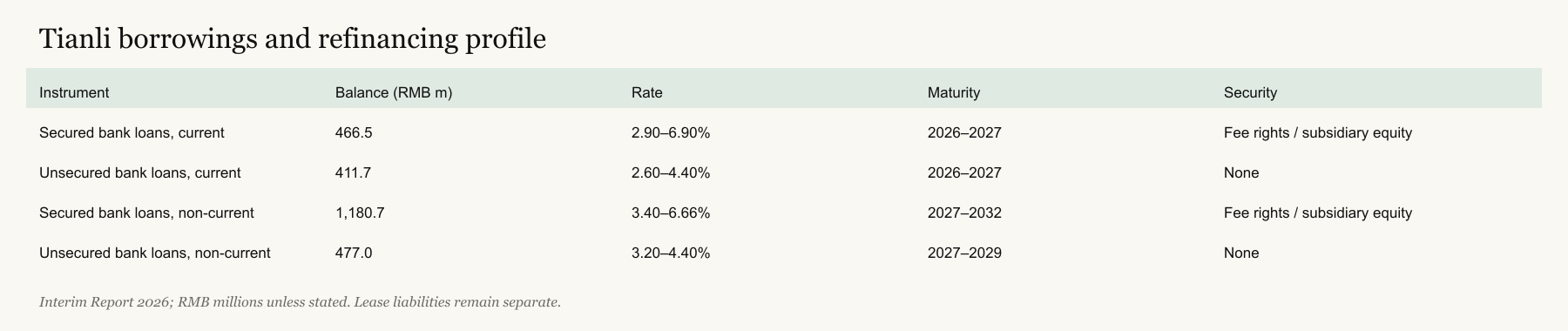
The capital structure at 28 February 2026, disaggregated before classification:
Instrument: Bank loans, secured, current; Balance (RMB'000): 145,000; Rate: 2.90-3.60%; Maturity: 2026; Security: Educational service fee rights / subsidiary equity; Availability: ,
Instrument: Bank loans, unsecured, current; Balance (RMB'000): 299,808; Rate: 2.60-3.60%; Maturity: 2026-2027; Security: None; Availability: ,
Instrument: Long-term bank loans, secured, current portion; Balance (RMB'000): 321,460; Rate: 3.40-6.90%; Maturity: 2026-2027; Security: Educational service fee rights / subsidiary equity; Availability: ,
Instrument: Long-term bank loans, unsecured, current portion; Balance (RMB'000): 111,870; Rate: 3.20-4.40%; Maturity: 2026-2027; Security: None; Availability: ,
Instrument: Bank loans, secured, non-current; Balance (RMB'000): 1,180,740; Rate: 3.40-6.66%; Maturity: 2027-2032; Security: Educational service fee rights / subsidiary equity; Availability: ,
Instrument: Bank loans, unsecured, non-current; Balance (RMB'000): 476,960; Rate: 3.20-4.40%; Maturity: 2027-2029; Security: None; Availability: ,
Instrument: Total financial borrowings; Balance (RMB'000): 2,535,838; Security: of which RMB1,647,200 secured; Availability: RMB1,432,710 undrawn committed facilities, drawable over two to three years
Instrument: Lease liabilities, current; Balance (RMB'000): 46,453; Rate: , ; Maturity: within 1 year; Security: , ; Availability: ,
Instrument: Lease liabilities, non-current; Balance (RMB'000): 266,491; Rate: , ; Maturity: beyond 1 year; Security: , ; Availability: ,
Instrument: Total lease liabilities; Balance (RMB'000): 312,944
Instrument: Amounts due to related parties (unsecured, interest-free); Balance (RMB'000): 1,475,108; Rate: nil; Maturity: 1-3 years; Security: None; Availability: ,
Instrument: Cash and cash equivalents; Balance (RMB'000): 449,264
Instrument: Time and restricted deposits; Balance (RMB'000): 9,694
All borrowings are denominated in RMB, which removes currency mismatch, the operating cash flow is RMB too. Financial borrowings are RMB2,535.8 million and lease liabilities RMB312.9 million; they are kept separate and the classification leads on financial borrowings. Against total equity of RMB3,323.0 million, financial borrowings are 76.3% of equity and borrowings plus leases 85.7%; against total assets of RMB10,020.1 million, financial borrowings are 25.3% (the group's own stated gearing measure) and 28.4% including leases. On total liabilities of RMB6,697.0 million the ratio to equity is 201.5%, but that measure is dominated by RMB952.7 million of prepaid tuition, RMB628.6 million of deferred income and RMB1,475.1 million of interest-free related-party balances, none of which is funded borrowing, so the funded-debt measure is the one used for the absolute filter and is stated as such.
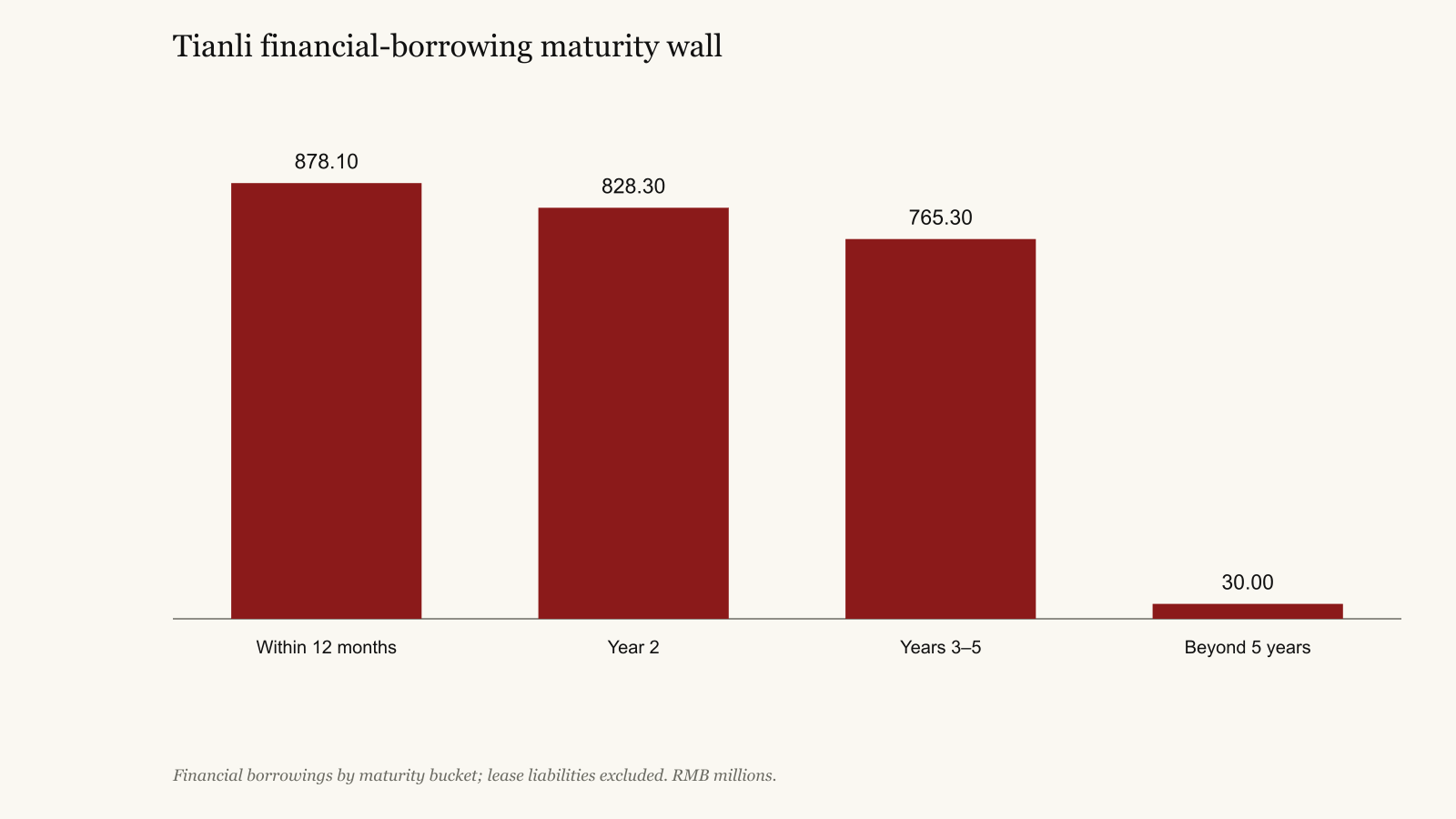
The maturity wall is the near-term item: RMB878.1 million of bank debt falls due within twelve months of 28 February 2026 against RMB449.3 million of cash. Set against that are RMB1,432.7 million of undrawn committed facilities available over two to three years, and the FY2025 profile shows the group refinancing routinely, RMB1,516.0 million drawn and RMB1,192.5 million repaid in FY2025 alone. Beyond that, the FY2025 note shows RMB828.3 million due in the second year, RMB765.3 million in years three to five and RMB30.0 million beyond five years. Interest coverage on FY2025 figures is 10.1 times on an EBITDA basis (EBITDA of RMB1,258.6 million against total finance costs of RMB124.8 million, a blended figure that includes RMB12.4 million of lease interest and is therefore conservative), and pre-tax profit covers finance costs 6.7 times. Effective rates are falling, the interim range is 2.60% to 6.90% against 3.30% to 7.00% a year earlier. No financial covenants are disclosed in either primary filing, and no covenant test, waiver or breach is reported; the security is asset-and-cash-flow pledge rather than maintenance covenant, which is the normal PRC bank structure.
Classification: Manageable. On the grid alone, debt to assets of 25.3% and coverage above 10 times, the name would read Conservative, and that is not the honest answer. The group has run net current liabilities in every one of the last five years, RMB2,313.3 million at 28 February 2026 against RMB2,126.2 million at 31 August 2025, and the directors give an explicit going-concern assessment in both filings resting on the undrawn facilities and a twelve-month cash-flow forecast. The auditor issued a clean opinion with no going-concern paragraph and no material-uncertainty emphasis, and the structural reason for the negative working capital is benign, a prepaid business model books a year of tuition as a current liability. But a company that needs a stated going-concern rationale in every filing is not Conservative. Refinancing risk is real but well covered; the group is not dependent on the equity market.
8. Real Estate, Leases, and Hidden Assets
This is a property-heavy business. At 28 February 2026 owned property, plant and equipment was RMB5,046.4 million, 50.4% of total assets and 157.3% of tangible book value, and right-of-use assets were RMB2,379.5 million, 23.7% of total assets and 74.2% of tangible book value. Right-of-use assets split RMB2,107.9 million of land use rights and RMB271.6 million of buildings and other premises, and the land-use-rights balance grew by RMB189.0 million in the half as the group prepaid for new sites, a further RMB463.5 million of prepayments for land use rights sits in non-current other receivables, up from RMB200.0 million at the year end. Matching lease liabilities are only RMB312.9 million, because most land use rights in China are acquired by a single upfront premium for a fifty-year term rather than by periodic rent, so the asset is largely paid for rather than owed.
Right-of-use assets are a capitalized right to occupy, not a liquidation floor, and they are disclosed here rather than stripped out of the tangible book value used everywhere in this report, removing an asset without removing its matching liability is the wrong operation, and in this case the matching liability is small precisely because the right was prepaid. The genuine downside support in the tangible book is the RMB5,046.4 million of owned school buildings and equipment, of which RMB651.6 million of buildings do not yet have property ownership certificates and therefore cannot be sold, transferred or mortgaged until those certificates are obtained (Interim Report 2026, note 8(a)). That is 12.9% of the owned property balance and a real, disclosed constraint on realisability, improved from RMB695.8 million at the year end.
Hidden asset value is plausible but unquantified. The land was acquired progressively from 2002 onward in second- and third-tier Chinese cities and is carried at amortised cost; no revaluation, appraisal or fair-value disclosure for the property portfolio appears in either filing, so any claim that it is worth more than book is inference, not fact. Working in the other direction, RMB1,647.2 million of bank loans are secured on subsidiary equity and school fee rights, and RMB985.2 million of the 2021 impairment against assets occupied by the deconsolidated schools was still carried net at 1 September 2025, those particular buildings are occupied rent-free by entities the group does not consolidate, which is why they were impaired in the first place and why RMB81.9 million of that impairment was written back in the half on the strength of newly obtained art-training operating licences. There is no sale-leaseback program and no disclosed intention to monetize property.
9. Capital Markets Access, Dilution, and Financing Flexibility
The share count is shrinking, and that is the finding. Shares in issue went 2,154,000,000 (31 August 2023) to 2,115,654,000 (31 August 2024) to 2,109,180,000 (31 August 2025) to 2,109,255,000 (28 February 2026), the last small rise being 75,000 shares from option exercises; over the same period treasury shares rose to 20,727,000 and a further 33,711,100 sit with the award-scheme trustee, so shares genuinely outstanding fell to 2,054,816,900. Weighted-average diluted shares fell from 2,114,964,000 (FY2024) to 2,084,739,000 (FY2025) to 2,065,649,000 in the interim half. Net repurchases were RMB31.3 million of cash in FY2025 (RMB38.8 million spent, RMB7.5 million received on option exercises) and RMB50.4 million in the interim half, and 13,227,000 repurchased shares were canceled in June 2026 on a third-party account.*
The dilution overhang is nominally 67,825,000 outstanding share options, 3.2% of issued shares, plus 4,515,000 unvested award shares. Every option is deeply out of the money: exercise prices are HK$2.38, HK$2.48 and HK$4.72 against a HK$1.02 share price, so at present none represents realistic dilution, but they also represent management incentives that are entirely worthless at today's price, which is its own governance observation. The general mandate to issue new shares was renewed at the 2026 annual general meeting with 98.46% support, so the capacity to issue up to 20% exists; it has not been used since the December 2020 placing and subscription, whose HK$695.0 million of net proceeds were fully applied by 31 August 2025. The company confirms it conducted no equity fund-raising in FY2025. With RMB852.6 million of annual operating cash flow, RMB449.3 million of cash and RMB1,432.7 million of undrawn committed bank lines, the group does not depend on the equity market to fund operations. Dilution risk is judged low.
10. Litigation, Regulatory, and Contingent Liability Risk
The notes reached in the primary documents are the annual report's Report of the Directors section headed "Litigation", the "Contingent Liabilities" and "Capital Commitments" disclosures in both the annual Financial Review and the interim Management Discussion and Analysis, note 32 / note 19 Commitments, note 37 Financial Guarantee Contracts, and note 33 / note 20 Related Party Transactions and Balances. On litigation the annual report states plainly that the group did not have any material litigation outstanding as at 31 August 2025; there is no separate legal-proceedings note in the financial statements because none is required, and the interim report repeats no litigation disclosure. On contingent liabilities both filings state that the group did not have any material contingent liabilities (31 August 2025: nil; 28 February 2026: nil), which sits awkwardly beside note 37 and is worth stating precisely: the group carries RMB254.0 million of financial guarantees for the deconsolidated Affected Business at 28 February 2026 (RMB374.0 million at 31 August 2025), recognises no expected-credit-loss allowance against them, classifies the exposure as Stage 1 and reports no transfers between stages. Management's position is that the initial fair value of those guarantees was not significant and no loss is expected; a reader should treat "no material contingent liabilities" as a statement about expected loss, not about gross exposure.
Capital commitments contracted but not provided for were RMB37.8 million at 28 February 2026, immaterial against a RMB10.0 billion balance sheet.
The prior-disclosure carry-forward produces three live items and no surprises. First, the 2021 Implementation Regulations: open since May 2021, still open, with the company stating that as at the date of the FY2025 report national and local classification-management regulations have still not been issued and it will make further announcements as appropriate. Second, the social insurance and housing provident fund non-compliance disclosed in the 2018 prospectus: the company states that as at 31 August 2025 it has established sufficient provision, which is a status update rather than a resolution, and the provision amount is not separately disclosed. Third, the qualification requirement under the Sino-foreign school-operation regulations, which the group has never satisfied: its stated remedy is to acquire or partner with overseas schools, a plan still described in the present tense in both filings. Subsequent events were nil in both, the annual reports none after 31 August 2025 up to 28 November 2025, and interim note 22 none after 28 February 2026 as at 10 April 2026. Two latent tax items round this out: RMB892.0 million of mainland tax losses carrying no deferred tax asset, and RMB2,259.2 million of unremitted subsidiary earnings on which no deferred tax has been provided, a RMB113.0 million liability at the 5% withholding rate if the group ever repatriated in full.
The single largest contingent exposure is not in any of these notes: it is the structured-contract architecture itself, discussed in the relevant discussion and carried as the top row of the risk matrix.
11. Accounting Quality and Disclosure Review
The auditor is Ernst & Young, unchanged for at least three years, and the opinion on the FY2025 statements is unqualified with no going-concern paragraph, no material-uncertainty emphasis and no reported material weakness. The interim was subject to an independent review, also by Ernst & Young, with the standard negative-assurance conclusion. Two key audit matters were reported. The first is revenue recognition, flagged for size and transaction volume rather than for any specific concern, with the usual controls, cut-off and analytical procedures. The second is the one that matters: the impairment assessment of property, plant and equipment and right-of-use assets occupied by the deconsolidated Affected Business, where the auditor engaged internal valuation specialists to test the discount rates and cash-flow projections behind a RMB100.0 million reversal of previously recognized impairment.
That reversal is the accounting item to watch. It flows straight into reported profit, RMB100.0 million in FY2025 and a further RMB81.9 million in the interim half, and it rests on directors' value-in-use calculations for assets the group does not consolidate and does not charge rent for, discounted at pre-tax rates of 17.0% and 17.4%, triggered by the schools obtaining art-training operating licences. The disclosure is good: the interim gives recoverable amount, carrying amount and reversal for each of two cash-generating units, and the recoverable amount of RMB190.7 million exceeds the carrying amount of RMB86.7 million. To the company's credit, its own adjusted-profit reconciliation strips the reversal out, so management is not presenting it as operating performance. But RMB181.9 million of pre-tax profit across eighteen months is estimate-driven, non-cash and reversible, and RMB985.2 million of the original impairment remained available to write back at 1 September 2025.
Elsewhere the picture is clean. Goodwill is small, RMB97.6 million, 3.0% of tangible book, and RMB8.8 million of it was impaired at FY2025 when a repetition school's enrolment fell; management explicitly states it performed no goodwill impairment test at 28 February 2026, which is permitted (IAS 36 requires an annual test) but is a disclosed choice worth noting the year after an impairment. Net deferred tax assets of RMB276.1 million rest largely on the impairment losses; RMB892.0 million of tax losses carry no deferred tax asset at all, which is conservative. There is one operating segment, so segment transparency is limited by design rather than by choice. Related-party disclosure is detailed and quantified, including pricing methodology, annual caps and guarantee-by-guarantee tables. Non-IFRS adjustments are reconciled line by line. Classification: Adequate, an unqualified opinion, full primary-source verification of every material note, and one genuine estimation-risk area where the auditor's pushback is described and appears proportionate.
12. Valuation and Margin of Safety
Tangible Book Value, Derivation (anchor 2026-02-28, Interim Report 2026 (six months ended 28 February 2026), Interim Condensed Consolidated Statement of Financial Position, pp.27-28; RMB thousands)
Table 1, equity bridge
Line item: Common shareholders' equity; Amount: 3,337,133.0; Source (filing page / tag / note): Equity attributable to owners of the Company, 28 Feb 2026; Period: 2026-02-28; State: present
Line item: − Goodwill; Amount: -97,624.0; Source (filing page / tag / note): note 10; Period: 2026-02-28; State: present
Line item: − Other intangibles; Amount: -32,257.0; Source (filing page / tag / note): Other intangible assets, 28 Feb 2026; Period: 2026-02-28; State: present
Line item: = Tangible book value; Amount: 3,207,252.0; Source (filing page / tag / note): derived: common equity − goodwill − other intangibles; Period: 2026-02-28; State: derived
Line item: ÷ Shares (point in time); Amount: 2,054.817; Source (filing page / tag / note): Interim Report 2026 note 16: 2,109,255,000 shares issued and fully paid, less 20,727,000 treasury shares, less 33,711,100 shares held by the trustee under the Restricted Share Award Scheme (note 17(a)); both blocks are carried as contra-equity in the statement of changes in equity; Period: 2026-02-28; State: present
Line item: = TBV / share; Amount: 1.5608; Source (filing page / tag / note): derived; Period: 2026-02-28; State: derived
Line item: (Minority interest, excluded by line choice, not subtracted); Amount: -14,086.0; Source (filing page / tag / note): , ; Period: 2026-02-28; State: present
P/TBV (derived) = 0.87 ÷ 1.5608 = 0.559× (price as of 2026-09-07)
Table 2, asset composition at the anchor period
Asset: Cash & short-term investments; Amount: 458,958.0; % of total assets: 4.6%; % of TBV: 14.3%
Asset: Accounts receivable; Amount: 94,776.0; % of total assets: 0.9%; % of TBV: 3.0%
Asset: Inventory; Amount: 21,195.0; % of total assets: 0.2%; % of TBV: 0.7%
Asset: Property, plant & equipment (owned); Amount: 5,046,416.0; % of total assets: 50.4%; % of TBV: 157.3%
Asset: Right-of-use lease assets (disclosed, never stripped from TBV); Amount: 2,379,477.0; % of total assets: 23.7%; % of TBV: 74.2%
Asset: Long-term investments; Amount: 13,131.0; % of total assets: 0.1%; % of TBV: 0.4%
Asset: Goodwill; Amount: 97,624.0; % of total assets: 1.0%; % of TBV: 3.0%
Asset: Other intangibles; Amount: 32,257.0; % of total assets: 0.3%; % of TBV: 1.0%
Asset: Other current / noncurrent assets; Amount: 1,876,227.0; % of total assets: 18.7%; % of TBV: 58.5%
Asset: Residual / unclassified; Amount: 0.0; % of total assets: 0.0%; % of TBV: 0.0%
Asset: Total assets; Amount: 10,020,061.0; % of total assets: 100%
Right-of-use note: ROU assets 2,379,477.0 = 74.2% of TBV. ROU is a capitalized right to occupy, not a liquidation floor, disclosed, never stripped out of the TBV/share used everywhere in this report.
No analyst adjustments are made to the bridge, so adjusted tangible book value per share equals tangible book value per share at RMB1.5608 (HK$1.82). The candidate haircut, writing off the RMB873.3 million interest-free receivable from the deconsolidated schools, is run in the scenario table below rather than folded into the headline figure, so the derivation stays a pure filing bridge. Currency: all analysis is in the reporting currency, RMB. One rate is used, HKD1.00 = RMB0.8559 (7 September 2026); the Hong Kong dollar's US peg mid-point of HKD7.80 = USD1.00 is used for the US dollar parentheticals on the decision figures only. History tables are never converted at today's rate.
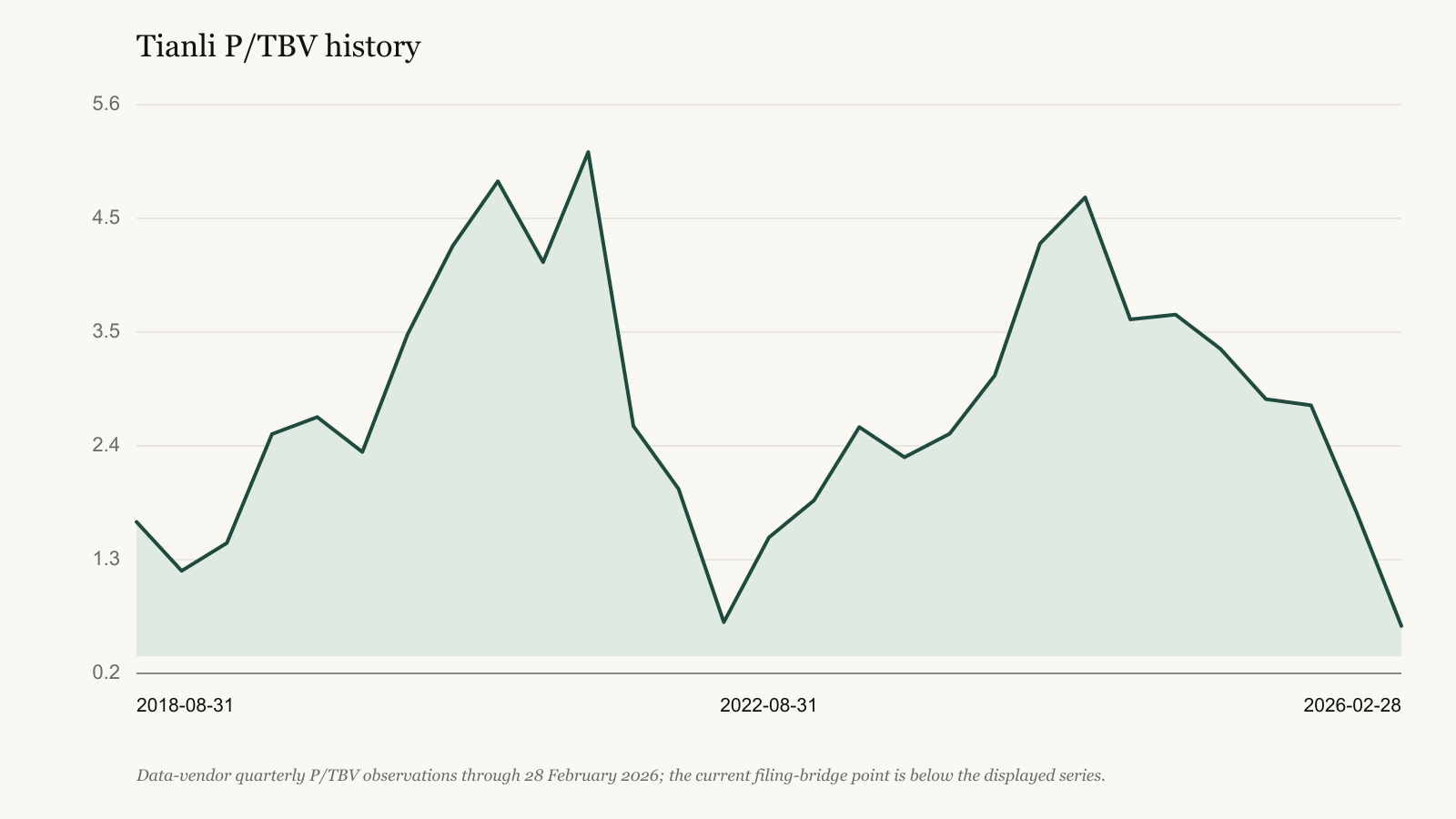
Historical relative multiple valuation. A P/TBV history of 29 observations spanning August 2018 to February 2026, 7.2 years at roughly quarterly cadence, is available from a third-party ratio series; it was not rebuilt point by point from filings and is disclosed as such.* Its distribution is: minimum 0.66×, lower quartile 1.86×, median 2.56×, upper quartile 3.58×, ninetieth percentile 4.39×, top-quartile mean 4.34×, maximum 5.17×. Read in the required order: the typical band is roughly 1.9× to 3.6× tangible book, where the multiple has spent most of its listed life; the floor and ceiling are 0.66× and 5.17×, the floor set only in the most recent observation; and today the derived multiple is 0.559×, below the entire recorded series. The current point is computed from the derivation above, not read off a chart, and it is lower than the series minimum because the price has fallen a further 65% since the last observation. There is no comparable P/TBV series before the 2018 listing, and no sourced normalized-P/E history exists for this issuer, so the earnings leg of this comparison is UNAVAILABLE on the stock's own history and is anchored on peers instead.
Metric: P / TBV (own history, 29 obs, Aug 2018 - Feb 2026); Current: 0.559×; Window floor: 0.66×; Typical band: 1.86× - 3.58×; Window ceiling: 5.17×; Implied price (band): RMB2.90 - RMB5.59 (HK$3.39 - HK$6.53)
Metric: Normalized P/E (peer-anchored, no own-history series); Current: 4.4×; Window floor: , ; Typical band: 3.0× - 8.0×; Window ceiling: , ; Implied price (band): RMB0.60 - RMB1.59 (HK$0.70 - HK$1.86)
The two legs disagree, and the disagreement is the analysis. The book leg says the stock is priced below anything it has ever traded at, implying 3.3 to 6.4 times upside on reversion to its own typical band. The earnings leg, anchored on the 2.95× trailing multiple at which a listed Hong Kong private-education peer traded in April 2026,* says the current 4.4× normalized multiple is roughly where the whole cohort now sits, cheap in absolute terms but not cheap relative to peers. Reconciling rather than averaging: the book leg is measuring how far this specific stock has fallen from its own history; the earnings leg is measuring a sector-wide regime change that has already happened. Both are true. The reconciled demonstrated range for the scenario work below therefore anchors on tangible book multiples, with the peer earnings multiple used as the bear-case check.
* Sourced from a third-party ratio history and third-party market data; not independently verified against source filings.
Sell range (framework rule). [median P/TBV, top-quartile-mean P/TBV] × current adjusted TBV/share over the stock's own history gives RMB4.00 - RMB6.77 (HK$4.67 - HK$7.91; US$0.60 - US$1.01), equivalent to 2.56× - 4.34× tangible book, from 29 observations covering 7.2 years (August 2018 to February 2026) at roughly quarterly cadence, sorted ascending with linear interpolation at the percentile. The distribution behind it is minimum 0.66× · lower quartile 1.86× · median 2.56× · upper quartile 3.58× · ninetieth percentile 4.39× · top-quartile mean 4.34× · maximum 5.17×. The flat 0.80× reference price is RMB1.25, fallback only, not the rule for this name, since the history comfortably exceeds the five-year floor. Neither coherence flag fires: the range starts far above today's price, and the price is nowhere near the top-quartile mean. Today's derived multiple sits at the zeroth percentile of the series.
Where in the range to exit, and why: at or just above the low end, RMB4.00 (HK$4.67), not the top. The range reflects the multiple the market paid when it treated this as a growth compounder inside an expanding regulatory perimeter. The earnings power underlying it has not deteriorated, return on equity was 21.8% in FY2025 against a 16.4% average across the four post-deconsolidation years, so today's returns are above, not below, the period average, and the credibility test the house applies to a sell range (current returns 30% or more below the multi-year average) does not fire. What has changed is not earnings but the multiple regime the whole cohort is granted, and there is no evidence in the filings that the regime reverts. Treating the median as the exit and the upper quartile as an unexpected gift is the honest reading.
Scenario table. The lens is price to tangible book, the way asset-heavy school operators and the rest of this cohort actually trade, cross-checked against normalized earnings.
Scenario: Severe downside; Key assumption: Structured contracts legislated away for the senior-high perimeter as they were for compulsory education in 2021; Method: Residual tangible book: RMB3,207.3m less the RMB873.3m Affected-Business receivable written to nil, less RMB254.0m of guarantees called in full, less a repeat of the FY2021 impairment at its actual absolute size of RMB1,085.2m, then divided by 2,054.8m shares; Value / share: RMB0.484 (HK$0.57), 0.31× today's unimpaired tangible book, not 0.31× applied as a multiple; vs current (RMB0.873): −45%
Scenario: Bear; Key assumption: No regulatory event; earnings flat at the normalized level and the cohort multiple holds where it is; Method: Normalized EPS RMB0.1989 × the 2.95× trailing multiple observed on a listed peer, rounded to 3.0×; Value / share: RMB0.597 (HK$0.70); vs current (RMB0.873): −32%
Scenario: Base; Key assumption: Business continues as filed; the market pays tangible book, the house's own absolute ceiling and a level this stock exceeded for its entire listed history until 2026; Method: 1.00× TBV/share of RMB1.5608. Cross-check: normalized EPS RMB0.1989 × 8.0× = RMB1.591, agreeing within 1.9%; Value / share: RMB1.561 (HK$1.82); vs current (RMB0.873): +79%
Scenario: Bull; Key assumption: Partial re-rating to the bottom of the stock's own historical band, without recovering the median; Method: 1.86× TBV/share (own-history lower quartile) = RMB2.903. Cross-check: normalized EPS RMB0.1989 × 15.0× = RMB2.984, agreeing within 2.8%; Value / share: RMB2.903 (HK$3.39); vs current (RMB0.873): +233%
The decision figures, stated explicitly. Current price HK$1.02 / RMB0.873 (7 September 2026), market capitalization approximately HK$2.10 billion (RMB1.79 billion; US$269 million). Intrinsic value range, base case: RMB1.56 - RMB2.90 per share (HK$1.82 - HK$3.39). Margin of safety at the current price against tangible book value per share: 44.1%. Buy-Below: RMB2.10 (HK$2.45; US$0.31), 1.35× TBV, read off 7.2 years of the stock's own history, the house construction, computed from the same distribution and window as the sell range. It carries an explicit qualification. RMB2.10 is 1.35× tangible book, which is above the 1.00× absolute ceiling that governs whether a name belongs in this universe at all, so the operative buy price is the lower of the two: RMB1.56 (HK$1.82; US$0.23) at 1.00× TBV. The universe-grid readout is RMB1.01 (0.65× TBV). All three are stated because the pair is internally inconsistent for a stock whose entire recorded valuation history sits above the universe ceiling, and naming the binding constraint matters more than publishing the highest number. Buy More Below: not reachable, the base cell is already the largest size, so there is no next size up. Sell range: RMB4.00 - RMB6.77 (HK$4.67 - HK$7.91), as derived above. Cheapness type: statistically cheap. The stock is cheap on assets, on earnings, on cash flow and against its own history simultaneously, which is the classic statistical profile; the honest qualifier is that a statistically cheap PRC education asset held through contracts rather than equity is exactly the shape a value trap takes, and nothing in the filings excludes that reading.
13. Risk Matrix
Risk: Structured contracts legislated away for senior-high schools, as they were for compulsory education in 2021; Evidence: Annual Report 2025 note 1 and Regulatory Updates; RMB1,085.2m impairment and 30 schools deconsolidated on 31 August 2021; classification-management rules still not issued; Severity: Critical; Probability: Low-Medium; Financial Impact: Loss of consolidation of the entire operating base; Valuation Impact: Tangible book largely unrealisable; the severe-downside case of RMB0.484 or worse; Mitigant: Senior high is post-compulsory and explicitly permitted to be for-profit; the group is pursuing the Sino-foreign qualification route; Monitor: Any State Council or provincial classification-management rule; any announcement on the qualification requirement
Risk: Affected-Business entanglement: receivable and guarantees to entities outside the group; Evidence: Receivable RMB873.3m (up from RMB686.9m two years earlier); guarantees RMB254.0m with no consideration received; no expected-credit-loss allowance recognized (note 20(c)(5), note 37); Severity: High; Probability: Medium; Financial Impact: Up to RMB1,127.3m, 35% of tangible book; Valuation Impact: Minus RMB0.549 per share if fully written off; Mitigant: Net position is a RMB526.5m payable to the same counterparties; guarantee exposure fell from RMB374.0m in twelve months; Monitor: The receivable balance at each reporting date; any allowance being raised; the guarantee schedule in note 37
Risk: Dividend suspension signals a change in payout policy or a cash constraint; Evidence: Board resolution 10 April 2026: nil interim dividend against RMB5.78 cents; cash fell from RMB965.2m to RMB449.3m in the half; capex RMB540.2m against RMB218.1m; Severity: High; Probability: Confirmed (already occurred); Financial Impact: Removes roughly half the distribution run rate; Valuation Impact: Yield support for the shares halves; Mitigant: Operating cash flow rose to RMB520.3m in the half; RMB1,432.7m undrawn facilities; Monitor: The FY2026 final dividend declaration, expected with the annual results in November 2026
Risk: Near-term maturity wall against reduced cash; Evidence: RMB878.1m of bank debt due within 12 months of 28 February 2026 against RMB449.3m of cash; current ratio fell from 0.487 to 0.416; Severity: Medium-High; Probability: Medium; Financial Impact: Refinancing at higher cost, or capex deferral; Valuation Impact: Multiple compression on liquidity fear; Mitigant: RMB1,432.7m undrawn committed facilities; RMB1,516.0m drawn and RMB1,192.5m repaid in FY2025 without incident; Monitor: Interim and annual cash balance, undrawn facility disclosure, effective interest rate range
Risk: Impairment reversals flatter reported profit; Evidence: RMB100.0m reversed in FY2025 and RMB81.9m in H1 FY2026, on directors' value-in-use estimates at 17.0 to 17.4% discount rates for assets occupied by non-consolidated schools; RMB985.2m of the original charge still carried net; Severity: Medium; Probability: High (recurring); Financial Impact: Up to 28% of FY2025 pre-tax profit is estimate-driven and non-cash; Valuation Impact: Overstates the earnings base a multiple is applied to; Mitigant: The company's own adjusted-profit measure strips it out; the auditor used valuation specialists on it as a key audit matter; Monitor: The impairment note in each filing; whether reversals continue and on what trigger
Risk: Governance: 46.13% control, combined chairman and chief executive, cost-plus related-party construction; Evidence: CG Code C.2.1 deviation; Nanyuan Construction at cost plus 9 to 11%, RMB50.1m in H1 FY2026 against RMB7.3m a year earlier; nomination committee chaired by the controlling shareholder; Severity: Medium-High; Probability: High (ongoing); Financial Impact: Value leakage of unknown size through construction pricing; Valuation Impact: Persistent governance discount; Mitigant: Annual director elections held and polled; caps stepping down to RMB170m by FY2027; auditor and independent-director review under Chapter 14A; Monitor: Half-yearly related-party note; the FY2026 transaction total against the RMB210m cap
Risk: Mix shift into low-margin product sales erodes group margin; Evidence: Product sales up 45.6% against procurement cost up 49.6% in H1 FY2026; group gross margin down 2.4 points to 35.2%; Severity: Medium; Probability: High (already occurring); Financial Impact: Each further point of margin is roughly RMB43m of gross profit annualised; Valuation Impact: Compresses the normalized earnings anchor; Mitigant: Education-services margin itself is stable; management fees are high-margin and growing 38.7%; Monitor: Half-yearly revenue mix and gross margin by line
Risk: Buildings without ownership certificates limit realisability of the asset floor; Evidence: RMB651.6m of buildings, 12.9% of owned property, cannot be sold, transferred or mortgaged until certificates are obtained (note 8(a)); Severity: Medium; Probability: Medium; Financial Impact: Reduces collateral and liquidation value; Valuation Impact: Weakens the asset-backed argument; Mitigant: Balance fell from RMB695.8m in six months, so certification is progressing; Monitor: The note 8 disclosure at each reporting date
Risk: Sector-wide de-rating persists regardless of results; Evidence: 16 of 21 Hong Kong-listed private-education issuers down more than 70% from peak; a peer at 2.95 times trailing earnings; the shares down about 57% year to date on results that improved; Severity: Medium; Probability: High; Financial Impact: None on the business; Valuation Impact: The base case simply never arrives; Mitigant: The chairman's vehicle bought 37,579,000 shares and a disclosed institution added 90,989,000 during the fall; Monitor: Cohort multiples; index and connect-eligibility changes; the FY2026 results reaction
14. Red Flags, Yellow Flags, and Green Flags
🟢 Green Flags
The controlling shareholder's vehicle bought 37,579,000 shares (about 1.8% of the company) in the six months to 28 February 2026, lifting his interest from 44.35% to 46.13% as the shares fell from roughly HK$3.60 to under HK$3.00; a disclosed institution added 90,989,000 shares over the same period, going from 12.00% to 16.31%.
Piotroski F-Score 8/9, with only the leverage signal failing, and that failure caused by terming out short-dated debt rather than by distress.
Operating cash flow of RMB852.6 million in FY2025 on reported profit of RMB648.1 million, 132% conversion, with free cash flow of RMB449.0 million after RMB403.6 million of growth capital expenditure.
Share count falling every year since 2023 (2,154.0m to 2,109.3m issued, and 2,054.8m genuinely outstanding), with all 67,825,000 outstanding options struck at HK$2.38 or above and therefore valueless at HK$1.02.
Unqualified Ernst and Young opinion, and related-party disclosure that quantifies pricing method, annual caps and guarantee-by-guarantee exposure.
🟡 Yellow Flags
Cash fell from RMB965.2 million to RMB449.3 million in the six months to 28 February 2026 while capital expenditure rose from RMB218.1 million to RMB540.2 million; the current ratio fell from 0.487 to 0.416.
Gross margin fell 2.4 points to 35.2% in the half as low-margin product sales grew 45.6% and became almost a third of revenue.
RMB181.9 million of impairment reversals across FY2025 and H1 FY2026 flow into reported profit on directors' value-in-use estimates for assets occupied by schools the group does not consolidate.
RMB651.6 million of buildings cannot be sold, transferred or mortgaged pending ownership certificates.
No goodwill impairment test was performed at 28 February 2026, the reporting date immediately after a RMB8.8 million goodwill write-down.
As of 31 August 2026: the joint company secretary resigned, with no reason verified from a primary source.*
🔴 Red Flags
The interim dividend was cut to nil on 10 April 2026, from RMB5.78 cents a share, in a half year when profit rose 21.0%, with no explanation offered in the interim report.
Interest-free, unsecured lending to the deconsolidated Affected Business keeps growing: RMB686.9m to RMB873.1m over two years, plus RMB254.0 million of guarantees for which the group receives nothing.
The entire operating business is controlled by contract, not equity, and the identical structure was overridden by regulation in 2021 at a cost of RMB1,085.2 million and thirty schools.
Cost-plus-9-to-11% construction with the chairman's own company jumped 6.9 times half on half, to RMB50.1 million from RMB7.3 million, against annual caps that step down each year.
Buybacks destroyed capital: 30,116,000 shares bought for roughly HK$99.0 million at a blended HK$3.29, now worth about HK$30.7 million, a 69% loss on the capital deployed.
⚡ Must-Watch Catalysts
FY2026 annual results and the final dividend decision, expected late November 2026, the single most informative event, since it reveals whether the interim suspension was a policy change or a timing decision.
First consolidation of the art-education acquisition announced 9 to 10 June 2026 (RMB104 million for 10% plus RMB140.8 million of capital, taking the stake to 51%), which should appear in the FY2026 accounts.*
7 September 2026: the earliest date on which the 20% minority holder of an acquired subsidiary may require the group to buy out its stake at not less than acquisition-date valuation.
The autumn 2026 enrolment number, against roughly 60,000 high-school students a year earlier.
Any State Council or provincial classification-management rule issued under the 2021 Implementation Regulations.
FINAL VALUE-INVESTING RECOMMENDATION
Verdict: BUY, BIG
Dimension: Current Price; Assessment: HK$1.02 (7 September 2026) = RMB0.873 at HKD1.00 = RMB0.8559; market capitalization approximately HK$2.10bn (RMB1.79bn; US$269m) on 2,054,816,900 shares outstanding
Dimension: Valuation and balance-sheet screens (the valuation framework); Assessment: PASS. P/TBV 0.559× against the 1.00× ceiling. Funded debt to equity 76.3% (financial bank borrowings RMB2,535.8m ÷ total equity RMB3,323.0m), not net of cash; 85.7% including RMB312.9m of lease liabilities, which are stated separately per IFRS 16; total liabilities to equity 201.5% but dominated by prepaid tuition, deferred income and interest-free related-party balances rather than funded borrowing
Dimension: Piotroski F-Score (the relevant discussion); Assessment: 8/9, Eligible. Failed signal: leverage did not decrease (debt/average assets 23.6% vs 20.8%), caused by terming out short-dated debt. Floor rule did NOT fire: liquidity improved in the same year (current ratio 0.487 vs 0.476). On the interim balance sheet the liquidity signal would also fail, which would fire the floor rule at the next annual, a flag, not a fact about this score
Dimension: P / TBV (derived: price ÷ filing TBV/share, date); Assessment: 0.559× (filing TBV/share RMB1.5608 at 28 February 2026; price 7 September 2026)
Dimension: Normalized P/E; Assessment: 4.4× on normalized net income of RMB408.7m, being the four-year average of complete post-deconsolidation years FY2022-FY2025 and also the lower of that average and trailing-twelve-month RMB730.0m. Graham-flavoured, not literally Schloss. Sensitivity: 29.6× if the eight-month FY2021 transition stub is included as a comparable year
Dimension: Cash Return (dividend + buyback yield); Assessment: 4.5% forward run rate on the last declared distribution (final FY2025 dividend RMB3.90 cents ÷ RMB0.873) plus roughly 2.8% of market capitalization of net buybacks in H1 FY2026 (RMB50.4m). On the FY2025 declared basis it was 11.1% dividend yield plus 1.7% net buyback = 12.8%; the interim FY2026 dividend was suspended, so the forward figure is the operative one
Dimension: Cheapness Tier, Numbers Only (the valuation framework); Assessment: Big, the base cell only, unmodified: P/TBV row 0.50×-0.65×, normalized P/E column ≤ 12×. On the FY2021-inclusive normalization sensitivity the same P/TBV row and the > 20× column read Small
Dimension: Capital-Allocation Warnings; Assessment: 2 fired. (2) Capital and credit routed to policy-driven entities outside the group, RMB873.3m interest-free receivable from the deconsolidated Affected Business, growing, plus RMB254.0m of guarantees for no consideration. (3) Dividend suspension, nil interim for H1 FY2026 against RMB5.78 cents, in a half when profit rose 21.0%. Warnings (1) control and (5) pay/related-party pricing are BORDERLINE, not fired; warning (4) is UNASSESSABLE
Dimension: governance-warning total Downgrade Applied?; Assessment: No. Neither flag is applied to the tier (framework rule, 2026-08-28). Shareholder-yield flag +1 notch-equivalent (yield ≥ 3.0%, free cash flow explicitly not weak); the valuation framework 2 warnings fired, −1 notch-equivalent. Both are reported for a human to weigh after seeing them, and neither moved the tier above
Dimension: Intrinsic Value Range; Assessment: RMB1.56 - RMB2.90 per share (HK$1.82 - HK$3.39), base to bull, from the tangible-book anchor cross-checked against normalized earnings
Dimension: Margin of Safety; Assessment: 44.1% against tangible book value per share of RMB1.5608 at the current price of RMB0.873
Dimension: Buy-Below Price (framework price, absolute valuation ceiling); Assessment: RMB2.10 (HK$2.45; US$0.31), 1.35× TBV, 7.2-year own-history lower-quartile mean. Qualified: that price is above the 1.00× absolute universe ceiling, so the operative buy price is the lower RMB1.56 (HK$1.82) at 1.00× TBV; the universe-grid readout is RMB1.01 (0.65× TBV)
Dimension: Buy More Below; Assessment: Not reachable, the base cell is already the largest size, so there is no next size up
Dimension: Sell Range (the relevant discussion); Assessment: RMB4.00 - RMB6.77 (HK$4.67 - HK$7.91; US$0.60 - US$1.01) = 2.56× - 4.34× TBV, from 29 observations over 7.2 years; percentiles sorted ascending with linear interpolation; flat 0.80× reference RMB1.25 is fallback only, not the rule for this name; no coherence flag fires; expected exit at or just above the low end, since the upper quartile reflects a multiple regime the cohort no longer receives
Dimension: Mainland-China Sizing Overlay (the sizing overlay ); Assessment: Triggered. Numbers-only tier Big is unchanged by the overlay, but this is a mainland-core business (operations, revenue and PRC-domiciled operating entities are entirely mainland Chinese, controlled through structured contracts) merely listed in Hong Kong, the overlay's own worked example of what does NOT get the "HK listing alone" exemption. Economic-risk bucket: mainland_china. Default max fresh-money entry tier: Standard, not Big. No dated human override is on file, so Standard is the operative cap pending one
Dimension: Position Sizing Guidance; Assessment: Numbers-only tier Big, capped to Standard by the Mainland-China entry-sizing overlay above, under a hypothetical general value mandate applied the same way to every company, with Governance Risk High and the structured-contract risk disclosed alongside it. General commentary for a publication, never sized to any individual reader
Dimension: Expected Holding Period; Assessment: Three to five years, long enough for two full annual reporting cycles and one regulatory review window
Dimension: Downside Risk; Assessment: RMB0.484 per share (HK$0.57), −45%, on the severe-downside construction in the relevant discussion: the RMB873.3m Affected-Business receivable written to nil, RMB254.0m of guarantees called, and the FY2021 impairment repeated at its actual absolute size of RMB1,085.2m
Dimension: Balance-Sheet Risk; Assessment: Manageable. Debt/assets 25.3% and EBITDA interest cover 10.1× would read Conservative on the grid, but net current liabilities of RMB2,313.3m and a stated going-concern rationale in every filing argue one notch lower
Dimension: Creditworthiness; Assessment: Adequate, all borrowing in RMB at 2.60%-6.90%, no disclosed financial covenants, RMB1,432.7m of undrawn committed facilities, RMB1,516.0m drawn and RMB1,192.5m repaid in FY2025 without incident
Dimension: Governance Risk; Assessment: High (2 warnings fired)
Dimension: Accounting Quality Risk; Assessment: Adequate, unqualified Ernst and Young opinion, two key audit matters with the auditor's procedures described, full primary-source verification of every material note, one genuine estimation-risk area in the impairment reversals
Dimension: Refinancing Risk; Assessment: Moderate, RMB878.1m of bank debt due within twelve months of 28 February 2026 against RMB449.3m of cash, covered by RMB1,432.7m of undrawn committed facilities drawable over two to three years
Dimension: Key Catalysts; Assessment: FY2026 annual results and the final dividend decision (expected late November 2026); autumn 2026 enrolment against roughly 60,000; first consolidation of the June 2026 art-education acquisition; any State Council or provincial classification-management rule under the 2021 Implementation Regulations
Dimension: Primary Thesis Killers; Assessment: (1) Structured contracts overridden for the senior-high perimeter as they were for compulsory education in 2021; (2) the RMB873.3m Affected-Business receivable and RMB254.0m of guarantees proving unrecoverable; (3) a permanent cohort de-rating in which improving results never re-rate the shares
VALUE INVESTOR MUST-WATCH LIST
FY2026 annual results, expected late November 2026, whether the interim dividend suspension of 10 April 2026 was a timing decision or a policy change, and whether a final dividend is declared at all.
The Affected-Business receivable at 31 August 2026, which has risen RMB686.9m to RMB873.1m over two years. A further increase without a repayment schedule, or a first expected-credit-loss allowance against it, changes the tangible-book arithmetic directly.
The RMB254.0m of financial guarantees in the guarantee note: whether the balance keeps falling (it fell from RMB374.0m over twelve months) and whether any Stage 1 classification changes.
RMB878.1m of bank debt maturing within twelve months of 28 February 2026 against RMB449.3m of cash, watch the refinancing and the undrawn facility balance, which was RMB1,432.7m.
Related-party construction with the chairman's company against the FY2026 cap of RMB210m. The half-year figure was RMB50.1m against RMB7.3m a year earlier; the cap steps down to RMB170m in FY2027.
Gross margin and revenue mix. Product sales were 32.3% of half-year revenue and grew 45.6% while group margin fell 2.4 points to 35.2%. Each further point of margin is roughly RMB43m of annualised gross profit.
Impairment reversals, RMB181.9m written back across eighteen months, with RMB985.2m of the original charge still available at 1 September 2025.
Autumn 2026 enrolment, against approximately 60,000 high-school students at the start of the autumn 2025 term and roughly 54,000 the year before.
Insider dealing after 28 February 2026, the chairman's vehicle added 37,579,000 shares and a disclosed institution 90,989,000 in the preceding six months; the record since then was not reached.
7 September 2026, the earliest date on which the 20% minority holder of an acquired subsidiary may put its stake to the group at not less than acquisition-date valuation.
Any classification-management rule issued by the State Council or a province under the 2021 Implementation Regulations, and any movement on the Sino-foreign qualification requirement the group has never satisfied.
RMB1.56 (HK$1.82), the 1.00× tangible-book line, the operative buy-below constraint and the level at which the absolute universe filter stops binding.
RMB4.00 (HK$4.67), the low end of the sell range and the price at which the sell question goes live.
The certification of RMB651.6m of buildings that currently cannot be sold, transferred or mortgaged; the balance fell RMB44.2m over the half.
Cohort valuation, with 16 of 21 listed Hong Kong private-education names down more than 70% from peak, a re-rating here most likely arrives as a sector event, not a company one.
SOURCES AND DILIGENCE GAP LOG
Successfully Accessed:
Annual Report 2025, incl. Independent Auditor's Report, Report of the Directors, Corporate Governance Report and audited consolidated financial statements | annual report | FY ended 31 August 2025 | published 2025-12-30 | HKEXnews, Tianli International Holdings Limited, stock code 1773, read in full as the primary document
Interim Report 2026, incl. Independent Review Report and interim condensed consolidated financial statements | interim report | six months ended 28 February 2026 | published 2026-05-15 | HKEXnews, stock code 1773, read in full as the primary document
Poll Results of Annual General Meeting held on 28 January 2026 | exchange announcement | AGM 2026 | published 2026-01-28 | HKEXnews, stock code 1773, resolution-by-resolution poll results, issued-versus-voting share reconciliation, board composition
Last traded price HK$1.02 and market capitalization HK$2.13bn | market quote | 7 September 2026, 16:08 HKT | https://www.google.com/finance/quote/1773:HKG | SECONDARY
Quote HK$1.025, year-to-date minus 56.93%, five-day minus 7.24%, market capitalization HK$2.14bn, two covering brokers | market data | 7 September 2026 | https://in.marketscreener.com/quote/stock/TIANLI-INTERNATIONAL-HOLD-45344000/ | SECONDARY, used as the second independent price check
HKD/CNY mid-market rate, 1 HKD = 0.8559 CNY | FX reference | 7 September 2026 | https://wise.com/us/currency-converter/hkd-to-cny-rate/history | SECONDARY
Discloseable transaction: a subsidiary to acquire 10% of an art-education group for RMB104m plus a RMB140.8m capital injection, taking the holding to 51% | press account of an exchange announcement | announced 9 to 10 June 2026 | https://cj.sina.com.cn/articles/view/5115326071/130e5ae7702002wd82 | SECONDARY
Share retirement of 13,227,000 repurchased shares (16 June 2026); resignation of the joint company secretary (31 August 2026) | corporate-actions summary | to 31 August 2026 | https://in.marketscreener.com/quote/stock/TIANLI-INTERNATIONAL-HOLD-45344000/ | SECONDARY
Broker note maintaining an Outperform rating, FY2026 to FY2028 revenue estimates RMB3,915m / 4,225m / 4,499m and adjusted net profit RMB741m / 821m / 901m | sell-side summary | 12 February 2026 | https://finance.sina.com.cn/stock/hkstock/hkgg/2026-02-12/doc-inhmpyya2953138.shtml | SECONDARY, context only, no estimate from it is used in any derivation
Sector context: 16 of 21 Hong Kong-listed private-education issuers down more than 70% from peak, 11 trading below HK$1 | press coverage | 17 February 2026 | https://www.finet.com.cn/news/67b31e7b5a771241dd7752ca.html | SECONDARY
Peer valuation: a Hong Kong-listed private-education comparable at a 2.95 times trailing P/E and an 11.3% dividend yield | market data | April 2026 | https://www.investing.com/equities/china-kepei-education-group | SECONDARY, the peer anchor for the earnings leg in the relevant discussion
Third-party P/TBV ratio history, 29 observations, August 2018 to February 2026 | ratio series | to 28 February 2026 | SECONDARY, the source for the sell-range distribution; not rebuilt point by point from filings, and disclosed as such wherever it is used
Diligence Gaps, Data Not Found or Estimated:
Litigation note, checked in the Annual Report 2025 (Report of the Directors, section headed "Litigation"): the group states it had no material litigation outstanding as at 31 August 2025, and no separate legal-proceedings note exists in the financial statements. A finding, not a gap.
[UNAVAILABLE] Exchange announcement archive, June to September 2026. The exchange's announcement search and several mirror hosts returned 403, 429 or empty responses. Why it matters: this is the six-month window in which the shares fell roughly 45%, and it contains the June 2026 art-education acquisition, the June 2026 share share retirement and the August 2026 company-secretary resignation. Effect: all three are carried as third-party summaries with an explicit footnote, and no figure from any of them enters the tangible-book bridge, the F-Score or the valuation. No primary-source explanation for the share-price collapse was located; the analysis attributes it to the cohort-wide de-rating on peer evidence rather than to any company-specific event, and a reader should treat that attribution as inference.
[UNAVAILABLE] Disclosure-of-interests register after 28 February 2026. Not reached. Why it matters: the controlling shareholder's vehicle bought 37,579,000 shares and a disclosed institution 90,989,000 in the six months to that date, and whether that continued is a live signal. Effect: all insider and substantial-shareholder positions in this report are stated as at 28 February 2026 and are not updated.
[UNAVAILABLE] Earnings-call transcript or shareholder question-and-answer record. Not located for either the FY2025 or the H1 FY2026 results. Effect: capital-allocation warning 4 is recorded as UNASSESSABLE rather than as not fired, and the absence of an explanation for the interim dividend suspension could not be tested against management's own words.
[UNAVAILABLE] Detailed FY2021 to FY2023 cash-flow and debt disclosure. The earlier annual reports were not retrieved, so operating cash flow, capital expenditure, total debt, goodwill and intangibles are populated only for FY2024 and FY2025; earlier years in the fundamentals table come from the five-year Financial Summary in the FY2025 annual report. Effect: the F-Score is computed on FY2025 against FY2024 with FY2023 supplying beginning-of-year assets, which is the standard construction; the normalization window is four years rather than the house default of ten.
[INFERRED] Normalized earnings basis. FY2021 is an eight-month transition period whose result is dominated by the 2021 deconsolidation, and it is excluded from the normalization on comparability grounds. Why it matters: including it moves normalized net income from RMB408.7m to RMB60.6m and the normalized multiple from 4.4 times to 29.6 times, which moves the base cheapness cell from Big to Small. Effect: both readings are stated in the relevant discussion and in the Final Recommendation; this is the single largest judgment in the report.
[ESTIMATED] Maintenance capital expenditure. Not disclosed separately; proxied at RMB195.3m for FY2025 as depreciation of owned property, plant and equipment plus amortisation of intangibles. Effect: normalized owner earnings of approximately RMB525.1m is an estimate, labeled as such, and no valuation figure in the relevant discussion depends on it.
[UNAVAILABLE] Property valuation. No appraisal, revaluation or fair-value disclosure exists for the owned school property portfolio. Effect: any claim that the land and buildings are worth more than the RMB5,046.4m carrying value would be speculation, and none is made.
[UNAVAILABLE] Debt covenants. Neither primary filing discloses financial covenants, maintenance tests or headroom. Effect: the report states that none is disclosed rather than that none exists, and covenant risk cannot be sized.
[UNAVAILABLE] Social insurance and housing provident fund shortfall. The company states sufficient provision has been established as at 31 August 2025 but does not quantify it. Effect: a legacy compliance item is carried forward as open-but-provided, unquantified.
Overall Data Quality Rating: GOOD
Both primary filings were retrieved and read in full as primary documents, and the litigation, debt, related-party, subsequent-events, leases, segment, going-concern and auditor-opinion notes were all reached in those primaries, the standard for the top rating. The rating is set one notch below it for one specific reason: the most recent six months of the record, June to September 2026, containing the sharpest part of the share-price decline and three corporate actions, could not be opened at the exchange and rests on third-party summaries, and the disclosure-of-interests register for the same period was not reached. Every figure used in the tangible-book bridge, the F-Score, the debt tests and the valuation comes from a primary filing; nothing from the third-party window enters a derivation.