

1. Scorecard
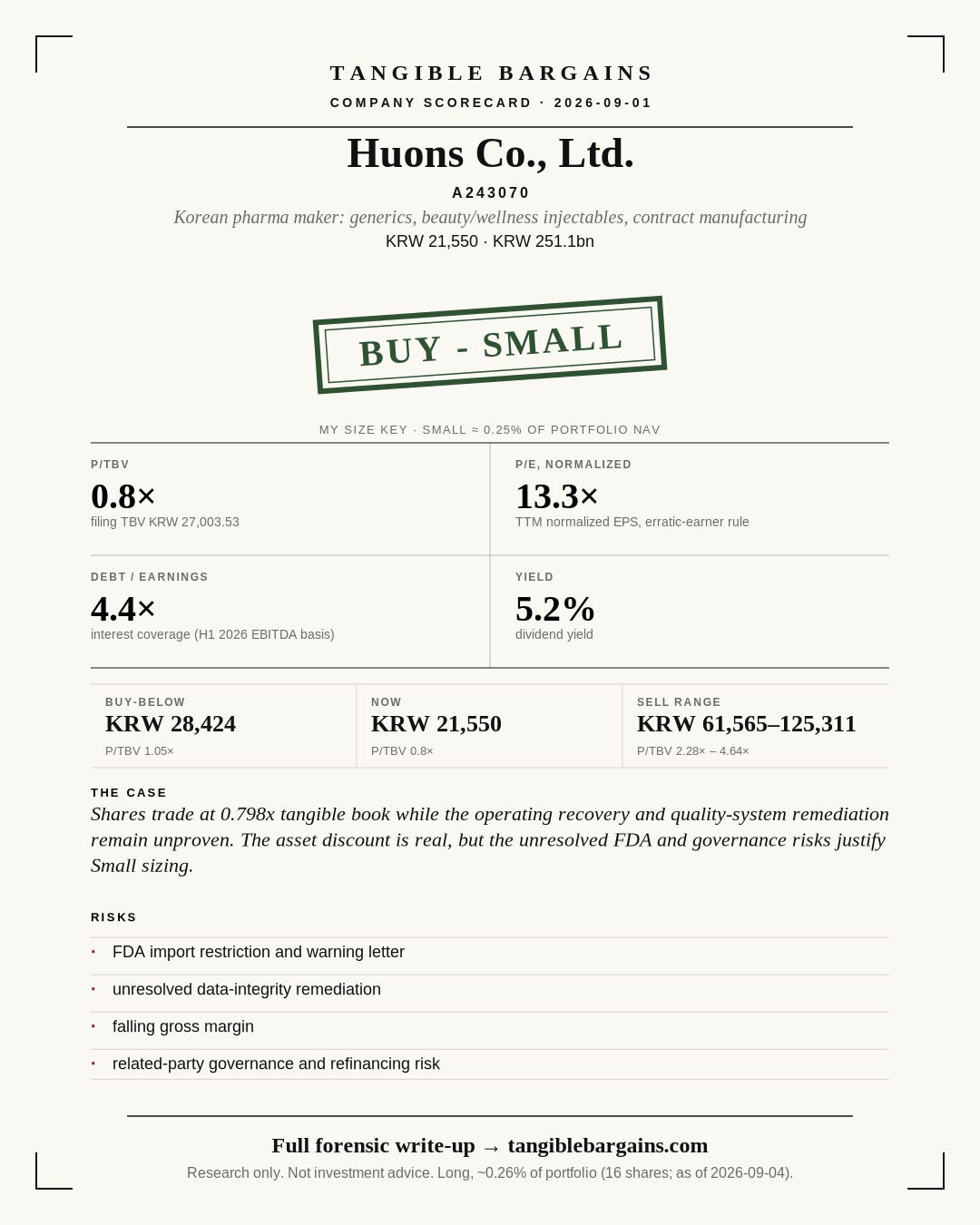
Position: Long, ~0.26% of portfolio (16 shares; as of 2026-09-04)
2. Argument
The short version
Huons trades at 0.798 times tangible book value, the cheapest its shares have been anywhere in a ten-year listed history. Most of that book is real: 83% sits in owned plant and equipment, not leases or intangibles. The company clears the standard debt and quality screens, with a Piotroski F-Score of 7 of 9 and borrowings at 38.9% of equity.
The discount exists because the business is genuinely disrupted. First-half 2026 operating income fell from KRW 25.9bn to KRW 2.28bn and the group posted a small net loss, after the FDA found fabricated laboratory records at the company’s Jecheon plant and halted its US injectable exports in April 2026, followed by a formal warning letter in June. The company’s own sanctions disclosure does not mention the warning letter.
Two of five capital-allocation warnings fired: an unexplained KRW 5.28bn provision that lines up with the recall, and a related-party merger, since abandoned, that briefly halved the share price. The numbers-only tier is Standard, but final sizing is Small given the combination of the fired warnings, a fabrication finding that was deliberate rather than accidental, and FDA’s own rejection of the company’s first attempt to fix it.
Why it qualifies
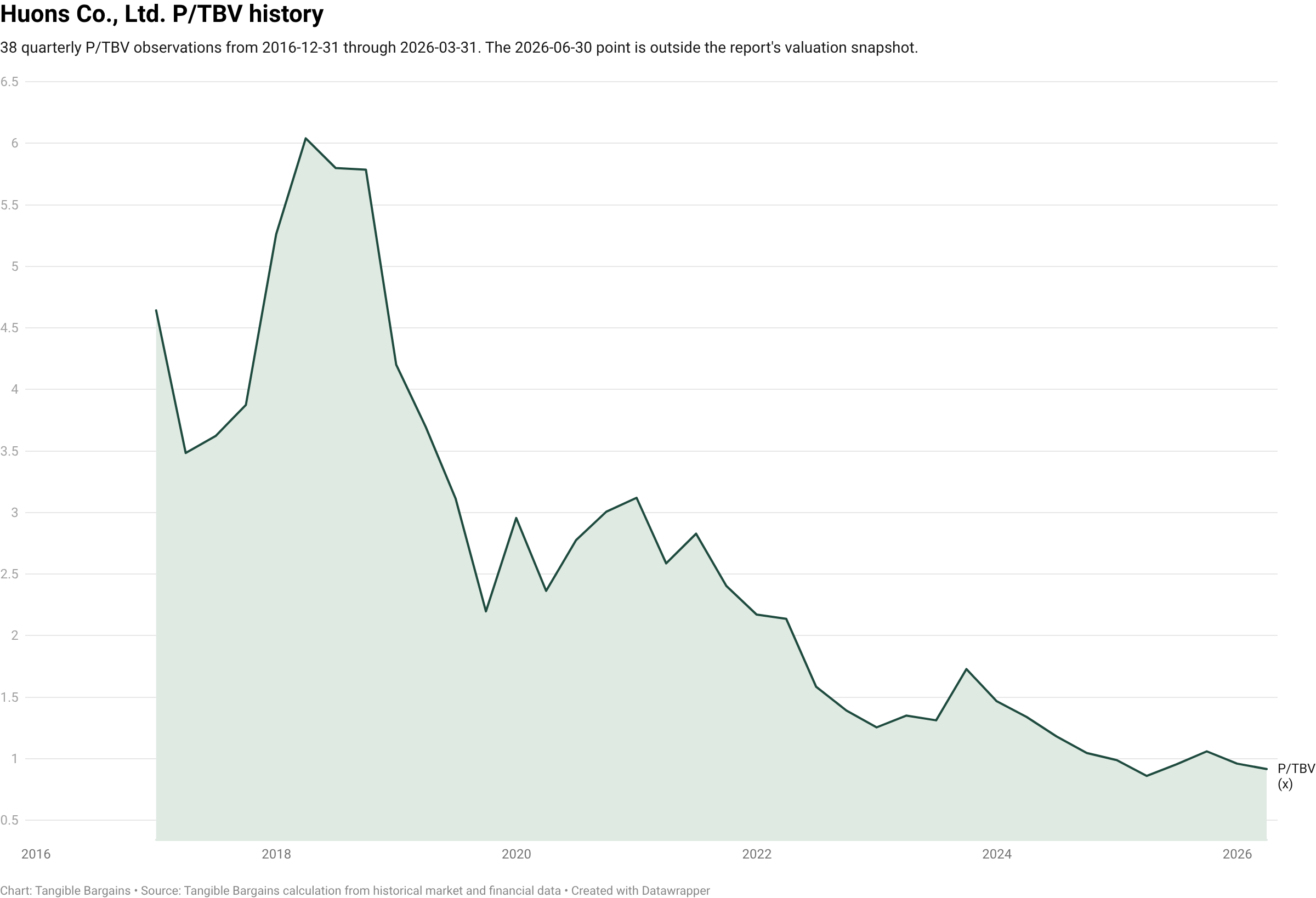
Trades at 0.798x tangible book, below every one of 38 quarterly observations in its own ten-year history.
83% of tangible book is owned land, plant and machinery, not leased space or goodwill.
Piotroski F-Score 7/9; financial borrowings are 38.9% of equity with KRW 60.8bn of undrawn bank credit.
Paid a 5.2% dividend yield over the trailing twelve months, funded entirely from cash, with no equity issued for cash in five years.
Why it is not a clean bargain
FDA warning letter (June 2026): the microbiology team leader admitted to using a knife to cut completed pages out of a logbook, replaced them with rewritten substitutes disguised to look original, and instructed an analyst to backdate and omit bioburden test results. FDA judged Huons’ first corrective-action response (staff dismissals, a new data-integrity team) insufficient. The company’s own sanctions disclosure omits the letter entirely.
Import Alert 66-40 blocks all drugs from the Jecheon plant from US entry, not only the three recalled injectables, and the inspection also cited separate aseptic-processing gaps (airflow, glove monitoring, disinfection procedures) beyond the paperwork fraud.
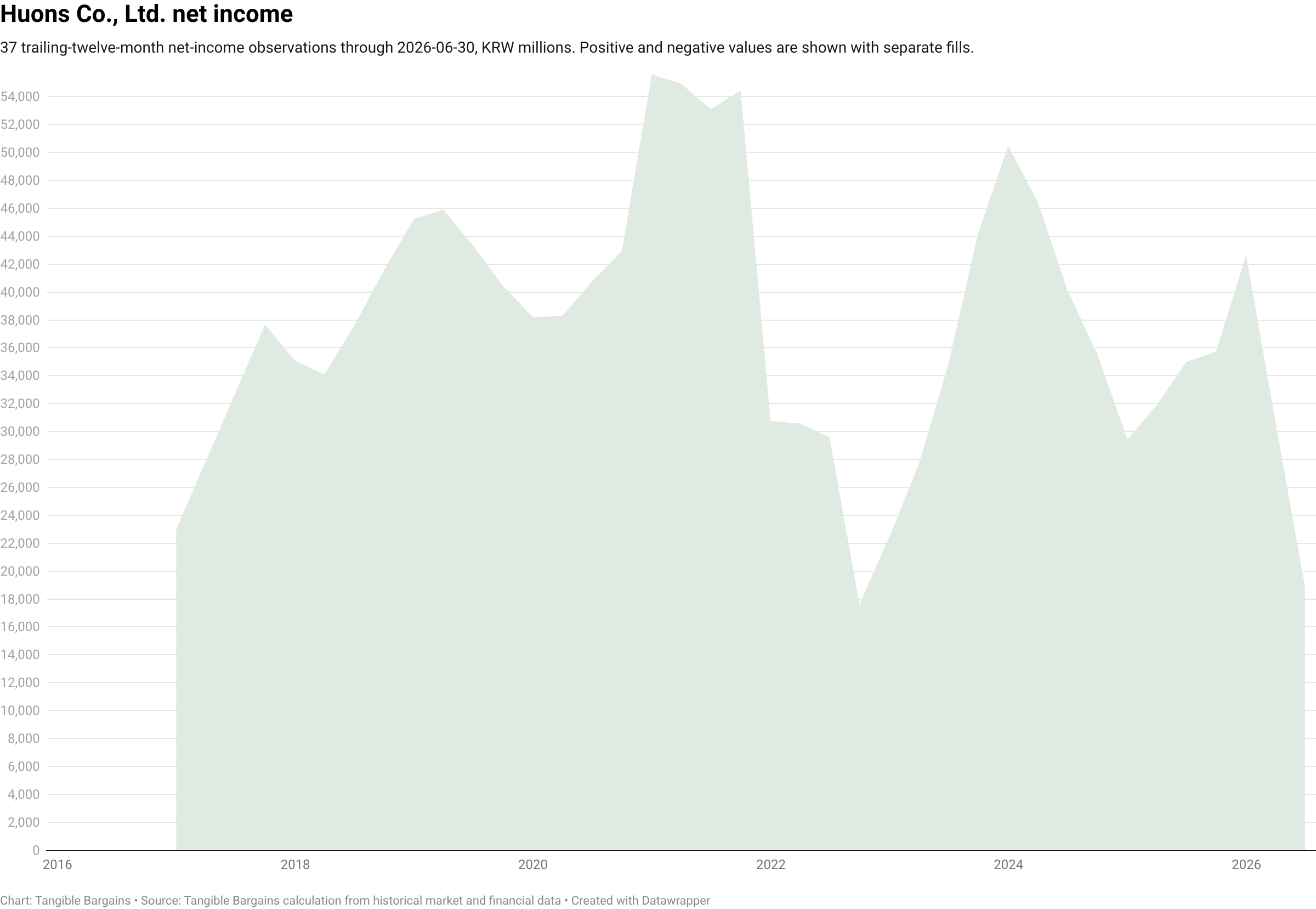
First-half 2026 operating income fell 91% year on year and the group posted a net loss; gross margin has declined for three straight years, from 51.8% to 43.1%.
A KRW 5.28bn provision, the largest new balance-sheet item, has no explanatory note anywhere in the half-year filing.
A board-approved merger with a related-party affiliate was rescinded in August 2026 after the share price roughly halved and shareholders objected.
Three years of free cash flow were negative in aggregate as capital spending outran operating cash flow, most of it funding the plant now under US import restriction.
What would change the view
FDA re-inspection of the Jecheon plant, targeted by management for the fourth quarter of 2026, and formal closure of the warning letter; treat this as optimistic, not a base case, since FDA already judged the first corrective-action response insufficient.
Resumption of North American injectable shipments, which management has guided for early 2027.
Third-quarter 2026 results, due in November, as the first clean read on whether the second quarter’s operating profit was a turn or a pause.
Whether the FY2026 annual report finally explains the KRW 5.28bn provision left unexplained in the half-year filing.
Any second attempt at a related-party restructuring involving Huons Lab or another affiliate.
A share price move to roughly KRW 35,000-40,500 (1.3x-1.5x tangible book), the level at which the exit question realistically goes live.
Sources and gaps
The FDA warning letter’s own page could not be fetched directly; its findings come from a search-indexed copy of the same page plus a third-party regulatory summary quoting it, cross-checked against the company’s own filing for the underlying facts. Debt covenant terms and segment-level profitability are not disclosed in either filing.
3. Backup and sources
This last layer is the full working file: every source, calculation, and gap, kept so the argument above can be checked. The scorecard and the argument are the synthesis. Open this only if you want to check the work.
Huons Co., Ltd. (KOSDAQ:A243070): Cheap against tangible assets, disrupted at the operating line
1. Executive Summary
Huons Co., Ltd. is a Korean pharmaceutical manufacturer that makes and sells prescription drugs (local anaesthetics, ophthalmic solutions, cardiovascular and metabolic products), beauty-and-wellness products (high-dose vitamin injectables, obesity drugs, health functional foods) and contract-manufactured medicines for third-party pharmaceutical companies, earning roughly 90% of its revenue inside Korea from two GMP plants in Jecheon, North Chungcheong Province. The numbers-only tier is STANDARD. After the governance review, final sizing is BUY — SMALL, because the valuation is attractive while the operating recovery and quality-system remediation remain unproven: the shares change hands at 0.798× tangible book value, the cheapest they have ever been in the ten-year history of the listed entity, while the company is simultaneously working through a US Food and Drug Administration warning letter whose findings include falsified laboratory records.
The valuation case is straightforward and asset-backed rather than earnings-driven. Tangible book value at 30 June 2026 was KRW 314.6bn, or KRW 27,003.53 per share, against a price of KRW 21,550 — a 20.2% discount to tangible book, with 83.2% of that tangible book sitting in owned property, plant and equipment and only 0.6% in right-of-use lease assets, so the discount is to real land, buildings and machinery rather than to capitalised occupancy rights. Financial borrowings of KRW 157.8bn against total equity of KRW 405.1bn (38.9%) clear the debt filter with room to spare, and the Piotroski F-Score is 7/9. Cash flow is intact: operating cash flow in the first half of 2026 was KRW 34.9bn, up 78% year on year, and the company paid KRW 13.1bn of dividends over the trailing twelve months, a 5.2% cash yield on the current market capitalisation.
What the price is discounting is a genuine and unresolved operating shock. First-half 2026 operating income fell to KRW 2.28bn from KRW 25.90bn a year earlier and the group recorded a net loss of KRW 0.89bn, with profit attributable to owners of just KRW 92m. The proximate cause is regulatory: following an inspection of the Jecheon plant from 12 to 21 November 2025, the FDA cited the company in April 2026 for insufficient sterility assurance, prompting a recall of US-bound product and a complete halt to North American shipments, and then issued a warning letter dated 15 June 2026. The company’s own filing states plainly that no exports to the United States arose in the current period and that GMP remediation is under way. Underneath the regulatory event sits a slower structural problem: consolidated gross margin has fallen from 51.8% in FY2023 to 48.3%, then 45.5%, and 43.1% in the first half of 2026.
Governance Risk is High. Two of the five capital-allocation warnings fire, and the accompanying facts are not cosmetic: a KRW 5.28bn sales-warranty provision — the largest new balance-sheet line of the period and, on the evidence, the recall reserve — appears in the half-year balance sheet with no explanatory note anywhere in the document; the FDA warning letter is absent from the report’s sanctions disclosure, which states “not applicable”; a KRW 9.03bn receivable from affiliate Huons USA, Inc. is fully provided against; and a proposed absorption of group R&D affiliate Huons Lab, resolved by the board on 18 May 2026, was abandoned on 26 August 2026 after the share price roughly halved and shareholders objected to the exchange ratio. A reader should treat Standard as the numbers-only tier and Small as the final sizing after the High governance flag is applied.
2. Business and Market Overview
Huons was carved out of Huons Global in a 2016 demerger and relisted on KOSDAQ on 3 June 2016; the underlying pharmaceutical business dates to 1965. It reports three revenue lines plus consolidated subsidiaries. Prescription pharmaceuticals were KRW 280.2bn of FY2025 revenue (45%), a broad multi-therapy portfolio — lidocaine local anaesthetics, the hyaluronic-acid eye drop Kynex, cardiovascular, metabolic, gastrointestinal and antibiotic products — sold to Korean hospitals, clinics and pharmacies. Beauty and wellness contributed KRW 162.7bn (26%): vitamin injectables, obesity drugs, arthritis injections, medical devices and the Merit health-functional-food range. Contract manufacturing was KRW 78.2bn (13%), mainly eye drops and injectables produced for other Korean and overseas pharmaceutical companies. Consolidated subsidiary revenue net of eliminations was KRW 108.0bn (17%), up from KRW 61.2bn in FY2024 as Panagene and Biorojet were consolidated.
The economics are those of a mid-sized generic-plus-specialty manufacturer in a price-regulated market. The filing is explicit that government sets pharmaceutical prices directly and that reimbursement policy therefore feeds straight into revenue and margin. Revenue is highly granular — the company states its sales consist of many products in small quantities, which is why it discloses by segment rather than by product — and no single external customer reaches 10% of revenue. Capital intensity is high and rising: gross property, plant and equipment stood at KRW 445.2bn at 30 June 2026 against KRW 288.9bn of half-year revenue, following an KRW 83.3bn property-and-equipment spend in FY2024 to build out the Jecheon second plant. Research and development ran at KRW 41.8bn in FY2025, 6.73% of revenue and rising from 5.91% in FY2024, funding a dry-eye candidate in Phase 2, a glaucoma candidate in Phase 3 and an obesity candidate in Phase 1.
As of 2026-06-30, exports were KRW 27.8bn of half-year revenue against KRW 29.2bn a year earlier, a 5.0% decline that understates the damage because North American injectable sales — KRW 18.4bn in FY2025 after 52.3% growth — went to zero part-way through the period. As of 2026-06-23, wholly-owned subsidiary Huons Bioscience was absorbed into the parent, and as of 2026-07-01 grandchild company Biorojet was absorbed into Huons N. The continuous glucose monitoring business was discontinued during the period. This is an understandable business, moderately predictable in its domestic base, not obviously cyclical, and currently disrupted rather than structurally melting — but the disruption is regulatory, and regulatory timelines are not the company’s to set.
3. Moat, Competitive Position, and Industry Cycle
Tested against the five sources of durable advantage, Huons scores thinly. Intangibles and brand: real but shallow — the Merit and Innerset consumer ranges have shelf presence, and FDA abbreviated new drug approvals for 1% and 2% lidocaine and 0.75% bupivacaine injectables were genuine regulatory assets, but the June 2026 warning letter has for now converted the most valuable of those into a liability. Switching costs: modest — requalifying a sterile line is expensive, which is why the Spectra Medical supply agreement has run since 2018 with KRW 58.1bn shipped cumulatively, but the same logic means a customer that does requalify elsewhere does not come back quickly. Network effects: none. Cost advantage: none demonstrated; gross margin is falling, not rising. Efficient scale: partial, in the narrow niche of Korean sterile eye-drop and injectable contract manufacturing, where GMP-certified capacity is scarce.
The moat is Narrow, and the honest reading is that it is narrowing. A company whose principal export franchise rests on regulatory approvals, and which has just been told by that regulator that its quality systems cannot be relied upon, does not have a durable competitive position in that franchise until it is re-inspected and cleared. Return on equity of 11.4% in FY2025, 8.5% in FY2024 and 15.5% in FY2023 does not evidence a compounding machine; it evidences a decent domestic manufacturer with a volatile export and licensing overlay. Nothing in the record suggests Huons can reinvest at rates that would justify paying a premium to tangible book.
Cycle position is Trough — but a company-specific trough rather than an industry one. Korean domestic pharmaceutical demand is not in recession; the margins of this company are. First-half 2026 operating margin was 0.79% against 8.58% a year earlier and 7.35% for FY2025 as a whole. Second-quarter operating income of KRW 2.93bn against a first-quarter operating loss suggests the bottom was the first quarter, but past the worst quarter is not the same as recovering, and the FDA import restriction that removed the export line was still in force at the balance-sheet date.
4. Management, Governance, and Capital Allocation
Song Su-young has been chief executive and board chair since roughly March 2022, was re-elected on 26 March 2025 with a term to 26 March 2028, and comes from an industrial-engineering and consulting background — Samsung Electronics, SAP Japan, Deloitte Consulting Japan — rather than from pharmaceutical manufacturing or quality assurance. The board has eight members: four inside directors, one non-executive director (the group chairman) and three outside directors who together constitute the audit committee. Directors are elected by shareholders at the annual general meeting. Board attendance was 100% for every director except one at 83%.
Compensation is not the problem here. Eight registered directors received KRW 1.80bn in FY2025 against a shareholder-approved cap of KRW 3.00bn; the group chairman was the only individual above the KRW 500m disclosure threshold at KRW 661m, all salary, no bonus, no option gains. Share-based compensation is small: the FY2025 restricted-stock charge was KRW 484.9m equity-settled plus KRW 250.4m cash-linked, and no options remain at the parent. Total FY2025 share-based compensation of roughly KRW 1.0bn is 2.4% of attributable net income and 3.0% of normalised net income, well below the threshold this method flags, and has not doubled year on year.
Insider activity is where the record gets interesting. The only significant movement disclosed for FY2025 was a gift: the entire personal holding of the group chairman, 477,750 shares or 3.99%, went to zero, distributed to three family members including a serving inside director who rose to 404,672 shares (3.38%). This is succession, not conviction buying or selling, but it tells a reader that the second generation is being positioned inside the operating company. No purchases or sales by directors or executive officers were found for 2026 in searches of the Korean insider-reporting regime; the absence of such a filing in a search is not proof that none occurred, and this is recorded as a diligence gap rather than as a finding.
Related-party dealing is extensive and warrants naming in full. In the first half of 2026 the group bought KRW 23.8bn of inventory from affiliates, plus KRW 2.4bn of outsourced processing, and paid KRW 10.1bn to parent Huons Global under other expenses, a line the note says includes dividends and which also carries headquarters occupancy. Huons Global is a pure holding company whose income consists of brand fees, service fees, rent and dividends. The filing discloses the amounts but nowhere discloses the pricing basis or benchmarks any of it to arm’s-length terms. On the financial side, the parent has provided joint-and-several guarantees for subsidiary borrowings totalling roughly KRW 25.7bn. And a KRW 9,025m trade receivable from affiliate Huons USA, Inc., arising from COVID-19 quarantine goods and medical devices, is fully provided against because collection is uncertain following a decline in local sales — roughly half a year of the normalised earnings of the whole group written off inside a related-party balance and disclosed in one sentence.
Capital allocation over the lookback has been mixed and increasingly expensive. Dividends per share ran KRW 630 (FY2023), KRW 630 (FY2024) and KRW 920 (FY2025), a 25% payout of attributable earnings, and in February 2026 the board adopted a 2026-2028 policy of KRW 200 per quarter, KRW 800 per year, rising 5-30% annually — funded, the filing states, from capital reserves transferred into retained earnings as a tax-exempt reduction dividend. That transfer was KRW 50bn in FY2025, moving share premium into distributable reserves. Consolidating the repurchase activity into one figure: the company bought back KRW 3.97bn of stock in FY2025 and KRW 2.08bn in FY2024 — KRW 6.04bn in total across the two years, with nothing repurchased in the first half of 2026. Treasury stock stood at 327,904 shares (2.74%) at 30 June 2026, most of it earmarked for an exchangeable bond or restricted-stock settlement, leaving little genuinely retirable. Acquisitions have not gone well: goodwill was impaired by KRW 2.28bn in FY2024 and KRW 1.70bn in FY2025, and unrecognised tax losses at group companies, on which no deferred tax asset is carried because realisation is judged highly unlikely, rose from KRW 32.0bn to KRW 69.1bn in a single year.
Running the capital-allocation warnings one by one. Control without minority protection: not fired, borderline — the controlling group holds 44.82%, above the threshold, but genuine director-election items occur at the annual meeting and the merger episode below shows minority shareholders can in practice defeat a controller-sponsored transaction. Capital routed to parent-mandated or low-return projects: fired. The board resolved on 18 May 2026 to absorb group R&D affiliate Huons Lab; the shares roughly halved, the extraordinary general meeting was postponed, and on 26 August 2026 the board rescinded the agreement, citing the gap between the merger consideration and the market price. Set alongside the KRW 9.0bn Huons USA write-off, KRW 3.98bn of goodwill impairment in two years and the KRW 83.3bn FY2024 plant build now under an import restriction, the pattern is capital directed toward group objectives rather than returns.
Dividend cut or inadequate payout: not fired, borderline — no cut occurred, but the FY2026 policy target of KRW 800 per share is 13% below the KRW 920 actually paid for FY2025, and funding distributions from a capital-reserve transfer rather than from earnings is a return of capital dressed as a yield. Non-answers on capital allocation, related parties or loss-making subsidiaries: fired. The KRW 5,277,642,666 sales-warranty provision is the single largest new item on the half-year balance sheet and carries no note anywhere in the document; the FDA warning letter and import restriction appear nowhere in the sanctions section of the report, which reads not applicable as of the report date; and the Huons USA receivable write-off gets one sentence with no discussion of how it accumulated. Silence counts. Outsized pay or off-market related-party deals: not fired, borderline — pay is modest and the share-based-compensation ratio test is passed comfortably; the unexplained pricing basis on KRW 23.8bn of affiliate purchases is a real unanswered question but not, on this record, evidence of off-market terms.
Two warnings fired. Governance Risk: High.
5. Corporate Ownership, Subsidiaries, and Joint Ventures
Ownership is concentrated in the group holding company, with one large institutional holder and a genuine retail float.
Ownership is concentrated in Huons Global at 40.74%, followed by Fidelity Management & Research at 9.99%, an inside director at 3.38%, other related parties at 0.70%, and treasury shares at 2.74%. The reported minority-holder group represents 36.58% of issued shares, while the controlling group and related parties hold 44.82% in total. Huons Global therefore controls the company in practice, but does not hold the two-thirds needed to pass a special resolution unaided.
The rows do not sum to 100% because the disclosed small-shareholder population excludes every holder of 1% or more, and holders between 1% and 5% are not separately identified; the controlling group and its related parties hold 5,369,472 shares, 44.82%, in total. The group chairman controls 42.76% of Huons Global and therefore controls Huons at one remove; his direct personal holding in Huons itself is now nil following the FY2025 gifts. The controlling group together holds 44.82%, comfortably above the level needed to block a special resolution but short of the two-thirds needed to pass one unaided — which is precisely why the Huons Lab merger could be, and was, defeated.
The disclosed group structure includes Huons N, Panagene, Biorojet, the former Huons Bioscience subsidiary, and Beijing Huonland Pharmaceutical. Panagene is consolidated on de facto control even though the group owns 42.66%, leaving 57.34% of its economics with outside holders. Biorojet was absorbed into Huons N on 1 July 2026, while Huons Bioscience was absorbed into the parent on 23 June 2026. Beijing Huonland is an equity-method associate.
The structure carries two specific leakage risks worth naming. Panagene is consolidated on de facto control with a minority interest larger than the parent stake, so 57.34% of its economics — currently losses of KRW 452m in the half — belong to outside holders, while 100% of its KRW 9.78bn of goodwill is deducted inside the tangible-book bridge; the group non-controlling interest balance of KRW 36.8bn is not available to Huons shareholders. Second, the parent has extended joint-and-several guarantees to subsidiary lenders totalling KRW 25.7bn, and has pledged KRW 218.5bn of property, plant and equipment, 83% of net book value, against KRW 102.9bn of bank borrowings — so the tangible asset base backing the equity is substantially encumbered.
6. Historical Financial Quality and Normalized Owner Earnings
Three audited consolidated years plus one half are available directly from the primary filings; FY2022 is included for trend context from a secondary source and marked accordingly.
Fundamentals (KRW millions; per-share figures in KRW)
The three-year consolidated record is shown in the financial-quality exhibit below. It keeps the useful comparisons together without making the reader fight a wide text table.
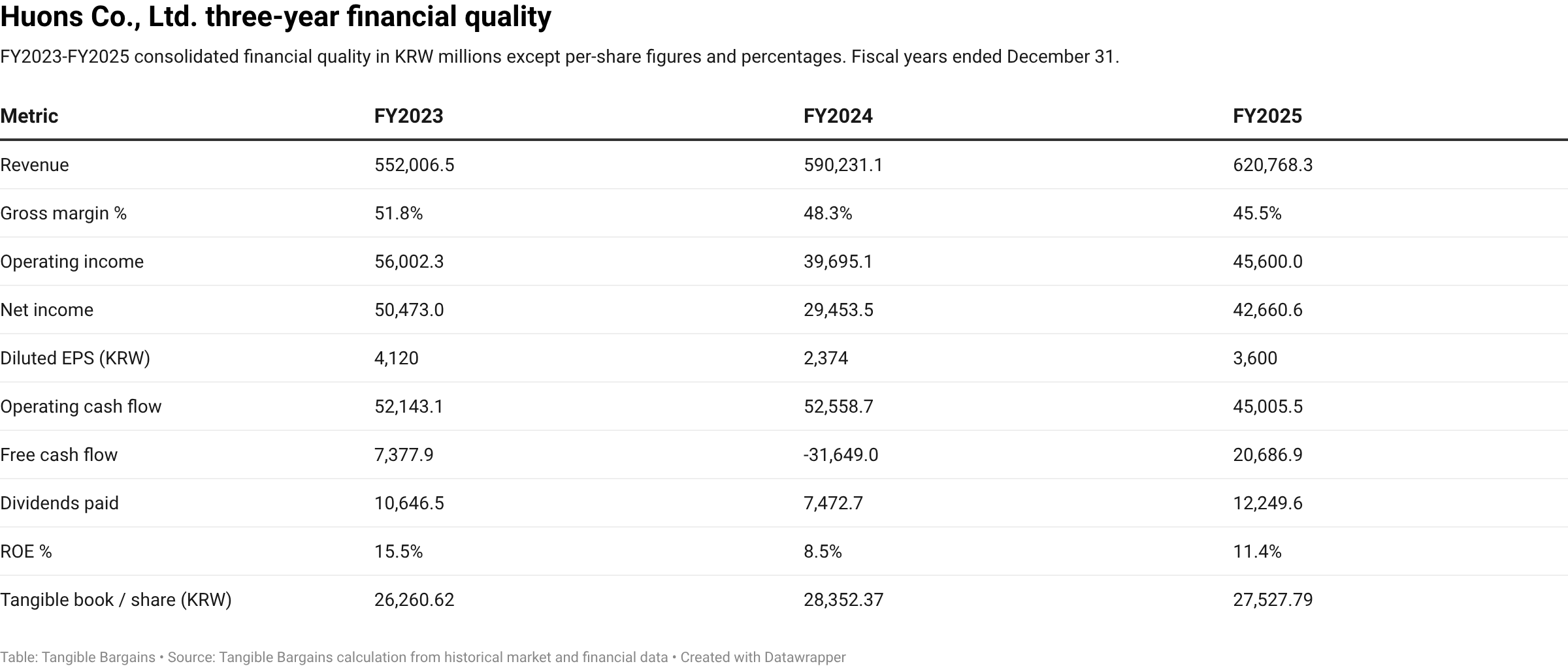
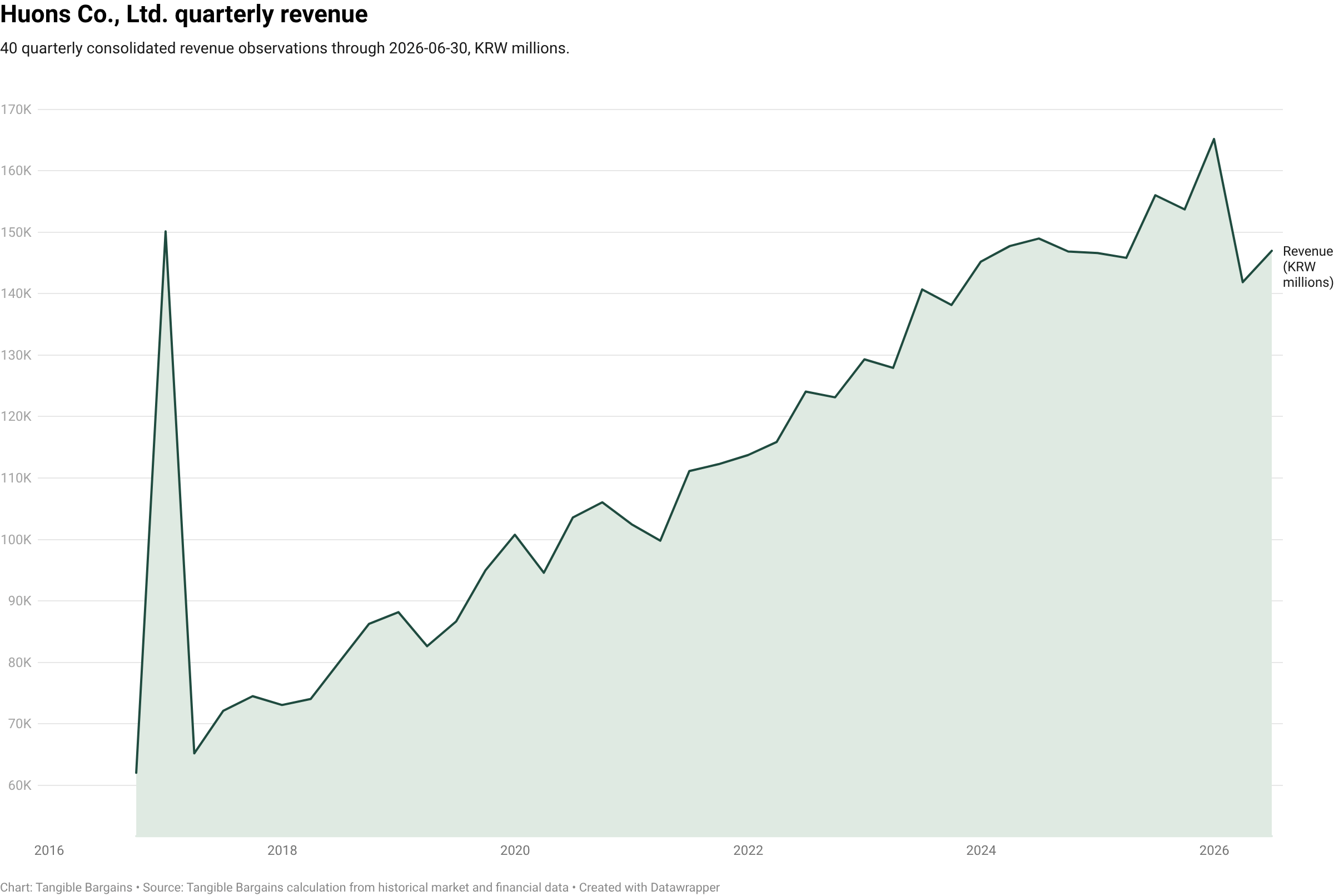
The record does not describe a compounder. Revenue grew every year, but each step cost gross margin. Cash generation is the more important number and the more uncomfortable one: aggregate free cash flow across FY2023 to FY2025 was negative KRW 3.6bn. The separate cash-conversion exhibit shows why the earnings quality deserves scrutiny.
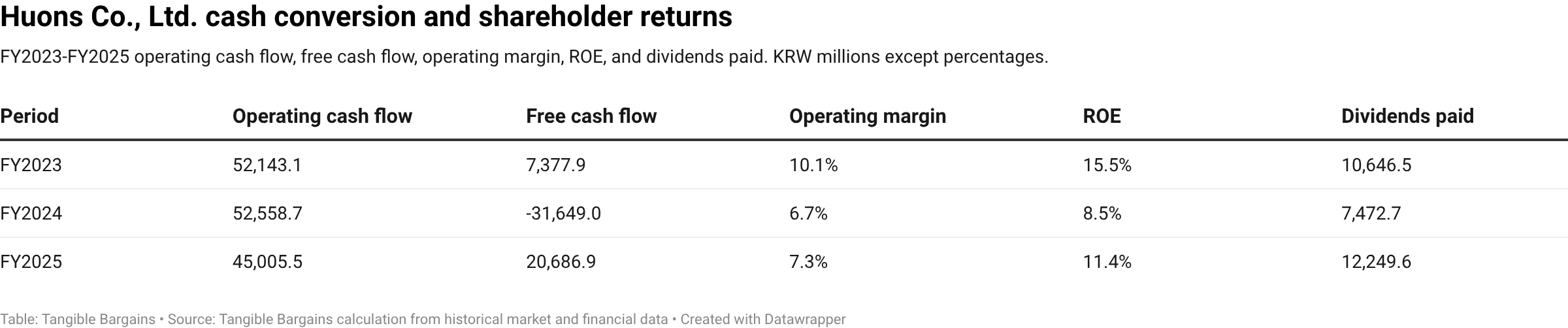
Net income is the amount attributable to owners of the parent. For FY2022 the reported figures were revenue KRW 492.4bn, operating income KRW 40.9bn and net income KRW 25.0bn, taken from a secondary source and used only for trend context.
The record does not describe a compounder. Revenue grew every year, but each step cost gross margin: 51.8% in FY2023, 48.3% in FY2024, 45.5% in FY2025 and 43.1% in the first half of 2026 — 870 basis points in two and a half years as the mix shifted toward lower-margin contract manufacturing and newly consolidated subsidiaries. FY2025 operating income was still below FY2023 on 12% more revenue. Cash generation is the more important number and the more uncomfortable one: aggregate free cash flow across FY2023 to FY2025 was negative KRW 3.6bn, because the group spent KRW 153.3bn on property, plant, equipment and intangibles over three years, most of it on the Jecheon second plant whose sterile injectable line is the subject of the FDA action. Three years of earnings went into an asset that is currently not permitted to serve its highest-value market.
Normalized owner earnings. FY2025 operating cash flow of KRW 45,005.5m less a maintenance-capex proxy of KRW 20,775.1m (the year’s own property-and-equipment depreciation charge) gives owner earnings of KRW 24,230.4m, or KRW 2,080 per share. That is roughly 57% of reported attributable net income, and the gap is the honest measure of how much of the reported profit is being consumed by the asset base. In the first half of 2026 operating cash flow was KRW 34,859.0m against KRW 19,562.9m a year earlier, but the improvement is not earnings — it is a KRW 11,067.7m working-capital release as trade receivables fell from KRW 114.5bn to KRW 95.0bn on lower activity, and it will not repeat.
Symmetry check on normalization. The FY2025 effective tax rate was 13.3% against 23.6% in FY2024. Taxed at the prior year’s rate, FY2025 consolidated net income would have been roughly KRW 37.2bn rather than KRW 42.2bn — about KRW 5.0bn, or 12%, of the reported figure came from a tax benefit whose driver is not separately explained in the tax note. Adding back one-off charges without removing this would overstate normalized earnings; both are therefore carried.
Normalized EPS and its basis. The earnings trajectory is erratic rather than growing or steadily declining, so the rule for an erratic earner applies: normalized EPS is the lesser of the multi-year average and the trailing twelve months. The four-year average is KRW 3,124; trailing twelve months is KRW 1,619. Normalized EPS is therefore KRW 1,619, and normalized P/E at KRW 21,550 is 13.3×. Two alternative readings are given for context and are not used in the decision: adding back the recall provision at an assumed 22% tax rate lifts trailing EPS to about KRW 1,972 and the multiple to 10.9×; the pre-disruption FY2023-FY2025 average EPS of KRW 3,466 would put the multiple at 6.2×. The tier this analysis reaches is the same on all three readings, which is a useful robustness result.
Earnings quality is otherwise reasonable but not pristine. Operating cash flow exceeded net income in each of the last three years. Inventory rose to KRW 96.6bn from KRW 94.4bn while revenue fell, consistent with the export halt leaving finished goods on the balance sheet. Selling commissions of KRW 46.8bn in the half, 38% of selling and administrative expense, are the largest cost line after cost of sales and are the mechanism through which Korean pharmaceutical distribution economics compress margin.
6.5 Piotroski F-Score — 7/9
Periods compared: FY2025 vs FY2024.
The nine-signal audit produces 7/9. The two failed signals are gross-margin improvement and asset-turnover improvement, precisely the operating signals that matter most here. The score compares FY2025 with FY2024; it is a fact about last year, not a clean read on the first half of 2026.
Score: 7/9. The failed signals are gross margin improved and asset turnover improved — precisely the two that matter most here. A company can score 7/9 while its unit economics deteriorate, because six of the nine are balance-sheet and cash-flow tests a well-capitalised manufacturer passes almost automatically. The failures name the problem: margin is being given away and the enlarged asset base is not yet producing revenue in proportion. All nine signals were computable and the floor rule did not fire: leverage fell and liquidity improved in the same year. It must be said plainly that the score compares FY2025 with FY2024, and that the first half of 2026 — a net loss, a further 240 basis-point fall in gross margin and a current ratio down to 1.41 — would fail six of the nine signals on the same test. The 7/9 is a fact about last year, not about now.
7. Balance Sheet, Debt, Covenants, and Refinancing Risk
The capital structure at 30 June 2026 is entirely Korean bank debt plus one small privately placed exchangeable bond. There is no public bond issue, no rated debt and no syndicated credit agreement.
The instrument-level borrowing detail is shown in the debt schedule exhibit below. The liquidity-coverage exhibit compares contractual near-term maturities with cash, current financial assets, and undrawn committed facilities; the current ratio is context, not a cash resource.
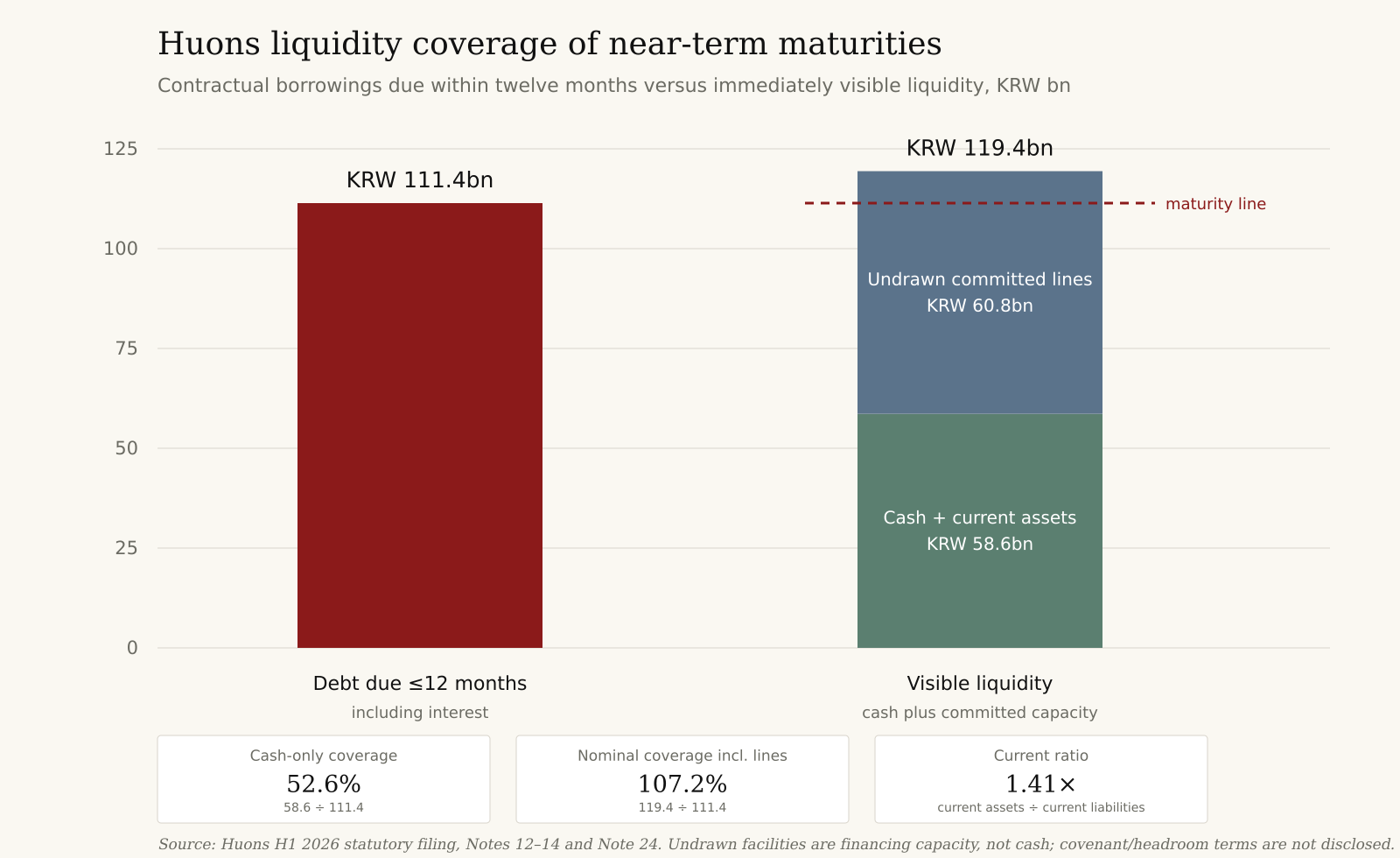
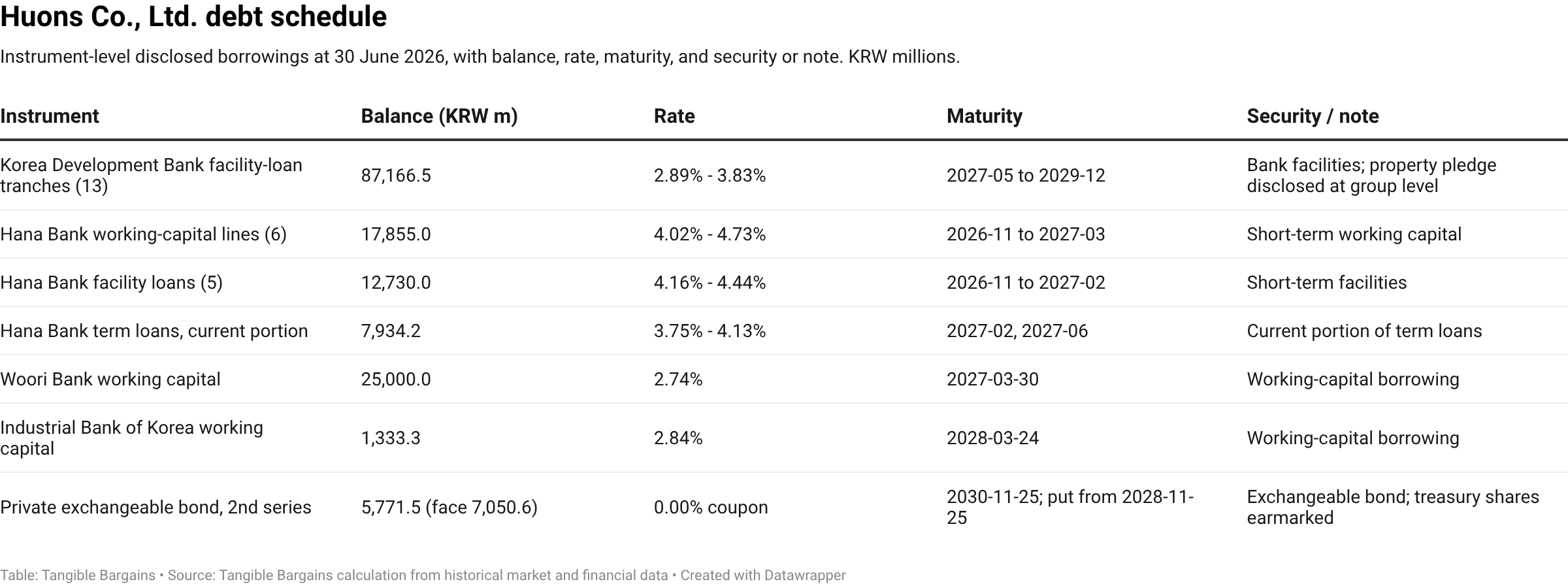
Financial borrowings and lease liabilities are stated separately throughout; leases are 1.3% of the borrowing total and immaterial to any leverage conclusion. Financial borrowings are 38.9% of total equity of KRW 405.1bn; total liabilities of KRW 244.9bn are 60.4% of total equity. On either basis the debt test used here — total debt not more than 100% of equity — passes comfortably, and it also passes on the stricter total-liabilities reading.
Two things temper that. The first is the maturity wall: KRW 111.4bn of borrowings including interest falls due within twelve months against KRW 58.6bn of cash and current financial assets. Almost all of it is rolling Korean bank paper that has been renewed repeatedly, and undrawn headroom is real — KRW 148.0bn of Korea Development Bank facility commitments against KRW 87.2bn drawn — but a company under an FDA warning letter renegotiating KRW 111bn of bank paper is not negotiating from strength. The second is coverage. FY2025 operating income covered finance costs 5.9 times and EBITDA covered them 9.4 times; in the first half of 2026 operating income did not cover finance costs at all, and EBITDA covered them 4.4 times. No covenant terms, financial ratios or headroom tests are disclosed anywhere in either filing, which is itself a gap.
Debt is 24.3% of total assets, which on the leverage leg alone reads Conservative; interest coverage on the current half-year run rate reads Elevated. Taking both legs together with the twelve-month maturity concentration and the absence of any disclosed covenant terms, balance-sheet risk is classified Manageable. A second consecutive half at first-half 2026 profitability would move it to Elevated.
8. Real Estate, Leases, and Hidden Assets
The tangible book is unusually literal. Owned property, plant and equipment of KRW 261.9bn is 83.2% of tangible book value and 40.3% of total assets, comprising land, buildings, machinery, tools and equipment, and construction in progress. A further KRW 22.4bn sits in investment property, the leased-out portion of the group’s buildings and land, carried at cost less depreciation.
Right-of-use assets are KRW 1,932.3m, equal to 0.6% of tangible book value, against lease liabilities of KRW 1,994.3m. Right-of-use is a capitalised right to occupy, not a liquidation floor, and it is disclosed here rather than stripped out of the tangible book value used everywhere in this analysis, since removing the asset without its matching liability would be the wrong operation. In this case the point is close to academic: at 0.6% of tangible book, the asset-backed framing survives the check intact, and the genuine downside support is owned land and buildings plus KRW 58.6bn of cash and current financial assets.
There is one identifiable hidden value and one identifiable offset. The hidden value: investment property carried at KRW 22,370.1m has a disclosed fair value of KRW 26,170.9m, an unbooked surplus of KRW 3,800.9m or KRW 326 per share, assessed by the group using published land prices and price indices rather than an independent valuer. The offset, and it is the larger of the two: KRW 218,498.3m of property, plant and equipment, 83% of the net book value of the whole fixed-asset base, is pledged as security for KRW 102,898.0m of bank borrowings. A tangible book that is 83% owned plant is a real floor only to the extent the plant is unencumbered, and here most of it is not.
9. Capital Markets Access, Dilution, and Financing Flexibility
The share count has been stable and is now shrinking slightly. Shares in issue went from 10,859,671 at end-2021 to 11,979,665 at end-2023 and have not moved since; the increases were stock dividends and a small convertible-bond conversion, and there has been no equity issuance for cash at any point in the five-year window. Weighted-average diluted shares fell from 12,089,628 in FY2024 to 11,904,631 in FY2025 as buybacks took effect, and shares outstanding net of treasury were 11,651,761 at 30 June 2026.
Remaining dilution is small and mostly out of the money. The exchangeable bond issued in November 2025 is exchangeable into 220,317 existing treasury shares at KRW 32,002, 48.5% above the current price, so it is currently anti-dilutive and in any case exchanges treasury stock rather than issuing new shares; restricted-stock awards total 81,385 units, also to be settled in treasury shares; and no parent-level share options remain outstanding. Because no defensible current-diluted denominator can be built from a filing-supported increment at a single date, the diluted sensitivity is recorded as unresolved and the point-in-time count leads throughout.
The company does not depend on equity markets to operate: it funds itself from operating cash flow and bank facilities, has KRW 60.8bn of undrawn Korea Development Bank facility commitments, and has never run a shelf or at-the-market programme. Dilution risk is judged low; the financing risk that matters is bank rollover, covered above.
10. Litigation, Regulatory, and Contingent Liability Risk
Three court matters are disclosed, and they are small in money terms. Huons is appellant and respondent in a Patent Court appeal over a compound patent, with a claim value of KRW 683.9m; the company lost in part at first instance and both sides have appealed. Huons and five other parties are defendants in a criminal proceeding under the Pharmaceutical Affairs Act, first instance ongoing, with no monetary claim stated. The group is plaintiff in an unjust-enrichment action for KRW 95.4m which it expects to win. Beyond litigation, the group has a contract-performance surety limit with Seoul Guarantee Insurance and joint-and-several subsidiary guarantees of KRW 25.7bn.
The material regulatory exposure is not in the litigation note at all. Following an FDA inspection of the Jecheon plant from 12 to 21 November 2025, the agency restricted entry of the company’s injectable products from April 2026, the company recalled US-bound product, and the FDA issued a warning letter dated 15 June 2026 covering current good manufacturing practice violations at the sterile injectable facility. The published findings are serious in kind, not only in degree: an endotoxin test failure that was neither documented nor investigated; bioburden plates showing significant growth discarded on a team leader’s instruction; camera timestamps manipulated to create backdated records; nearly 1,900 uncontrolled blank current-good-manufacturing-practice forms found in the microbiology laboratories; and logbook pages removed and replaced with newly fabricated pages. The remediation the agency requires includes an independent data-integrity investigation, a three-year retrospective review of out-of-specification results and annual third-party GMP audits. The company’s own disclosure of all this is a single sentence in a supply-contract progress table; the sanctions section states that there are no sanctions as of the report date. Recall of at least two of the three affected products was released in June 2026, but the import restriction and the warning letter were unresolved at the balance-sheet date, and management’s stated aim of re-inspection by end-2026 and resumption of exports in early 2027 is a management assertion, not a confirmed fact.
The falsification was directed and physical, not passive neglect. The microbiology team leader admitted to using a knife to cut completed pages out of the logbook, then had the pages replaced with newly written substitutes made to resemble the originals, and separately instructed an analyst to backdate and omit testing information tied to bioburden samples. Huons told FDA investigators it could produce only a portion of the requested laboratory data, citing data-integrity breaches under which failed results had already been discarded. The company has since dismissed multiple employees involved and formed a data-integrity team over the microbiology laboratory, but FDA’s own letter assessed that response as insufficient, citing continued weak oversight — a reason to treat management’s Q4 2026 re-inspection target as optimistic rather than a base case; comparable data-integrity warning letters elsewhere have taken multiple years to close. The inspection also cited aseptic-processing gaps independent of the paperwork fraud: inadequate airflow in smoke studies, operators obstructing first air in critical areas, weak barrier-system practice, and glove-monitoring and disinfection procedures the agency found insufficiently specified. Separately, the import restriction (effective 3 April 2026) covers all drugs and drug products offered for import from this facility, not only the three named injectables.
The single new balance-sheet item that has appeared is the KRW 5,277.6m sales-warranty provision, unnoted in the filing, which on the corroborating record is the recall reserve recognised in the first quarter of 2026. The financial exposures here are individually modest against a KRW 314.6bn tangible book; the exposure that matters is the loss of the North American injectable franchise and the reputational and requalification cost of a data-integrity finding, neither of which appears as a provision.
11. Accounting Quality and Disclosure Review
The auditor is Samil PwC, appointed for FY2023 to FY2025 under Korea’s periodic auditor-designation regime, with an unqualified opinion on both the consolidated and separate statements in each of FY2023, FY2024 and FY2025, no material uncertainty related to going concern and no emphasis-of-matter paragraph. Management assessed internal accounting control as effective with no material weakness, and the audit committee met the auditor six times including a session on fraud-risk controls over cash. The designation period expires with FY2025, so the FY2026 auditor may change.
Within the financial statements, three estimates carry real judgement. Goodwill of KRW 18,031.6m, 5.7% of tangible book, sits in four cash-generating units, most of it in Panagene, a loss-making listed subsidiary in which the group holds only 42.66%, and goodwill has already been impaired in each of the last two years. Deferred tax assets are KRW 5,475.9m, but the more telling number is what is not recognised: unused tax losses of KRW 69,121.1m, up from KRW 31,979.9m a year earlier, all carried at nil because realisation is judged highly unlikely. Segment disclosure is by three revenue lines only, with no segment profitability, so a reader cannot see whether the contract-manufacturing margin or the beauty-and-wellness margin is the one eroding.
Disclosure quality is classified Adequate, not High, for specific reasons. Against: the KRW 5,277,642,666 sales-warranty provision appears as a new current liability with no note in a 200-page half-year report; the FDA warning letter and import restriction, plainly the most material development of the period, are disclosed in one sentence inside a supply-contract progress table while the sanctions section reads not applicable; the fully provided related-party receivable is explained in a single clause; and related-party purchases of KRW 23.8bn are disclosed in amount but not in pricing basis. In favour: the audited statements are complete, internally consistent and cross-foot; the auditor is a major firm under mandatory designation with a clean opinion and a rising fee; the borrowing, pledge, contingency, related-party and subsequent-event notes are all present and specific. This is a company that discloses what the forms require, competently, and volunteers nothing.
12. Valuation and Margin of Safety
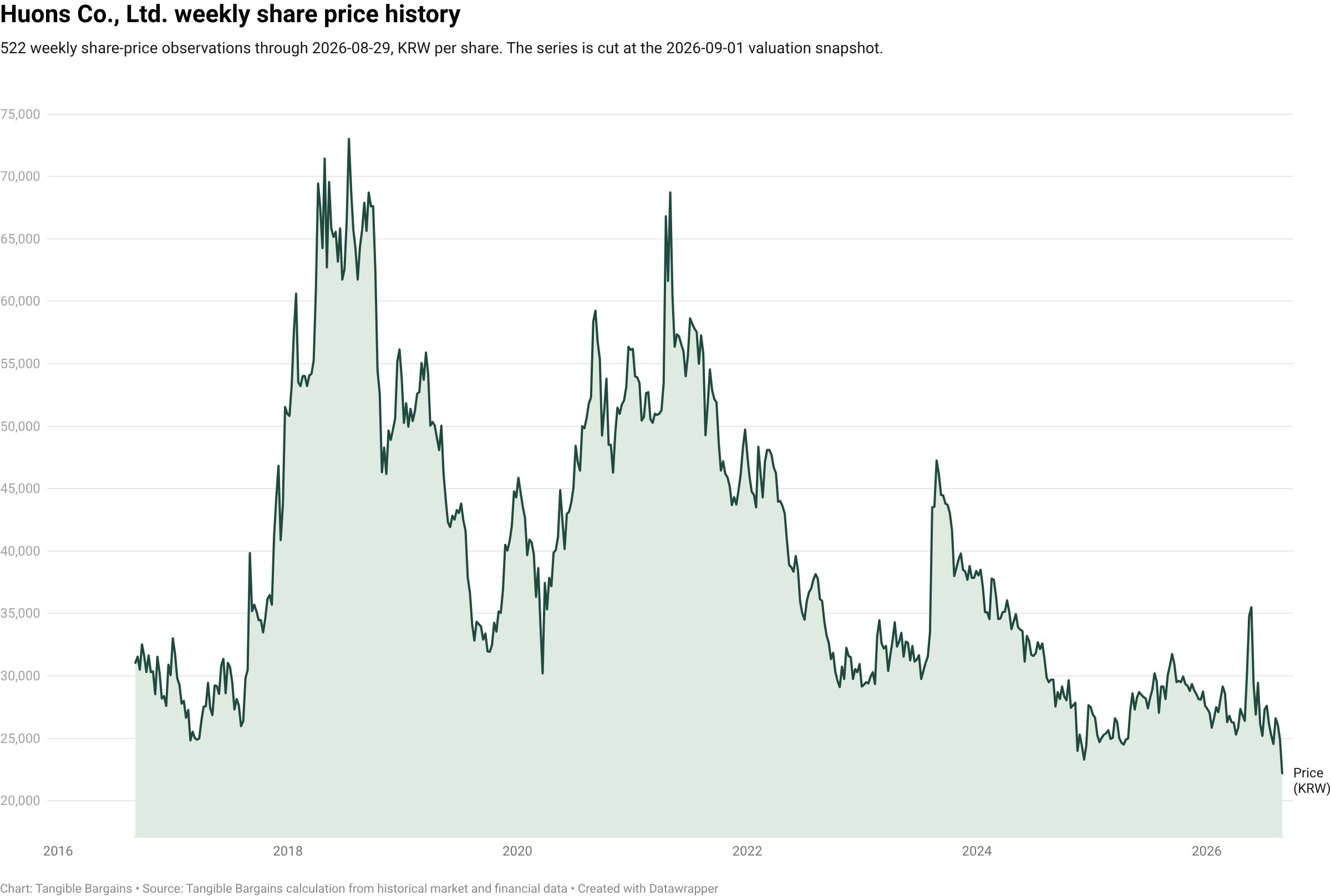
Tangible Book Value — Derivation (anchor 2026-06-30; KRW millions)
Table 1 — equity bridge
The tangible-book bridge is straightforward: common shareholders’ equity of KRW 368,364.0m less goodwill of KRW 18,031.6m and other intangibles of KRW 35,693.7m produces tangible book value of KRW 314,638.7m. Dividing by 11,651,761 shares gives KRW 27,003.53 per share. No unbooked property surplus is added to this bridge.
P/TBV (derived) = 21,550.00 ÷ 27,003.5290 = 0.798× (price as of 2026-09-01). No adjustments are added to the bridge: the KRW 3,800.9m unbooked investment-property surplus identified above is deliberately not capitalised here, since it rests on the group’s own index-based estimate rather than an independent valuation.
Table 2 — asset composition at the anchor period
At the 30 June 2026 anchor, cash and short-term investments were KRW 58,603.9m, receivables KRW 101,107.7m, inventory KRW 96,636.2m, owned property, plant and equipment KRW 261,891.9m, and right-of-use assets KRW 1,932.3m. Owned property and equipment equals 83.2% of tangible book; right-of-use assets equal only 0.6%. The asset floor is real, but much of the property is pledged.
Historical relative multiple valuation
A quarterly price-to-tangible-book series of 38 observations running from 31 December 2016 to 31 March 2026 is available. Read in order, the multiple has not oscillated around a stable mean, it has de-rated almost monotonically for eight years: 4.64× at end-2016, a peak of 6.04× in March 2018, 2.17× by end-2021, 1.25× by end-2022, 0.99× by end-2024 and 0.92× at 31 March 2026. Treating the whole decade as one distribution therefore describes two different companies. The typical band for the current regime, taken as the interquartile range of the thirteen quarters from March 2023, is 0.96× to 1.34×, median 1.06×; the window floor is 0.86× (March 2025), the window ceiling for the full ten years is 6.04× (March 2018). Today’s derived 0.798× sits below every one of the 38 observations, the 0th percentile of its own history.
The two legs disagree, and the disagreement is the analysis. The book leg says the shares are cheaper than at any point in the listed history of the company, against a tangible book that is 83% owned plant and 19% cash. The earnings leg says that on the earnings actually being produced today, the shares are not cheap at all, at 13.3× depressed trailing earnings they are near the market multiple, and only become cheap if profitability returns to something near the FY2023-FY2025 average. Reconciled, the range that both legs can support is roughly KRW 26,000 to KRW 29,000, the intrinsic-value range used below.
Sell range
Applying the same rule to the same 38-observation quarterly series: Sell Range KRW 61,565 – KRW 125,311 (the local-currency range), being 2.28× to 4.64× current TBV per share, the median and the top-quartile mean of the stock’s own distribution. Thirty-eight observations at four per year over 9.5 years is comfortably past the floors this method requires, so this is not a data-limited reading. The flat 0.80× reference of KRW 21,603 is fallback only, not the rule for this name.
Credibility of that range, given today’s earnings power. The range is mechanically correct and it should not be read as a forecast. Trailing-twelve-month return on equity is 5.1% against an FY2023-FY2025 average of 11.8%, 57% below the multi-year average that underlies the sell-range period, and far below the 20%-plus returns that supported the 4×-6× multiples of 2016-2018. The top of this range was earned by a business with a growing FDA-cleared export franchise and mid-teens returns on equity; it is not credible on current earnings and should not be treated as a target. The exit question realistically goes live at the bottom of the range, and in practice much earlier: a reasonable expectation is to reassess as the multiple approaches the 1.3× to 1.5× of tangible book last seen in 2022-2023, roughly KRW 35,000 to KRW 40,500, rather than to hold for a reversion to the 2018 regime.
Scenarios
The scenario lens is deliberately separate from the mechanical own-history range:
Severe downside: the FDA re-inspection fails or slips beyond 2027, sterile-injectable assets are written down by 25% of tangible book, and value falls to KRW 14,177 per share.
Bear case: US recovery slips past 2027, margin stays at the first-half 2026 level, and value is KRW 23,223 per share.
Base case: the import restriction is lifted during 2027, margins rebuild, and value is KRW 28,624 per share.
Bull case: North American shipments resume, contract manufacturing and pipeline revenue improve, and value is KRW 35,645 per share.
The Base Case cross-checks against the earnings leg: KRW 28,624 is 8.3× the pre-disruption average EPS, a multiple this stock last traded at in 2025, so the two methods agree at the base. The Bear Case sits above the current price, which is itself the finding: at KRW 21,550 the market is pricing in something worse than the bear case set out here.
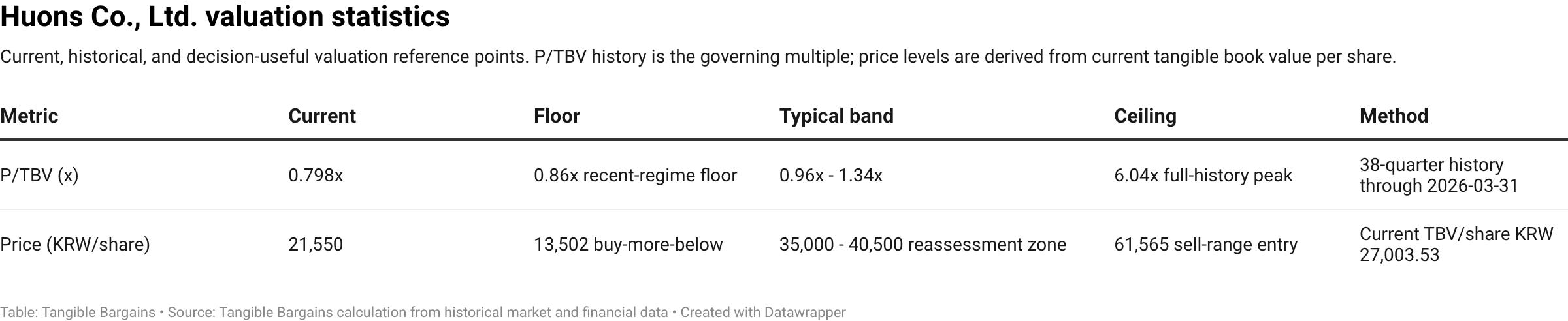
Current price KRW 21,550 (2026-09-01; market capitalisation KRW 251.1bn, KRW 251.1bn). Intrinsic value range on the base case: KRW 26,000 – KRW 29,000. Margin of safety at the current price: 20.2% below tangible book value per share. Buy-Below KRW 28,424 (1.05× TBV, 9.5-year own-history), the stock is already below it. Buy More Below KRW 13,502 (0.50× TBV). The industry-appropriate cross-lens for a capital-heavy generic manufacturer is enterprise value to EBITDA: net financial debt plus market capitalisation gives an enterprise value of roughly KRW 350.3bn against FY2025 EBITDA of roughly KRW 72.8bn, 4.8×, and against annualised first-half 2026 EBITDA of roughly KRW 39.0bn, 9.0×, the same story the earnings leg tells.
Cheapness type: asset-value cheap, with an explicit value-trap watch. The discount is to tangible assets, not to a stream of earnings, and the assets are real, owned and largely productive. But 83% of those assets are pledged to lenders, three years of free cash flow have been negative, gross margin has fallen for three consecutive periods, and the highest-return use of the newest asset is currently prohibited by a foreign regulator. This is cheap because something is wrong, and the question a buyer is underwriting is whether what is wrong is fixable within two years.
13. Risk Matrix
The main risks are easier to read as a list:
FDA warning letter and import restriction persist, keeping the North American franchise offline.
Data-integrity findings prove systemic rather than site-specific, forcing a permanent valuation discount.
Gross-margin erosion continues and undermines the base and bull cases.
Controller-sponsored transactions and related-party dealing continue to disadvantage minorities.
Bank rollover risk rises as KRW 111.4bn of borrowings including interest comes due within twelve months.
Pledged property, goodwill, unrecognised tax losses, and a dividend funded from capital reserves weaken the asset-value support.
14. Red Flags, Yellow Flags, and Green Flags
The single most important flag below is the first red one: a documented instance of employees fabricating quality records is a different order of problem from a missed operating quarter, and it is the fact most likely to overturn the verdict on human review.
Green Flags
Trades at 0.798× tangible book value, below all 38 quarterly observations in its own ten-year price-to-tangible-book history, with 83.2% of that tangible book in owned land, buildings and machinery and only 0.6% in right-of-use assets.
Financial borrowings are 38.9% of total equity and 24.3% of total assets, with KRW 58.6bn of cash and current financial assets and KRW 60.8bn of undrawn committed facilities.
Piotroski F-Score of 7/9 on FY2025 against FY2024, with all nine signals computable and the floor rule not fired.
Cash returned: KRW 13.05bn of dividends in the trailing twelve months, a 5.2% yield, plus KRW 6.04bn of buybacks across FY2024-FY2025, under a formally adopted 2026-2028 policy.
No equity issued for cash at any point in five years; shares outstanding have fallen since end-2023.
Yellow Flags
Aggregate free cash flow across FY2023-FY2025 was negative KRW 3.6bn: KRW 153.3bn of capital spending absorbed three years of operating cash flow.
FY2025 net income was flattered by roughly KRW 5.0bn from an unexplained drop in the effective tax rate, while unrecognised tax losses rose sharply, all carried at nil.
KRW 218.5bn of property, plant and equipment, 83% of net book value, is pledged against KRW 102.9bn of bank borrowings.
The FY2026 dividend target is 13% below the amount paid for FY2025, and the policy is explicitly funded from a capital-reserve transfer rather than from earnings.
No covenant terms, ratios or headroom are disclosed for KRW 152.0bn of bank debt, most of which matures within twelve months.
Segment disclosure gives revenue by three lines and no segment profitability, so the source of the margin erosion cannot be located from the filing.
Red Flags
The FDA warning letter of 15 June 2026 records fabricated and manipulated quality records at the Jecheon plant: the microbiology team leader admitted to using a knife to cut completed pages out of a logbook and replace them with rewritten substitutes disguised to look original, and instructed an analyst to backdate and omit bioburden test results; an undocumented endotoxin failure; nearly 1,900 uncontrolled blank CGMP forms. The company fired the staff involved and formed a data-integrity team, but FDA judged that response insufficient.
A KRW 5,277,642,666 sales-warranty provision, the largest new line on the 30 June 2026 balance sheet, appears with no explanatory note anywhere in the half-year report, and the sanctions section of the same report states that there are no sanctions.
First-half 2026 operating income of KRW 2.28bn against KRW 25.90bn a year earlier, a net loss, and gross margin down to 43.1% from 51.8% in FY2023.
A KRW 9,025m related-party trade receivable from an affiliate fully provided against, explained in one clause, with no account of how it accumulated.
The board resolved a merger with a group affiliate in May 2026 and rescinded it in August 2026 after the share price roughly halved and shareholders objected to the exchange ratio.
Goodwill impaired in each of the last two years, on acquisitions made within the same window.
Must-Watch Catalysts
FDA re-inspection of the Jecheon plant, targeted by management for the fourth quarter of 2026, and the closure of the June 2026 warning letter.
Resumption of North American injectable shipments, guided by management for early 2027.
Third-quarter 2026 results, expected in November 2026, as the first clean read on whether the second-quarter operating profit was a turn or a pause.
Whether the KRW 800 annual dividend target is maintained at the FY2026 year-end declaration.
Any revival of group restructuring involving Huons Lab or other affiliates.
First-instance judgment in the Pharmaceutical Affairs Act criminal case.
Appointment of the FY2026 auditor, as the mandatory designation period covering FY2023-FY2025 has expired.
FINAL VALUE-INVESTING RECOMMENDATION
Verdict: BUY — SMALL. The numbers-only tier is Standard; final sizing is Small, given Governance Risk High and an unresolved foreign-regulator data-integrity finding.
Key decision metrics. Current price is KRW 21,550 as of 1 September 2026. P/TBV is 0.798x, normalized P/E is 13.3x, shareholder yield is 5.2%, and the Piotroski F-Score is 7/9. The numbers-only tier is Standard. Final sizing is BUY — SMALL because Governance Risk is High, the FDA data-integrity finding remains unresolved, and the earnings recovery is not yet demonstrated. The intrinsic-value range is KRW 26,000 to KRW 29,000; Buy-Below is KRW 28,424; Buy More Below is KRW 13,502; and the mechanical Sell Range is KRW 61,565 to KRW 125,311. The realistic exit question should be reassessed much earlier, around KRW 35,000 to KRW 40,500, if the operating recovery is credible.
VALUE INVESTOR MUST-WATCH LIST
FDA re-inspection of the Jecheon plant, management targets the fourth quarter of 2026.
The quarterly export line: North American injectable revenue was KRW 18.4bn in FY2025 and zero from April 2026.
Gross margin, quarter by quarter: 43.1% in the first half of 2026 against 45.5% for FY2025 and 51.8% for FY2023.
Third-quarter 2026 results, expected November 2026.
The KRW 5,277,642,666 sales-warranty provision, whether the FY2026 annual report finally explains it.
Bank rollovers: KRW 111.4bn of borrowings including interest matures within twelve months.
The dividend, and whether the KRW 800 annual target survives the FY2026 year-end declaration.
Any revival of group restructuring involving Huons Lab or another affiliate.
Insider filings: no director or officer purchases or sales were found for 2026.
The Pharmaceutical Affairs Act criminal case, first-instance judgment.
Appointment of the FY2026 auditor.
Panagene: 57.34% of it belongs to outside holders, and it carries a meaningful share of the group’s goodwill.
KRW 35,000-40,500 (1.3×-1.5× tangible book), the level at which the sell question realistically goes live.
KRW 13,502 (0.50× tangible book), the Buy More Below price.
SOURCES AND DILIGENCE GAP LOG
Successfully Accessed:
Annual business report (사업보고서), 10th fiscal period | annual statutory filing | FY ended 2025-12-31 | filed 2026-03-23 | read in full in the original Korean
Half-year report (반기보고서), 11th fiscal period | interim statutory filing | six months ended 2026-06-30 | filed 2026-08-14 | read in full in the original Korean
US FDA Warning Letter to Huons Co., Ltd., MARCS-CMS 724650 | foreign regulator primary document | inspection 2025-11-12 to 2025-11-21 | 2026-06-15 | https://www.fda.gov/inspections-compliance-enforcement-and-criminal-investigations/warning-letters/huons-co-ltd-724650-06152026 — the page returned HTTP 404 on direct fetch; the violation text quoted in the regulatory discussion was partially accessed; the company’s filing and regulator materials were used for the underlying facts
KOSDAQ market quotation, Huons 243070: price, market capitalisation, 52-week range | market data | as of 2026-09-01 | https://www.investing.com/equities/huons-co-ltd | SECONDARY — cross-checked against a second quotation source showing the same KRW 21,550 and consistent market capitalisation
Huons board rescinds the Huons Lab merger agreement | financial press | May-August 2026 | 2026-08-26 | https://www.mt.co.kr/thebio/2026/08/26/2026082617442755604 | SECONDARY — corroborated against the half-year report’s own disclosure-progress table
Q2 2026 results and FDA import-restriction impact analysis | financial press | Q1-Q2 2026 | 2026-08-11 | https://www.businesspost.co.kr/BP?command=article_view&num=444588 | SECONDARY
Q1 2026 recall provision and North American injectable export halt | financial press | Q1 2026 | 2026-08-07 | https://en.sedaily.com/finance/2026/08/07/huons-injectable-business-hit-by-fda-curbs-as-q1-swings-to | SECONDARY — corroborates the recall-related sales-warranty line in the half-year balance sheet
FDA recall termination for North American injectables | pharmaceutical trade press | June 2026 | 2026-06-04 | http://www.mdtoday.co.kr/news/articleViewRedirect.html?oldNo=1065595120555354 | SECONDARY
CGMP-enforcement analysis of the Huons warning letter | third-party regulatory commentary | 2026 | 2026-07-01 | https://www.nexgenhealthgroup.com/post/what-huons-fda-warning-letter-reveals-about-today-s-cgmp-enforcement | SECONDARY — used only where it repeats the letter’s own language
FY2022 consolidated revenue, operating profit and net income | pharmaceutical trade press | FY2022 | 2023-02-01 | http://www.hitnews.co.kr/news/articleView.html?idxno=52286 | SECONDARY
Company profile and business description | company website | current | 2026-09-01 | https://www.huons.com | SECONDARY — used only for corporate identity
Quarterly price-to-tangible-book history, 38 observations, 2016-12-31 to 2026-03-31 | third-party ratio history | 2016-2026 | SECONDARY — the most recent observation was cross-checked against an independently derived figure and agrees
Diligence Gaps — Data Not Found or Estimated:
Going Concern — checked in the annual business report for FY2025: no such note or language present (a finding, not a gap). The auditor recorded no material uncertainty related to going concern in any of FY2023, FY2024 or FY2025.
Debt covenants [UNAVAILABLE] — neither filing discloses financial covenants, ratio tests or headroom for KRW 152.0bn of bank borrowings, KRW 111.4bn of which matures within twelve months. This matters because it is the one leverage risk that could crystallise faster than the operating recovery.
Insider transactions for 2026 [UNAVAILABLE] — no director or officer purchase or sale filings were located in the Korean insider-reporting regime for calendar 2026. Absence in a search is not proof of absence.
Segment profitability [UNAVAILABLE] — revenue is disclosed for three business lines but no segment operating profit is given, so the gross-margin erosion since FY2023 cannot be attributed to a specific line from the filing.
The KRW 5,277,642,666 sales-warranty provision [INFERRED] — the largest new balance-sheet item at 30 June 2026 carries no note in the half-year report. It is identified here as the US recall reserve on the strength of a secondary report of a similar-size Q1 2026 recall-related charge and the filing’s own disclosure of an April 2026 recall; the identification is a reasonable inference, not a confirmed fact.
FY2022 comparatives [ESTIMATED] — taken from a secondary report of the FY2022 results release and not independently verified against the FY2022 statutory filing. Used only for trend context and for the four-year average EPS; the normalized EPS actually used is the trailing-twelve-month figure, which does not depend on them.
Effective-tax-rate benefit in FY2025 [INFERRED] — the tax note discloses the deferred-tax movements but does not explain why the effective rate fell. The roughly KRW 5.0bn effect is quantified from the two disclosed rates; the cause is not established.
FDA warning letter full text [INFERRED from partial access] — the letter itself returned HTTP 404 on direct fetch. The specific findings quoted are drawn from search-index extraction of the FDA page and from a third-party regulatory analysis quoting the letter. The existence, date, inspection window and subject matter are corroborated by the company’s own filing; the itemised findings rest on those two sources rather than on a full read of the letter.
Peer multiples [UNAVAILABLE] — no reliable current price-to-book or price-to-earnings comparison set for Korean mid-cap pharmaceutical manufacturers was sourced, so the valuation rests on the stock’s own history rather than on relative peer positioning.
Overall Data Quality Rating: EXCELLENT — both primary filings were fetched and read in full in the original Korean, and the litigation, debt, related-party, subsequent-events, lease, segment and auditor notes were all located in them. The gaps above are real but none of them touches the tangible-book bridge, the balance sheet, the cash-flow statement or the F-Score inputs, all of which come directly from audited primary statements.