

1. Scorecard
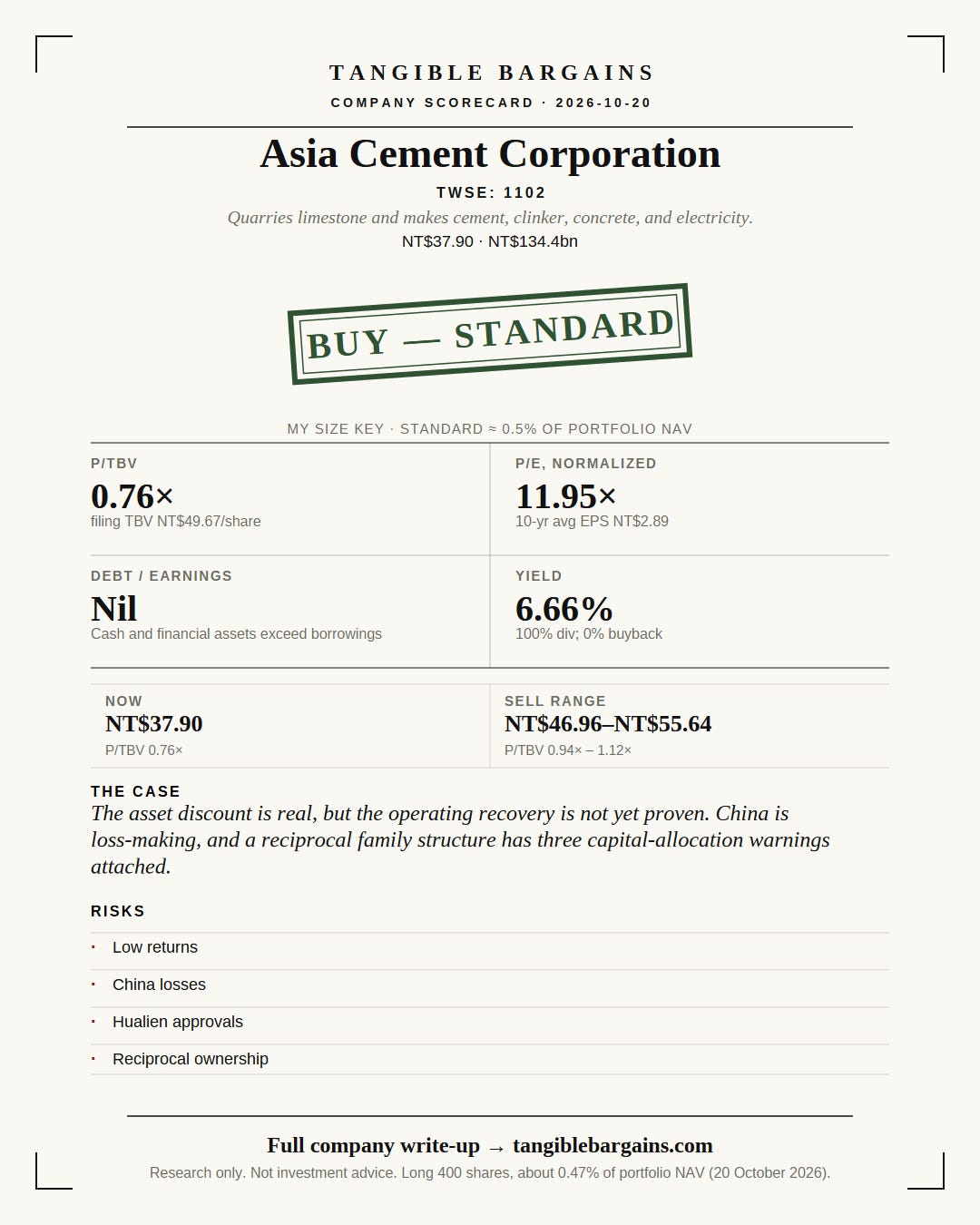
Verdict: BUY — STANDARD.
Actionable now: Yes — accumulate at ≤ NT$38.06 (price NT$37.90 as of 20 October 2026).
Position: Long 400 shares, about 0.47% of portfolio NAV (20 October 2026).
2. Argument
The short version
Asia Cement owns quarries, cement plants, concrete operations and power assets across Taiwan and China. At NT$37.90 on 20 October 2026, the stock sits just under its Buy-Below and well below filing tangible book.
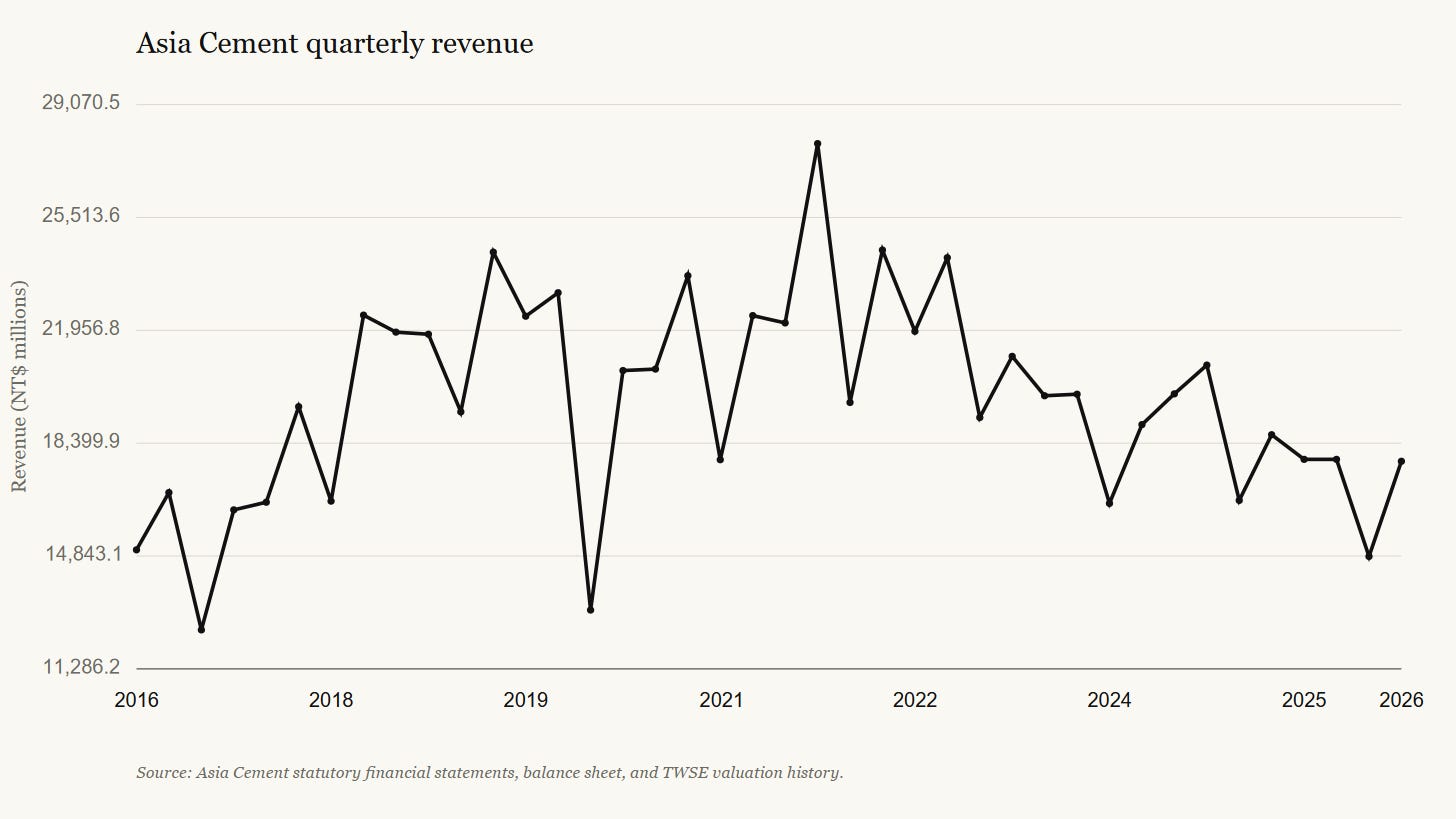
The book is cheap. The business still has to earn it. Return on equity has fallen, the China operation is loss-making, and much of first-half profit came from outside the operating line. Hualien mine approvals remain unresolved, while reciprocal family ownership complicates capital allocation. September revenue improved from August, but one month does not establish a recovery.
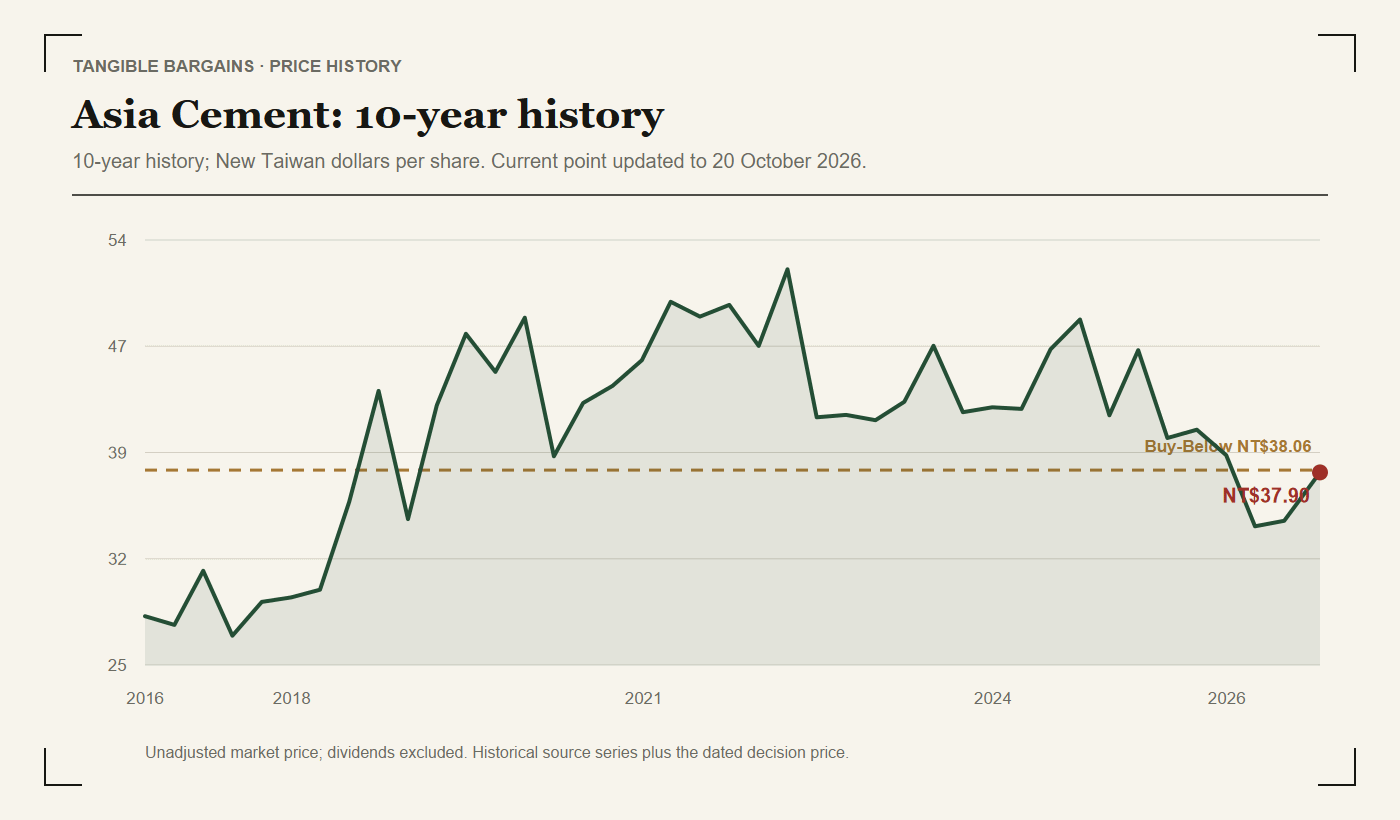
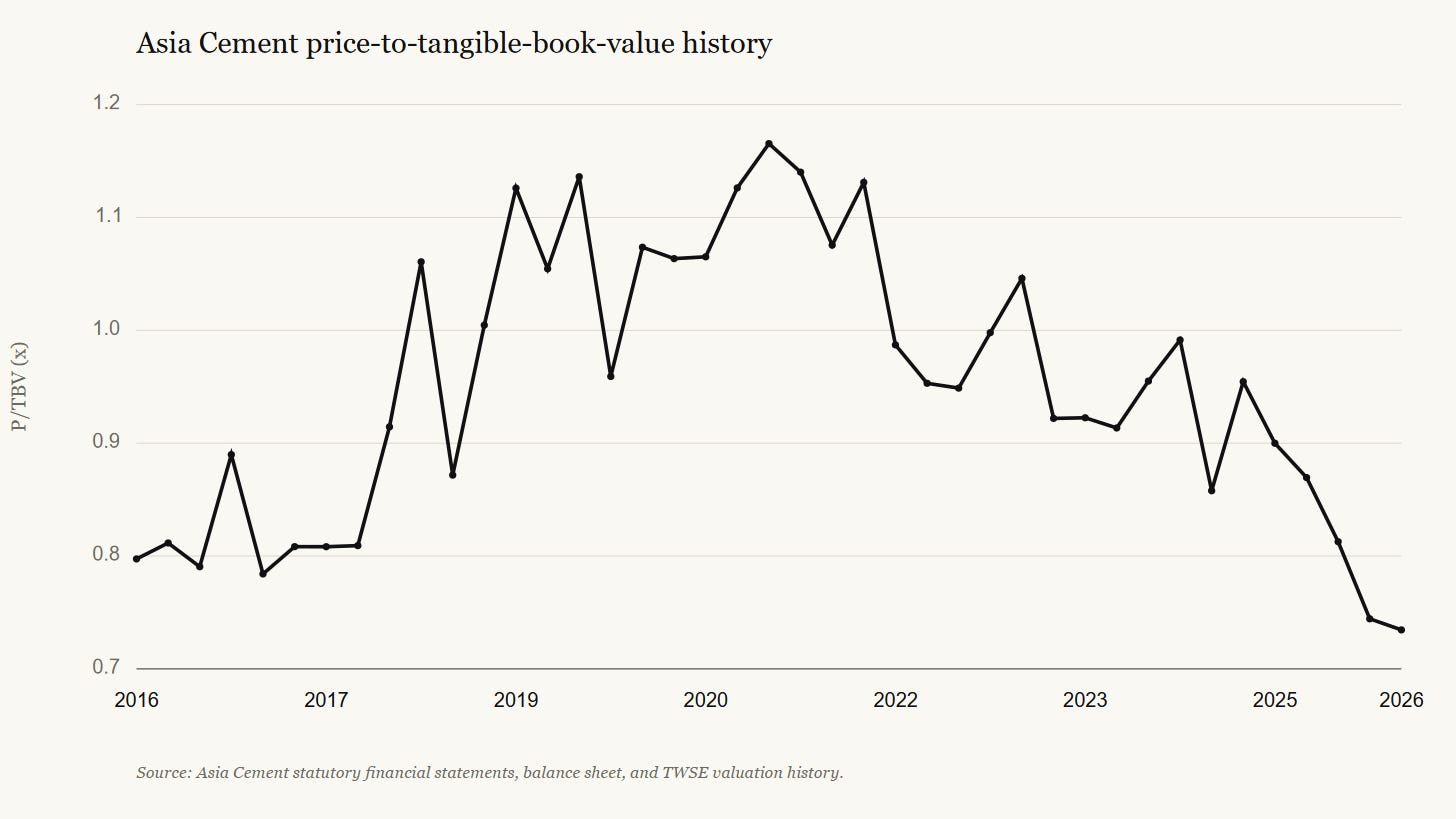
The 10-year history shows where the dated decision price sits. It is context for the valuation, not evidence that a fallen share must rebound.
What Asia Cement owns and operates
Asia Cement quarries limestone and produces cement, clinker and ready-mix concrete in Taiwan and mainland China. It also owns power and other industrial assets. The company is part of the Far Eastern group, and its balance sheet contains a large 22.92% holding in Far Eastern New Century rather than only cement plants and working capital.
That structure makes price-to-book less straightforward. Far Eastern New Century owns 19.89% of Asia Cement in return, creating a reciprocal loop. These percentages refer to two different companies and cannot be subtracted: Asia Cement owns 22.92% of Far Eastern New Century, while Far Eastern New Century owns 19.89% of Asia Cement. The shares inside that loop have market value, but the same controlling group influences whether they are sold, retained, or used to support group strategy. Book value is real without being freely deployable.
The Taiwan quarry is another reminder that physical ownership and economic access are different. The final judgment revoked an extension of the Hualien mining right, and the replacement consent, environmental review and consultation process remain incomplete. The plant may be valuable, but its long-run feedstock economics depend on permissions that have not yet been secured.
The reciprocal ownership loop
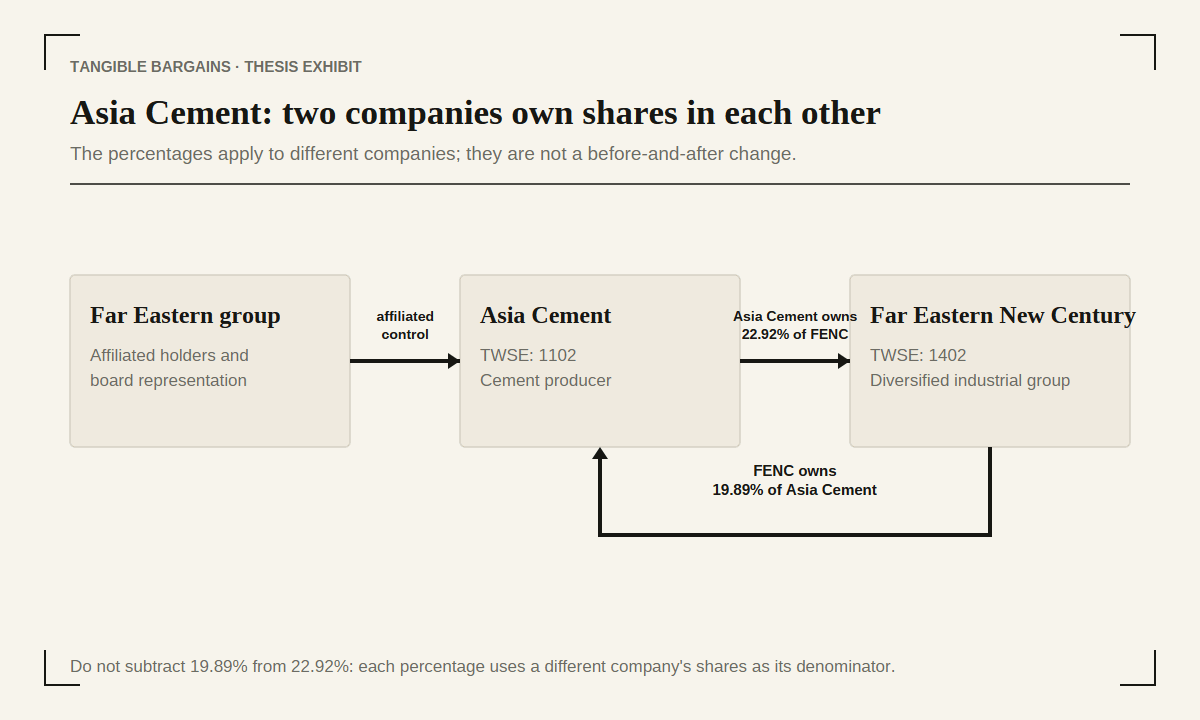
Asia Cement owns 22.92% of Far Eastern New Century; Far Eastern New Century separately owns 19.89% of Asia Cement. The percentages use different share counts, so they cannot be subtracted or treated as a before-and-after change.
Why it qualifies
Filing-derived tangible book is NT$49.67 a share against a NT$37.90 market price.
The 6.66% shareholder yield is entirely dividend, with no buybacks.
Cash and financial assets of about NT$97bn sit against NT$94.4bn of financial borrowings.
The operating line has to do more of the work
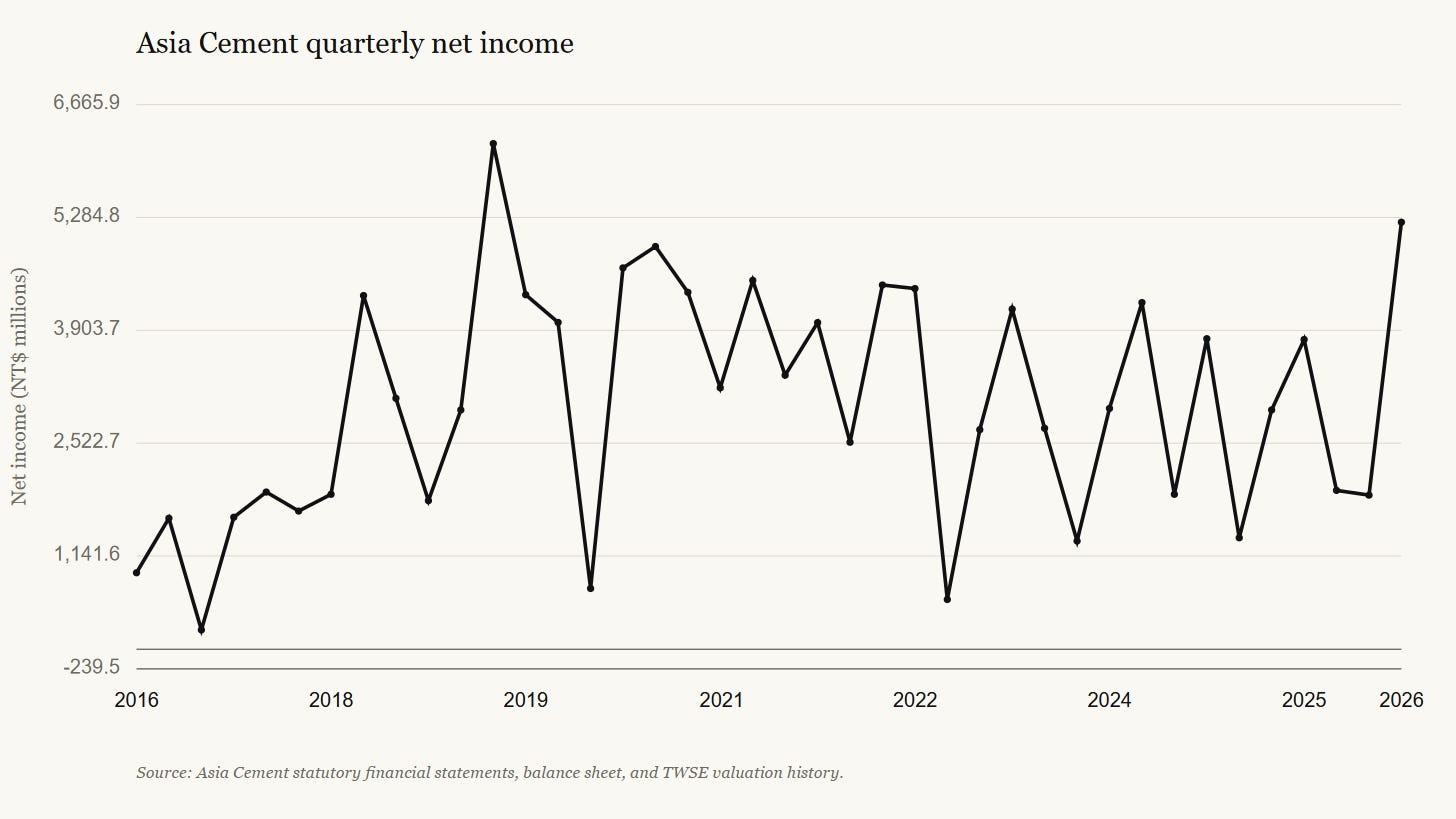
Return on equity fell from 12.0% in 2019 to 5.6% in 2025 as equity accumulated faster than operating earnings. The Chinese cement business remains loss-making, with gross margin around RMB13 per tonne. In the latest half, 62% of pre-tax profit came from outside the operating line.
Cash and financial assets of roughly NT$97 billion nearly matched NT$94.4 billion of financial borrowings, so the balance sheet is not obviously strained. The difficulty is earning an adequate return on it. A one-month revenue improvement in September is welcome but does not establish the sustained pricing and volume recovery required for the base case.
China adds a different problem: industry overcapacity and weak construction demand can keep prices below the level needed to earn the carrying value of the plants. At roughly RMB13 of gross margin per tonne, the operation is far from the RMB25 level used in the base case. The recovery must appear in unit economics, not merely consolidated revenue.
Why it is not a clean bargain
Return on equity fell from 12.0% in 2019 to 5.6% in 2025 while equity grew.
The Chinese cement operation is loss-making, with gross margin around RMB13 a tonne.
Non-operating income supplied 62% of first-half 2026 pre-tax profit.
The Hualien mining-right extension was revoked by final judgment, and the current consent and environmental review are not complete.
Reciprocal ownership and related-party capital use produce three capital-allocation warnings.
What closes the gap to book
The dividend supplies a 6.7% cash yield while shareholders wait. The capital-gain route requires Chinese per-tonne margins to recover, Taiwan operations to contribute more operating profit, and the Hualien mine approvals to move forward without damaging restrictions.
The NT$46.96 low end of the Sell Range is the more credible objective. The upper end requires better returns from the existing equity base and a market willing to look through the reciprocal structure. Until then, the position is paid to wait but should not be described as a clean asset realization. The ownership loop also reduces the meaning of a simple market-value sum: selling the affiliate stake could weaken group control, so it should not be treated as a readily monetizable portfolio. A clean recovery would show higher operating profit, lower dependence on investment income and permitting progress at the same time, not merely a higher quoted affiliate value.
What would change the view
A sustained recovery in Chinese per-tonne gross margin from RMB13 toward the RMB25 needed for the base case.
Clear progress through the Hualien environmental review and Truku consultation.
Operating profit recovering while the share of non-operating gains falls materially.
The stock reaching NT$46.96, the low end of the Sell Range, where the sell question becomes live.
Sources and gaps
The analysis uses the company's FY2025 annual report, the Q2 2026 statutory filing, and exchange price history. Individual insider transactions for the last twelve months and an earnings-call transcript were unavailable. The Hualien permitting history is drawn from company materials and secondary reporting; the live Taipower matter is the smaller civil claim remanded in May 2025.
3. Numbers that matter
Filing tangible book is NT$49.67 per share, putting the 20 October price at about 0.76 times tangible book. Buy-Below is NT$38.06, and the market price sits narrowly beneath it. The working Sell Range is NT$46.96 to NT$55.64, with the low end more credible until return on equity recovers. Cash and financial assets were about NT$97 billion against NT$94.4 billion of financial borrowings in the original filing work. Return on equity fell from 12.0% in 2019 to 5.6% in 2025, and 62% of first-half 2026 pre-tax profit came from non-operating items. September revenue was NT$6.719 billion, up 20.2% from August. Asia Cement owns 22.92% of Far Eastern New Century, while Far Eastern New Century owns 19.89% of Asia Cement. The reciprocal structure is the governance fact behind the book discount. The core sources are the FY2025 annual report, Q2 2026 statutory filing, mine and environmental disclosures, and exchange price history.
Research only, not investment advice.