


About
Read financial statements for a living. Buy hard assets for less than they seem to be worth.
This is a personal research publication written pseudonymously by a U.S.-based accounting, internal-controls, and compliance professional.
Why this, why now
Buying a dollar of hard assets for fifty cents is the one kind of investing that has ever felt native to how I think. I started doing it with real money in March 2024, loosely at first. It worked well enough that pretending it was still a hobby stopped making sense.
The rules were written down, the prior account was reconciled against broker reporting, and the current portfolio started from zero so the public record would have a clean beginning.
The boundary
There are no employer resources, confidential facts, or implied endorsements here. The site is written from the author's own capital and own research process.
AI tools help pull filings, normalize statements, and flag anomalies. They do not own a conclusion. Material numbers are traced back to a source before publication.
The record · evidence, not proof
The prior account returned +54.17% across the testing period. That is why the site exists, not a promise that the live account will repeat it.
2024–26 · Prior testing phase: Run on a separate personal account before the public portfolio started.
Now · Current account: Starts from zero and carries its own dates, holdings, cash drag, and mistakes.
Always · Specific uncertainty: When something is unknown, the page says what is missing and why it matters.
Disclosure: Tangible Bargains is a personal research publication, not investment advice. Nothing here is tailored to a reader's financial situation, and the portfolio is disclosed for transparency rather than as a signal to copy.
Full story · show the work
The sections below carry the existing project history, prior-account record, evidence exhibits, AI boundary, independence disclosure, and reader expectations.
What this is
Tangible Bargains hunts for obscure, unpopular, frequently mediocre businesses trading at unusually large discounts to their tangible assets and their normalized earning power. I am not trying to find the next great compounder. I am trying to pay fifty or sixty cents for something conservatively worth closer to a dollar, and then wait for the market to admit it was wrong.
This isn’t new. Benjamin Graham built the intellectual case. Walter Schloss ran it for almost half a century, often holding more than 100 names at once, out of a sub-leased corner of someone else’s office. What I run is a modern, more diversified, publicly documented version of the same idea: cheap first, survival second, a good story dead last. I’m willing to own mediocre. I’m not willing to own insolvent.
How the process works, briefly
Every candidate has to be cheap against conservatively adjusted tangible book value, has to clear a survival screen (leverage, liquidity, dilution, and the Piotroski F-Score used as a veto), gets checked for whether its owners see the value on the balance sheet, and gets a sell price computed from its own book value and its own trading history before I ever buy. The complete rule set, with every number, lives on the Methodology page. The rules governing the portfolio are exactly as public as the portfolio itself.
And because “trust me, it works” is not a research standard: the full body of evidence for this approach, alongside the best published arguments against it, is on Does this actually work? That page exists so you can audit the thinking, not just the trades.
Where this came from
This isn’t my first attempt at markets. It’s the first one that fit.
In early 2024 I found the corner of the internet where people still quietly run the Walter Schloss playbook: hundreds of tiny, statistically cheap, globally scattered companies that no analyst covers and no fund can buy. It made immediate sense to me. I read financial statements for a living; buying a dollar of hard assets for fifty cents is the one kind of investing that has ever felt native to how I think. So I started doing it with real money in March 2024, loosely at first, no published rules, just the discipline of cheap, alive, diversified.
It worked well enough that pretending it was still a hobby stopped making sense. I reconciled the whole run against IBKR PortfolioAnalyst’s own figures rather than my feelings about it, wrote the rules down properly, and built this site to run the strategy the way it deserves: versioned methodology, live portfolio, published trade log, mistakes left on the page. The experimentation phase is over. This is the taking-it-seriously phase.
The record from the experimentation phase
PRIOR ACCOUNT. Everything in this section describes the account I ran from March 2024 through August 2026, before this site went live. It is not the account the site tracks going forward; that one starts from zero on the Portfolio page. Figures below are time-weighted returns from Interactive Brokers’ PortfolioAnalyst reporting, not my own math.
Cumulative, March 6, 2024 (the first trade under this framework) through August 14, 2026: +54.17%
By year: 2024 +13.62% · 2025 +27.71% · 2026 through August 14: +6.25%
Returns are time-weighted figures generated by IBKR PortfolioAnalyst for this prior account and reconciled by me against the underlying account activity. They have not been independently audited.
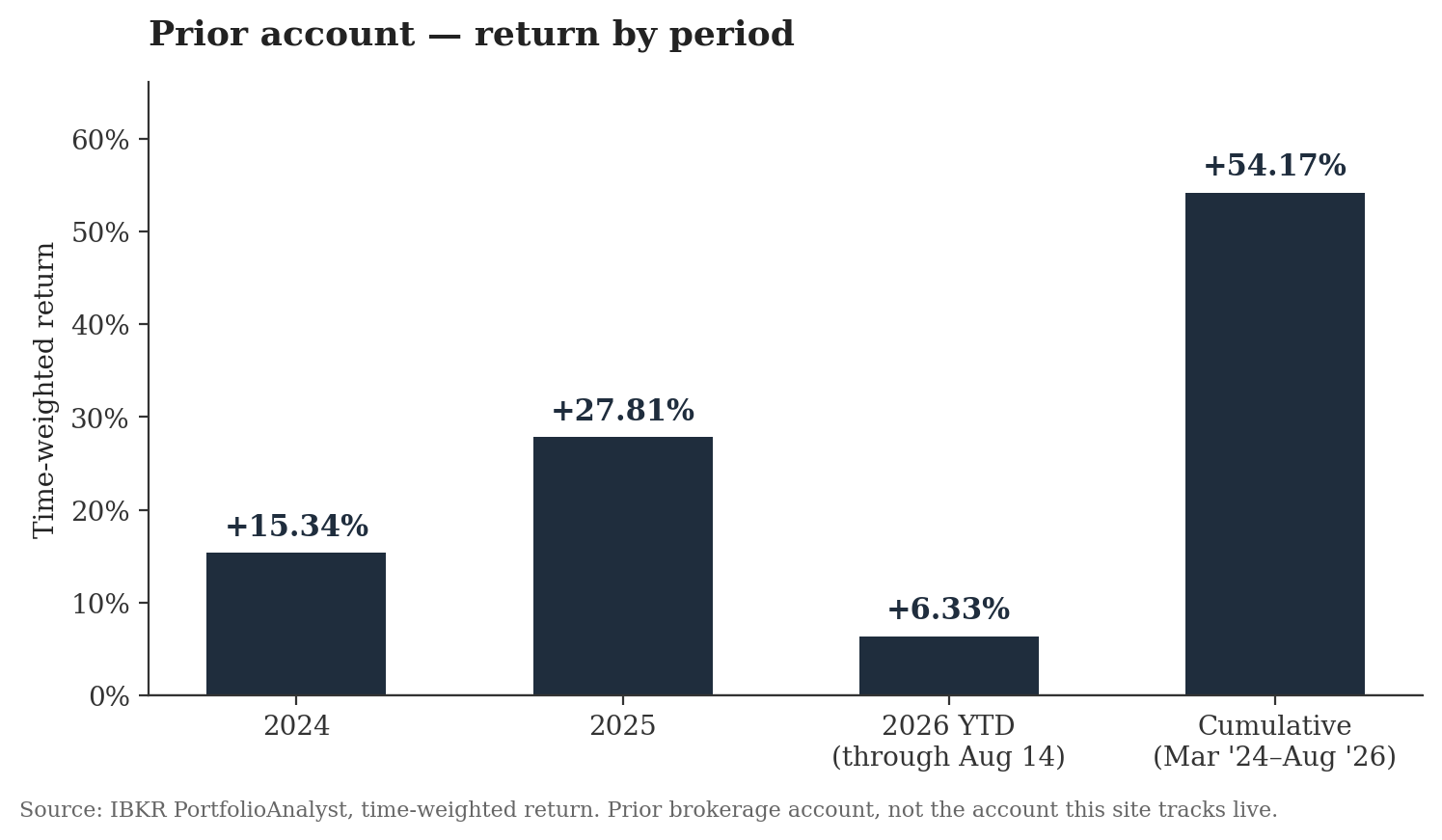
That window — March 2024 onward — is the entire period this process has actually been running, and it’s the only period these figures describe. The early stretch was cash-heavy while the basket was still being built out: roughly a quarter of the book sat in cash or cash-equivalent T-bill funds (SGOV, SHV, SHY) on average, not as a strategy call but because it takes time to find enough names worth owning. No retrospective “fully invested” version to make the number look better — that drag is genuinely part of the record, not an asterisk.
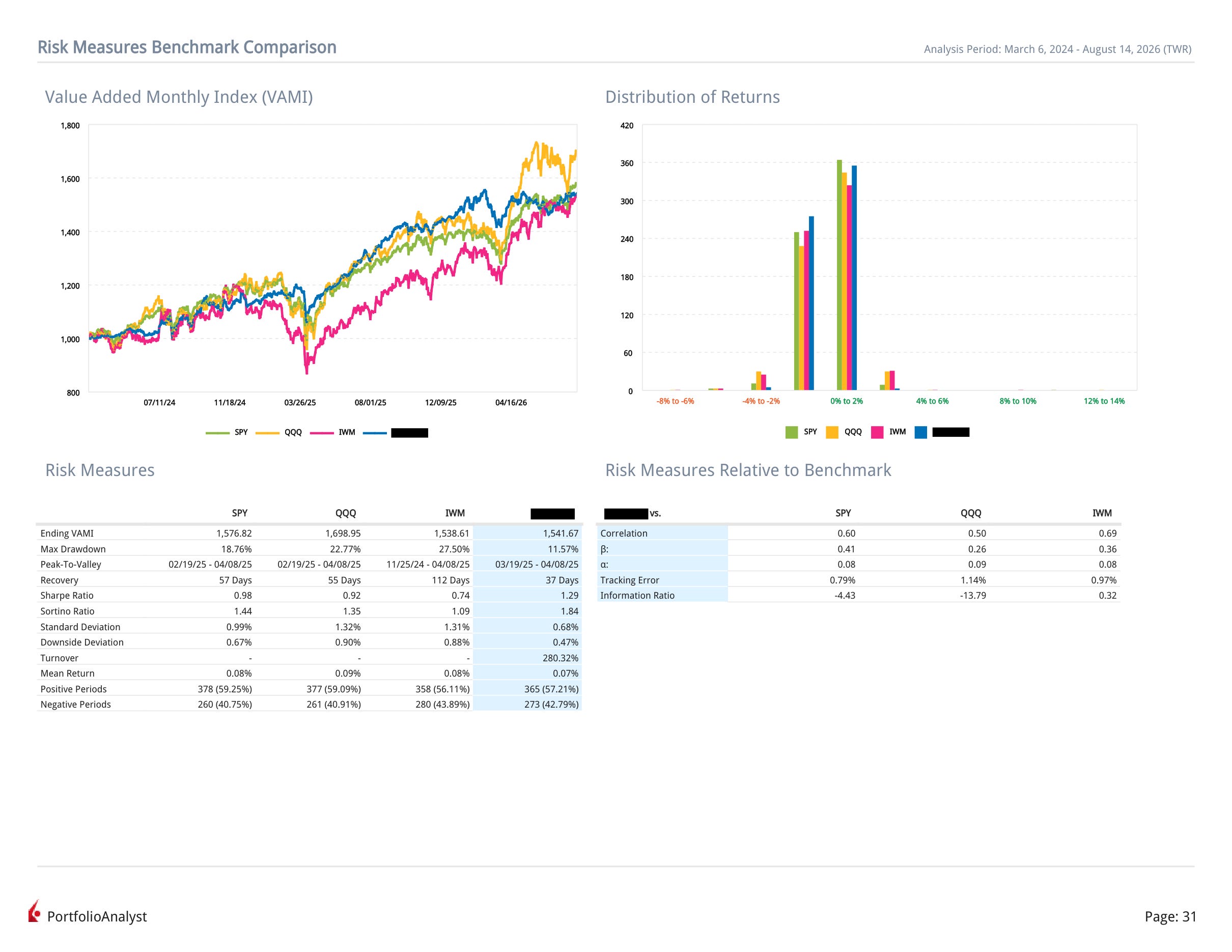
Excerpt from the full IBKR PortfolioAnalyst statement, Risk Measures Benchmark Comparison. Account number redacted; every figure matches what’s published above.
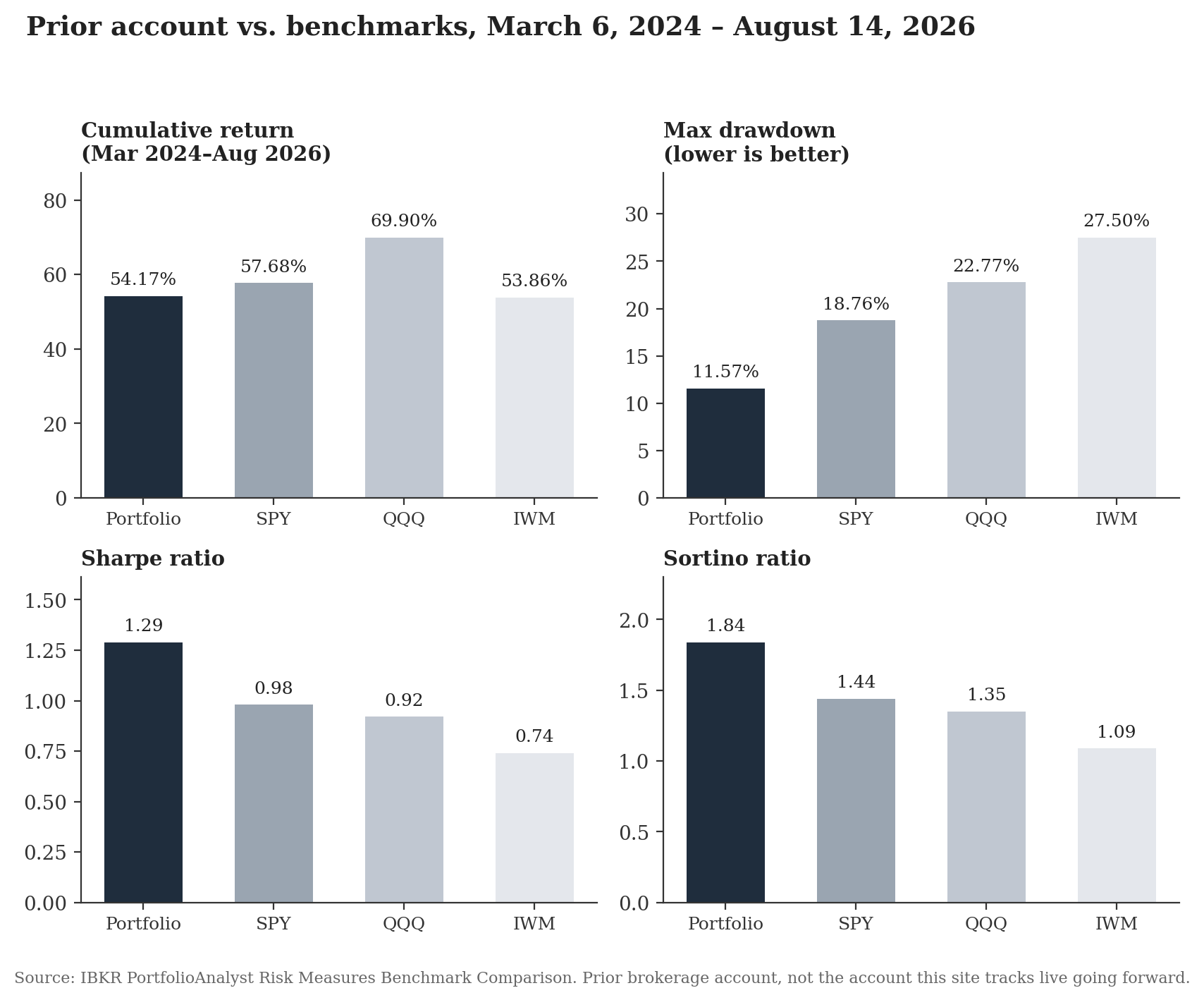
Two and a half good years is evidence, not proof. It’s short, it overlapped with a strong market for the kinds of things I buy, and none of it guarantees the live account repeats it. It’s on this page because it’s why the site exists, presented the same way everything else here is presented: broker-generated, reconciled, dated, and with the unflattering parts left in.
The portfolio is real
Tangible Bargains tracks actual personal capital, not a hypothetical model. Results include cash drag, execution prices, spreads, dividends, and losses, on purpose. The point of publishing a live portfolio isn’t “copy my trades.” It’s making the research honest. If a position drops 20% and turns out to be a mistake, the mistake stays on the page.
Completed trades are published generally in a daily batch, whenever schedule permits, always after execution is complete — publication timing has nothing to do with the investment decision, and a trade is never backdated. This is not a signal service and it never will be. Nobody gets my order before I’ve filled it, and nobody gets a “buy this before it moves” push. If that’s what you’re looking for, this isn’t it.
AI does the drudgery. A human owns every conclusion.
Research tooling helps pull filings, normalize financial statements, and flag anomalies faster than doing it by hand. No automated output is treated as true because a machine said so. Every material number is traced back to a primary filing, every report is reviewed by a human before it goes up, and if the primary source couldn’t be found, the write-up says so instead of quietly filling the gap.
Who’s writing this
Tangible Bargains is written pseudonymously by a U.S.-based accounting, internal-controls, and compliance professional who applies the same skepticism to balance sheets on the side that the job applies to audit files during the week. The publication is independent of that job. No employer resources, no confidential information, no implied endorsement from anyone but me.
I don’t know your risk tolerance, your tax situation, or your time horizon, and nothing on this site is personalized advice. I’m not your financial adviser, and this isn’t a substitute for talking to one. I’m showing you exactly what I own, exactly why I thought it was cheap, exactly what would prove me wrong, exactly what I paid, and exactly how the whole thing performed, including the parts that didn’t work. What you do with that is on you.
What you get
Company write-ups — the forensic workups. What the company owns, what it’s worth if everything got liquidated tomorrow, why the market can’t be bothered with it, and the price where that stops making sense.
Portfolio — the live basket, verified against broker statements, with current standing against every cap in the methodology.
Trade log — what actually got bought and sold, including the boring mechanical stuff: spreads, fill times, the tranche that took four days because the stock trades $8,000 a day.
The methodology — the whole rule set, public, frozen at launch, with changes dated and logged from then on.
The evidence — the research behind the strategy and the research against it, every source linked.
Disclosures
Deep value has real academic support and real multi-year stretches where it simply doesn’t perform, and pretending otherwise would be exactly the kind of story-selling this whole project exists to avoid.
Tangible Bargains is a personal research publication, not investment advice. Nothing here is a recommendation to buy or sell any security, and nothing is tailored to any individual reader’s financial situation. The portfolio shown is the author’s own capital, disclosed for transparency and education, not as a signal to replicate trades. Do your own research; consult a licensed professional before making investment decisions.
Same closet energy as every other cigar-butt investor since Graham. Worse jokes. Real footnotes.
